How Compound Interest Works (and the Formula)
Understanding how compound interest works starts with one idea: your interest earns interest, so growth builds on itself instead of staying flat. This guide breaks the compound interest formula into plain parts, shows why compounding frequency changes the result, and contrasts it with simple interest so the advantage is obvious. You will follow a worked example step by step and see how the same money grows differently under each approach. The point is to make the math feel intuitive rather than intimidating. When you would rather see a projection than crunch exponents, the free GrabCast compound interest calculator does the arithmetic in your browser with no sign-up.
📈 Try the Compound Interest tool now — freeOpen →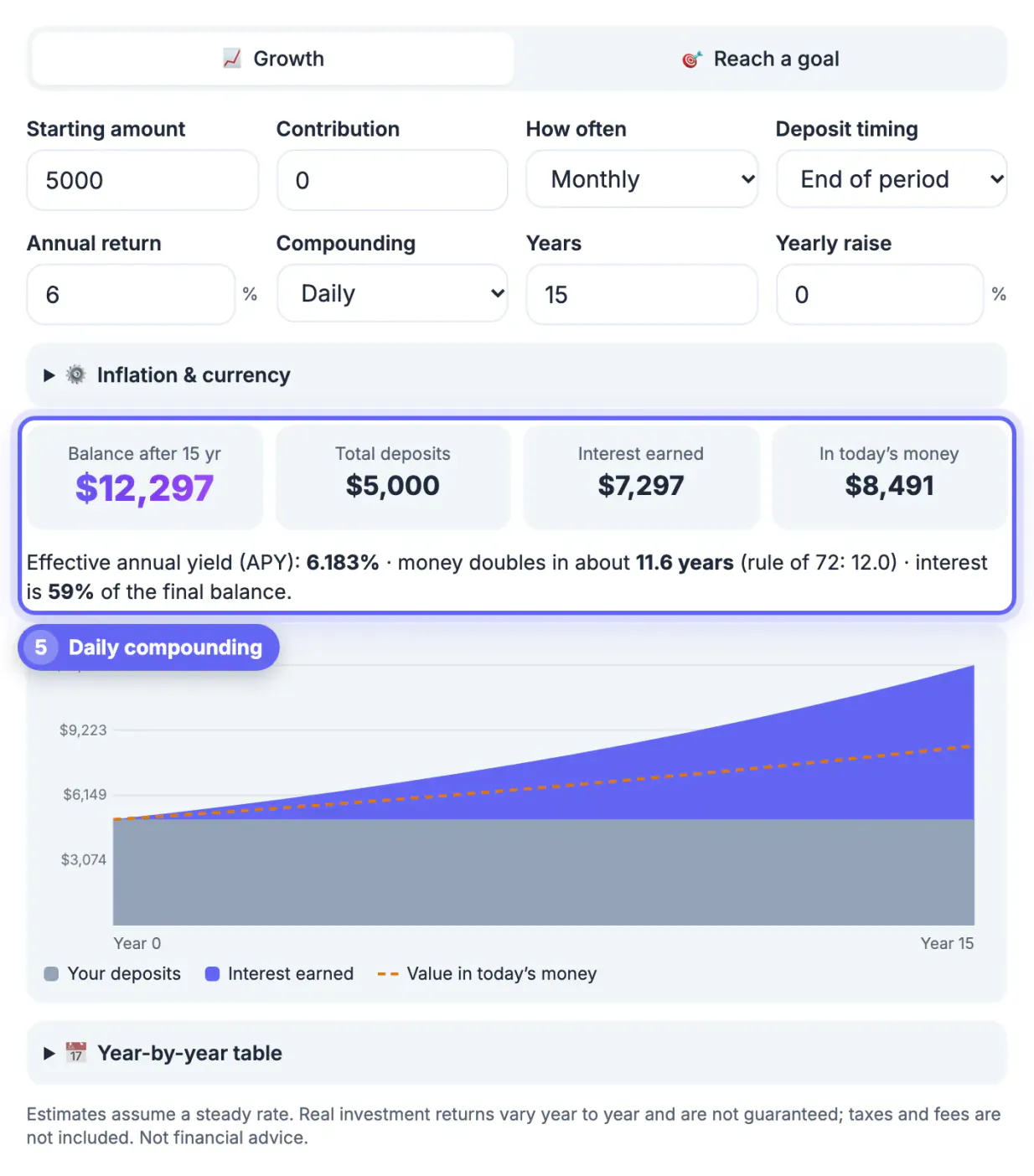
Compound interest surprises people because it grows slowly at first and then seems to take off, which runs against our habit of expecting steady, straight-line change. The reason is that each period's interest joins the principal and earns interest in the next period, so the growing base keeps enlarging the gains. Over short spans the effect is modest and easy to dismiss, but over decades it dominates, which is why it rewards patience so richly. Grasping the mechanism removes the mystery and, more usefully, makes the case for starting early and leaving money alone. It also explains why the same idea works against you on debt, where unpaid interest compounds into a heavier balance.
How compound interest works
The core idea is growth on growth: earnings are folded back in.
- Each period, interest is added to the principal.
- The next period's interest is calculated on the larger balance.
- This repeats, so the base grows every period.
- The growth curve steepens over time rather than staying flat.
The compound interest formula explained
Each symbol maps to a real input.
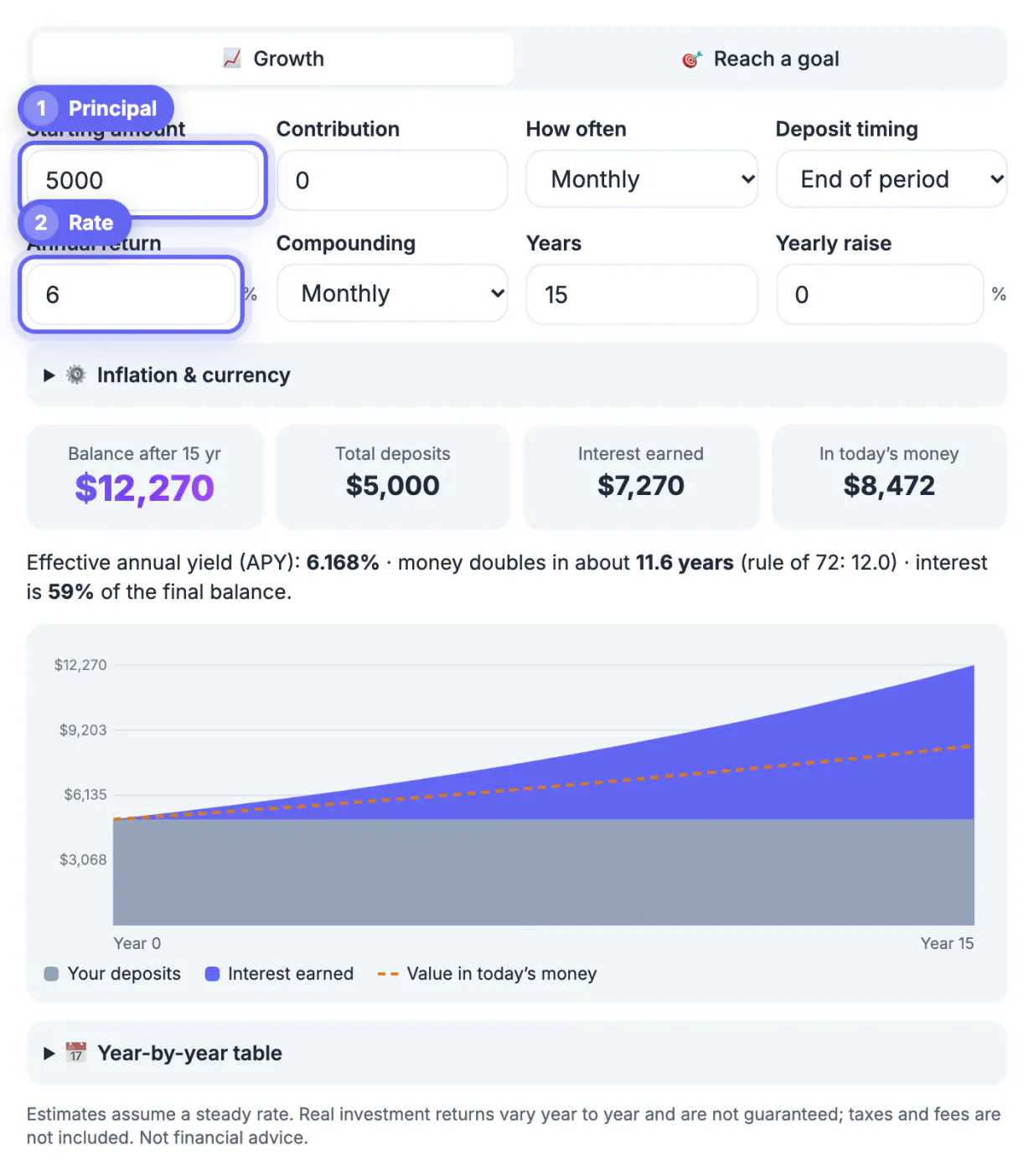
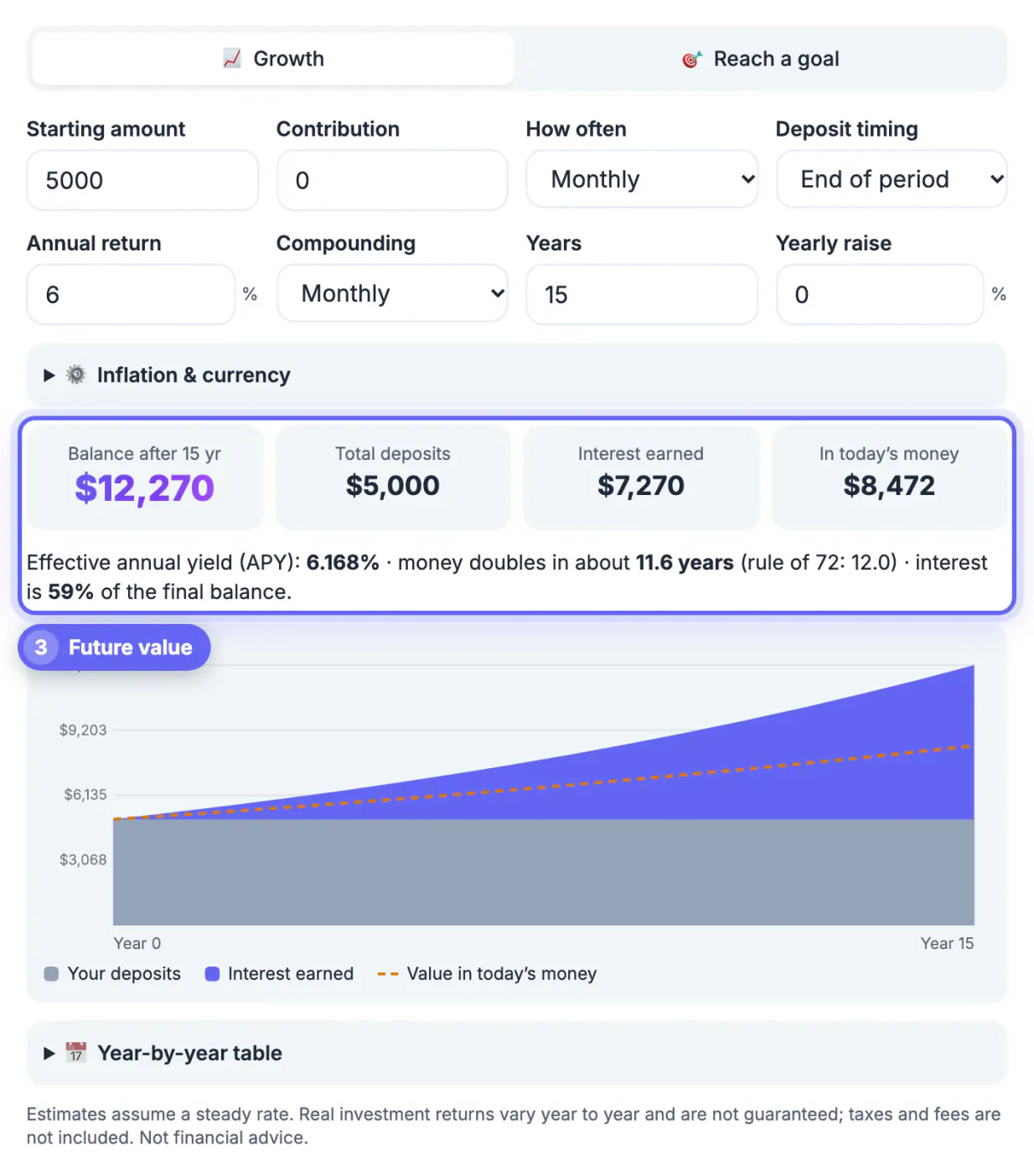
- Future value = P times (1 + r/n) raised to (n times t).
- P is the principal, the amount you start with.
- r is the annual rate as a decimal and t is the years.
- n is how many times interest compounds per year.
Why compounding frequency matters
More frequent compounding earns slightly more.
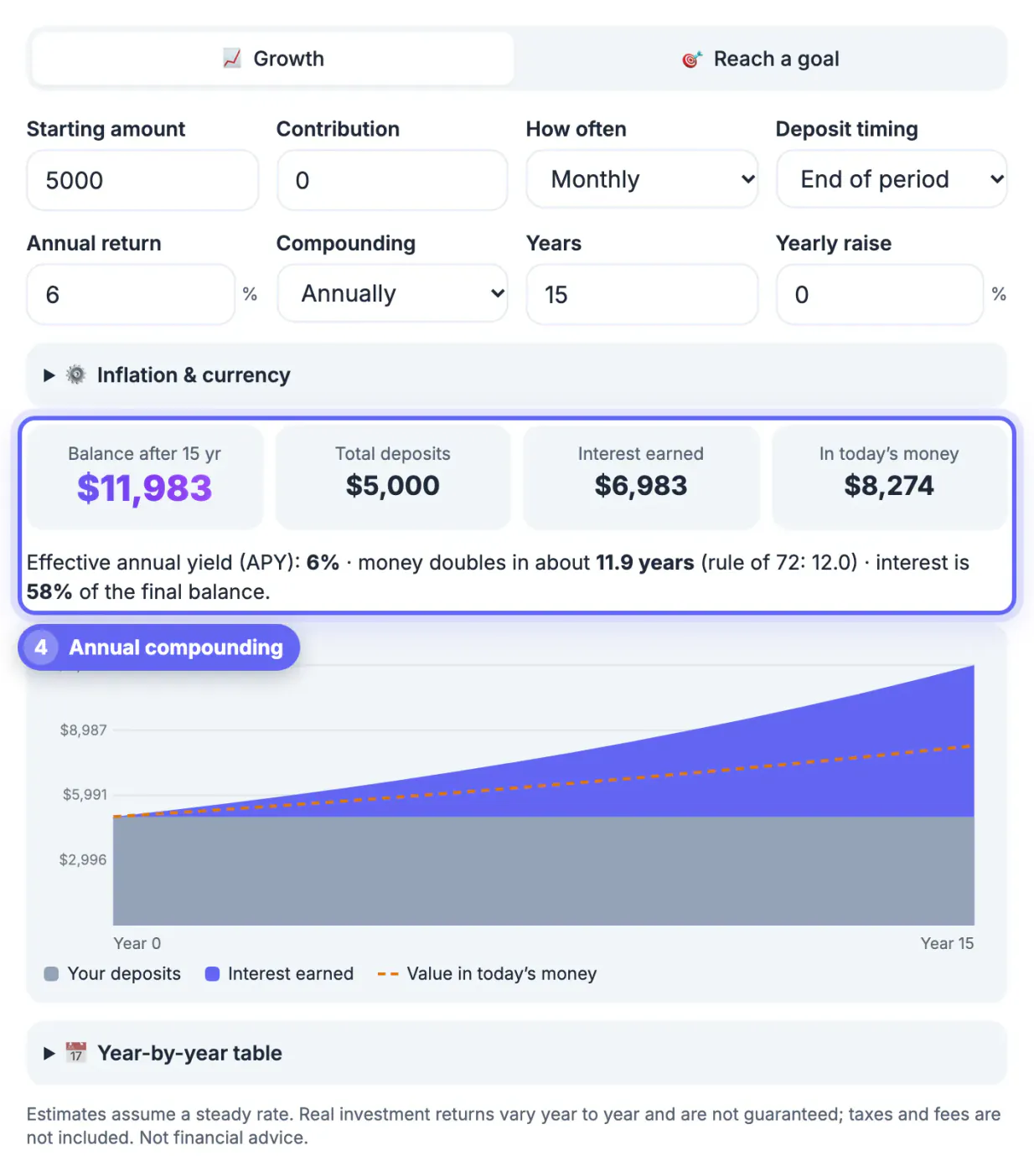
- Yearly compounding adds interest once per year.
- Monthly compounding adds it twelve times, on a growing base each time.
- The more often it compounds, the higher the ending balance.
- The gain from frequency shrinks as it approaches continuous compounding.
Compound vs simple interest
The difference widens with time.
- Simple interest is calculated only on the original principal.
- $1,000 at 5 percent simple for 10 years earns a flat $500.
- The same amount compounded yearly grows to about $1,629.
- The extra $129 is interest that itself earned interest.
When compounding works against you
The same mechanism that grows savings also grows debt, so understanding it protects you from balances that quietly spiral.
- Unpaid credit-card interest compounds, often monthly, on a rising balance.
- A small carried balance can grow faster than intuition suggests over a year.
- Paying more than the minimum attacks the principal that future interest feeds on.
- The higher the rate, the more punishing the compounding becomes on debt.
- Treat high-interest debt as compounding in reverse and clear it before it snowballs.
Debt compounds too, and the Credit Card Payoff Calculator shows how a balance behaves over time when you only pay part of it.
A step-by-step growth example
Suppose you deposit $5,000 at 6 percent a year, compounded monthly, and leave it for 20 years. The monthly rate is 0.5 percent over 240 periods, so the balance grows to about $16,551. Simple interest at the same rate would only reach $11,000, which shows how much of the final sum is growth built on earlier growth.
- Add $100 each month and the same 20 years ends near $62,000, with only $29,000 of that contributed by you.
- Waiting ten years to start roughly halves the outcome, even if you deposit the same amount afterward.
- Raising the rate by one percentage point matters more the longer the money stays invested.
To model your own deposits and goals without doing the exponent by hand, the savings goal calculator guide walks through the inputs and how to read the chart.
Common compounding mistakes to avoid
Most wrong answers come from a small slip in setup rather than the maths itself. Watch for these when you check a result.
- Mixing units, for example using the annual rate with monthly periods, which understates or overstates growth by a wide margin.
- Forgetting that the quoted rate is nominal; the effective annual yield is slightly higher when compounding is frequent.
- Ignoring fees and inflation, which reduce the real return you actually keep.
- Assuming a return is guaranteed when savings rates and market returns change over time.
A quick sanity check helps: the rule of 72 says money doubles in roughly 72 divided by the percentage rate years, so 6 percent doubles in about 12 years. If your result disagrees wildly, revisit the inputs.
Step-by-step
Common mistakes to avoid
Pro tips
Frequently asked questions
How does compound interest work in simple terms?
Interest is added to your balance, and future interest is then calculated on that larger balance. Because the base keeps growing, gains accelerate over time.
What is the compound interest formula?
Future value equals principal times (1 + r/n) raised to (n times t), where r is the annual rate as a decimal, n the periods per year, and t the years.
Does compounding frequency really matter?
Yes, a little. Compounding monthly earns slightly more than yearly because interest is added to a growing base more often, though the gain has a ceiling.
How is compound interest different from simple interest?
Simple interest is figured only on the original principal, while compound interest is figured on principal plus accumulated interest, so it grows faster over time.
Can GrabCast do the formula for me?
Yes. The free compound interest calculator applies the formula in your browser, so you get the future value without working the exponent by hand.
Compound interest works by adding each period's interest to the balance so future interest grows on a larger base, following future value = P times (1 + r/n) raised to n times t. It beats simple interest by an amount that widens with time. When the exponent math gets tedious, the free GrabCast compound interest calculator handles it instantly.
Related guides
Browse more: all calculator guides · the Compound Interest tool