Compound Interest Calculator for Savings Goals
A compound interest calculator for savings answers two practical questions: how much a balance plus regular deposits will be worth by a certain date, and how much you need to put away each month to reach a target. For example, $2,000 in a high-yield account plus $300 a month at an assumed 4.25 percent grows to about $13,769 in three years, and $969 of that is earnings rather than your own deposits. This guide walks through every input in GrabCast's free Compound Interest Calculator using three real savings jobs, an emergency fund, a house down payment and a long-term habit that grows with your pay. It shows which settings change the answer by hundreds of dollars and which barely move it, plus how to read the chart and export the schedule. The rates are illustrations; the rate on your own account can change at any time.
📈 Try Compound Interest now — freeOpen →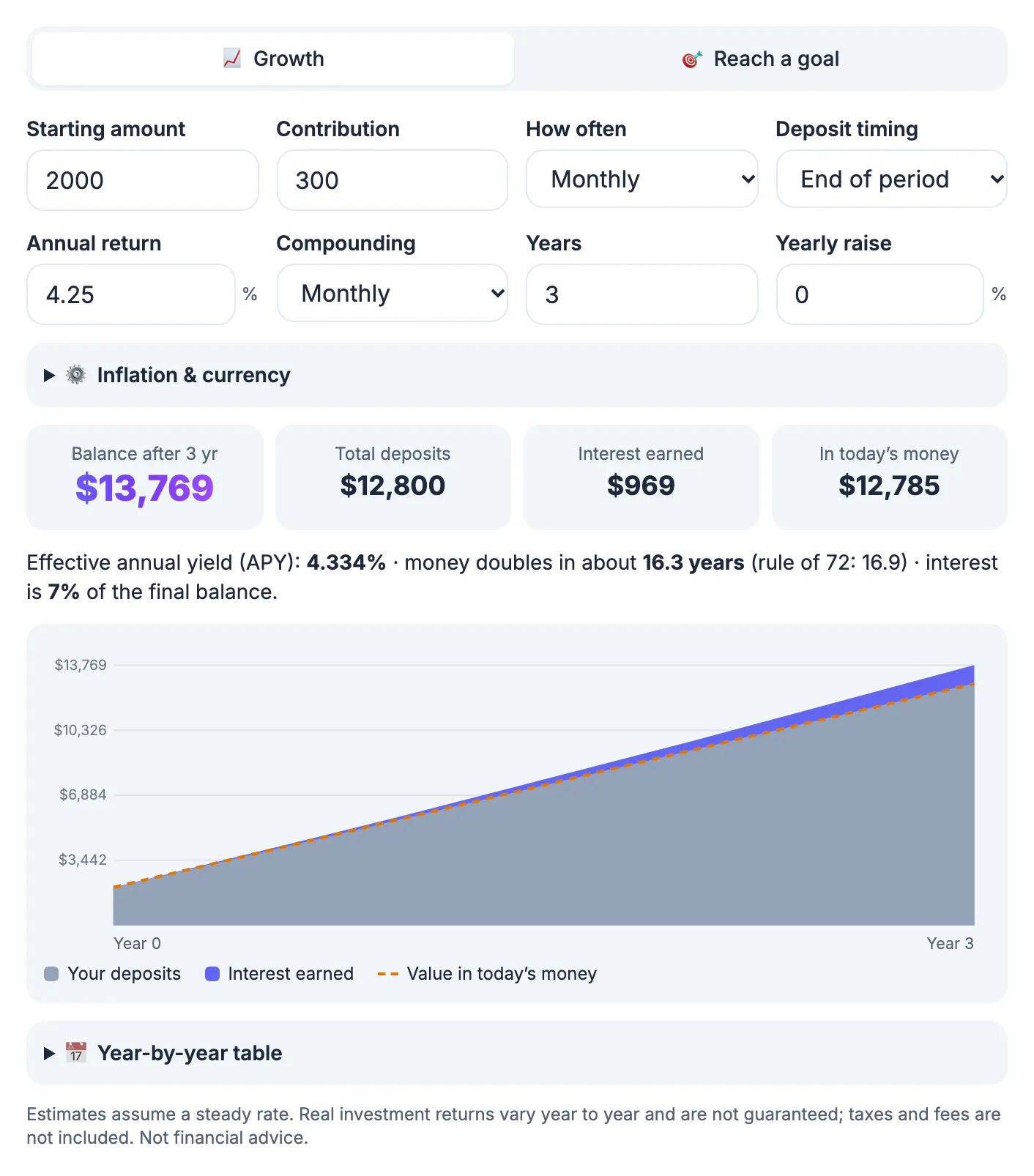
Most people save toward a number they picked by feel, then discover late that they are short. A projection turns the goal into a monthly figure you can automate on payday. It also shows how the pieces trade off. Adding a year to the deadline, raising the deposit by $50 or finding an account that pays half a point more each shows up as a dollar amount, so you can pick the least painful lever instead of guessing. For short goals such as an emergency fund, a projection also keeps expectations honest: over three years most of the balance is your own money, and earnings are a helpful bonus rather than the engine. For long goals the picture flips, and seeing that shift on a chart is often what convinces people to start now rather than after the next raise. Finally, putting the result in today's dollars keeps a large future number from feeling bigger than it will be at the checkout.
The inputs in a compound interest calculator, and which ones matter
GrabCast's calculator has a Growth tab and a Reach a goal tab. On Growth you set:
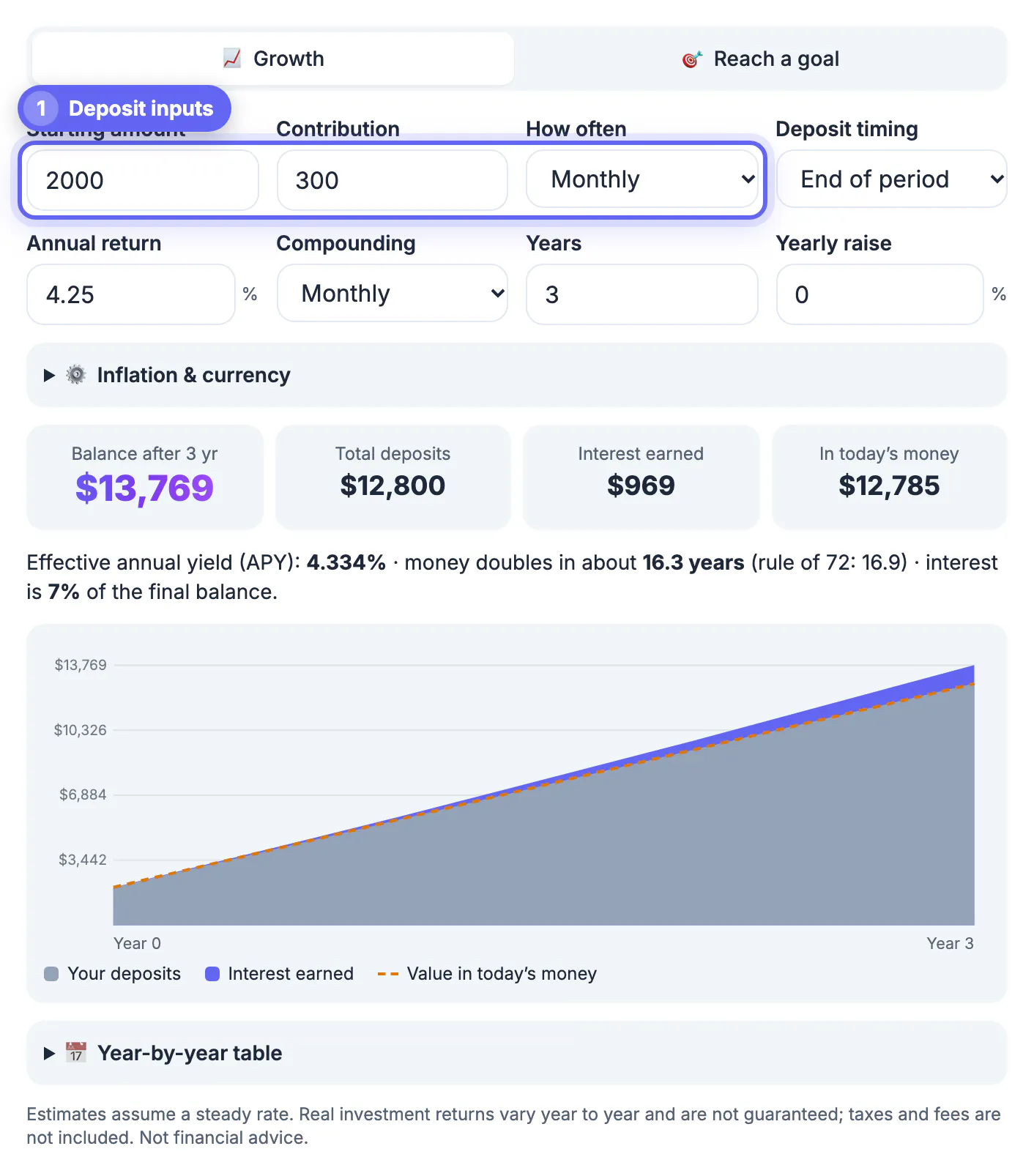
- Starting amount and deposit amount, with deposits made weekly, every 2 weeks, monthly, quarterly or yearly.
- Deposit timing: at the end of each period, the usual assumption for a paycheck transfer, or at the start.
- Annual return and the compounding schedule: daily, monthly, quarterly, semiannually, annually or continuous.
- Years, from 1 to 100, plus an optional yearly raise that grows your deposit each year.
- Inflation and currency, which adds a value in today's money and switches between 8 currency symbols.
In practice, the deposit, the rate and the number of years drive the answer. The schedule and timing are fine-tuning: on the emergency fund below, depositing at the start of each month instead of the end adds about $41 over three years.
An emergency fund: when your deposits do the heavy lifting
Say you have $2,000 in a high-yield savings account and set up a $300 monthly transfer, with an assumed 4.25 percent rate compounded monthly and a three-year horizon.
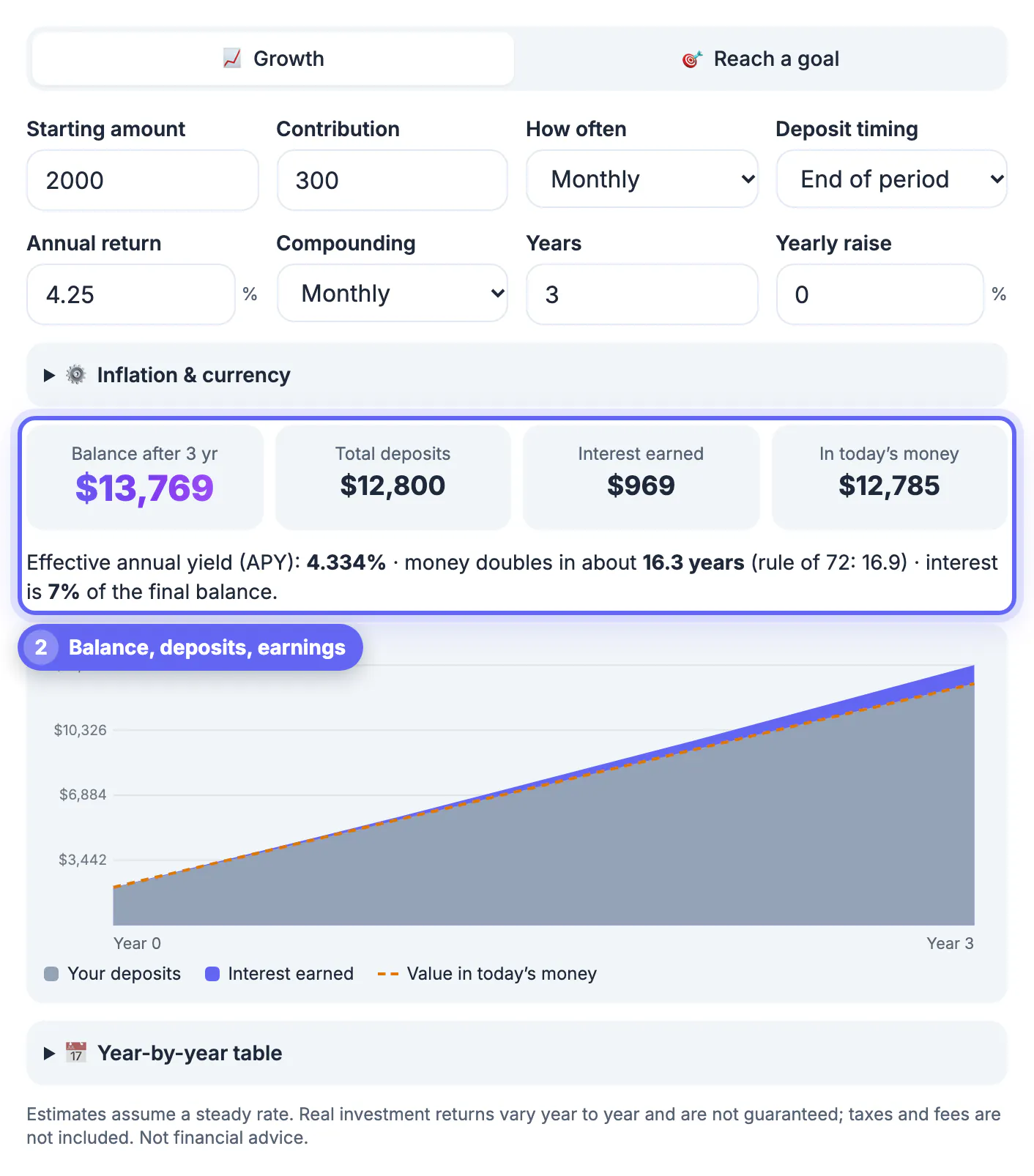
- Ending balance: about $13,769.
- Your deposits: $12,800, including the $2,000 start.
- Earnings: about $969, roughly 7 percent of the final balance.
- Same plan with deposits at the start of each month: about $13,809.
The lesson for short goals is that the monthly transfer matters far more than the account. Raising the deposit from $300 to $350 adds $1,800 of principal over three years, while half a point of extra rate adds roughly $120. Shop for a good rate once, then focus on the habit. Keep in mind that savings account rates are variable, so rerun the numbers when your bank changes its APY.
A down payment target with the Reach a goal tab
When you know the destination, work backward. Switch to Reach a goal, enter the target, what you already have, the rate and the deadline, and the tool solves for the deposit.
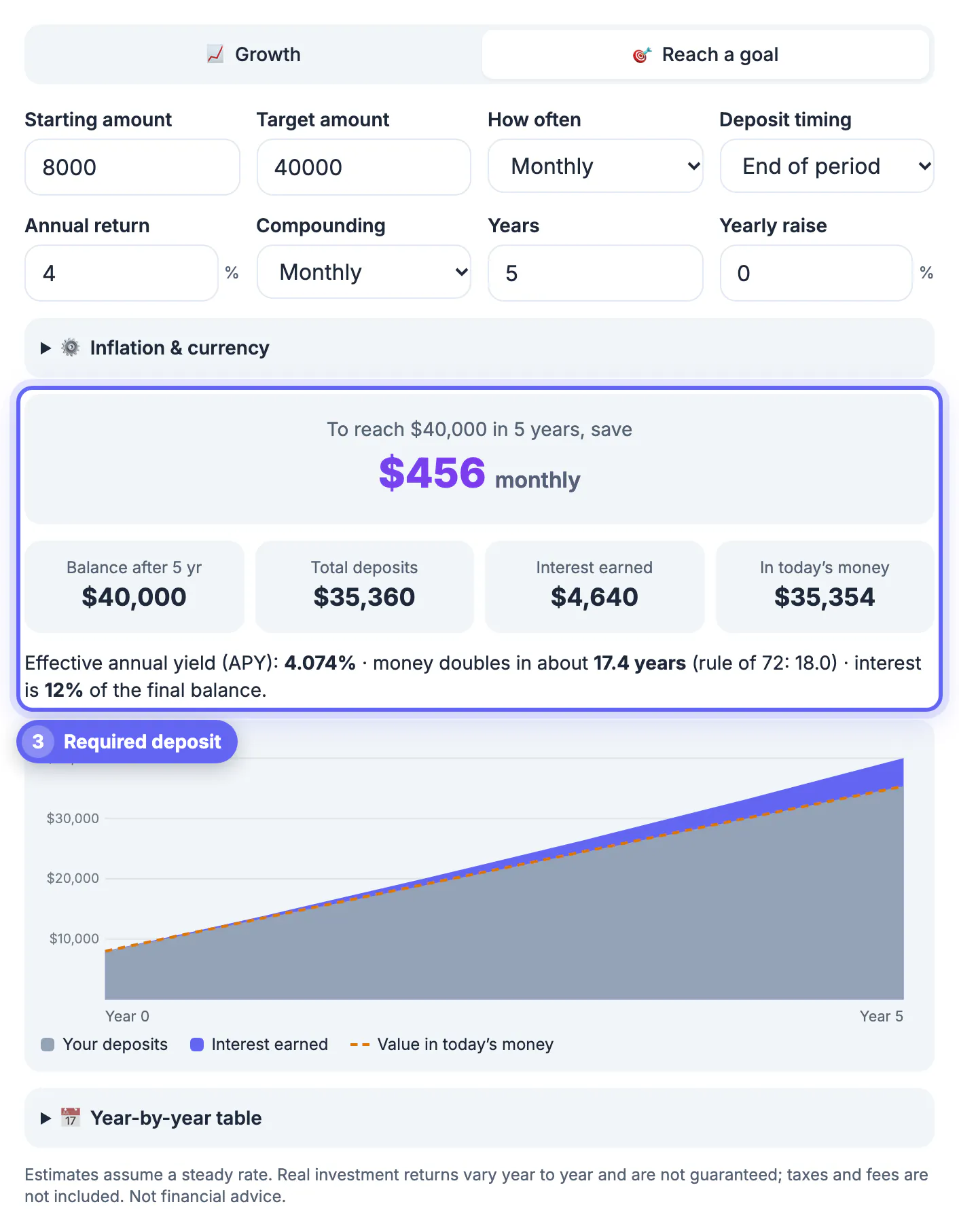
- Target: $40,000 in five years for a down payment and closing costs.
- Already saved: $8,000, which grows to about $9,768 on its own at an assumed 4 percent.
- Required deposit: about $456 a month at the end of each month.
- Stretching the deadline to six years lowers the deposit to about $367, while a four-year plan needs about $589; try both before committing.
For money you will need within a few years, many people use an assumed rate close to what an insured savings account or CD pays today rather than a stock market figure, because a market drop right before closing can shrink the fund when it is needed. The calculator does not know where your money sits, so the rate you enter should match that choice.
Yearly raises, inflation and reading the results
Long goals add two settings worth using. A yearly raise increases the deposit each year, and inflation converts the ending balance into today's buying power.
- $300 a month for 20 years at an assumed 5 percent: about $123,310 on $72,000 of deposits.
- The same plan with a 3 percent yearly raise: about $157,800 on roughly $96,733 of deposits.
- At 2.5 percent inflation, that $157,800 buys about what $96,300 buys today.
- Doubling time: at 4.5 percent compounded monthly a balance doubles in about 15.4 years, and the tool shows that next to the Rule of 72 estimate of 16.
The stacked chart splits each year into deposits and earnings, with a line for the inflation-adjusted value, and the year-by-year table can be downloaded as CSV for a spreadsheet. A share link saves the inputs so you can reopen the plan later. The math runs in your browser; it does not include taxes or fees and assumes a steady rate, so treat the output as an estimate, not a promise.
If the goal is retirement rather than a down payment, the Retirement Calculator models long-term contributions.
Step-by-step
Common mistakes to avoid
Pro tips
Frequently asked questions
What does a compound interest calculator for savings show
It projects the balance from a starting amount, regular deposits, an assumed rate and a number of years, and splits the result into your deposits and the earnings. GrabCast's version also shows the APY, the value in today's money and how long the balance takes to double.
How much should I save each month to reach a goal
Use the Reach a goal tab. Enter the target, what you have now, a rate and a deadline, and it solves for the deposit. For $40,000 in five years with $8,000 saved at an assumed 4 percent, it is about $456 a month.
Does deposit timing make a difference
A small one. Depositing at the start of each period gives every deposit one extra period of growth. On $500 a month for ten years at 4 percent, start-of-month deposits end about $245 higher than end-of-month ones.
What rate should I enter for a savings account
Use the APY your account pays today, and try a lower figure too, because savings rates are variable. This guide cannot recommend a rate or account; for money invested in markets, returns are not guaranteed, and a licensed professional can help with your situation.
Is my data private
Yes. The calculator is free, needs no sign-up and runs in your browser, so the numbers you type are not sent to a server. If you create a share link, it carries your inputs, so send it only to people you want to see the plan.
For short goals, a compound interest calculator mostly proves that your deposits do the work, so automate a realistic transfer and pick a decent account once. For long goals, add a yearly raise and an inflation rate, compare a cautious scenario with a hopeful one, and let the Reach a goal tab tell you the deposit a target really needs.
Related guides
Browse more: all calculator guides · Compound Interest