How Much to Save a Month to Reach $1 Million
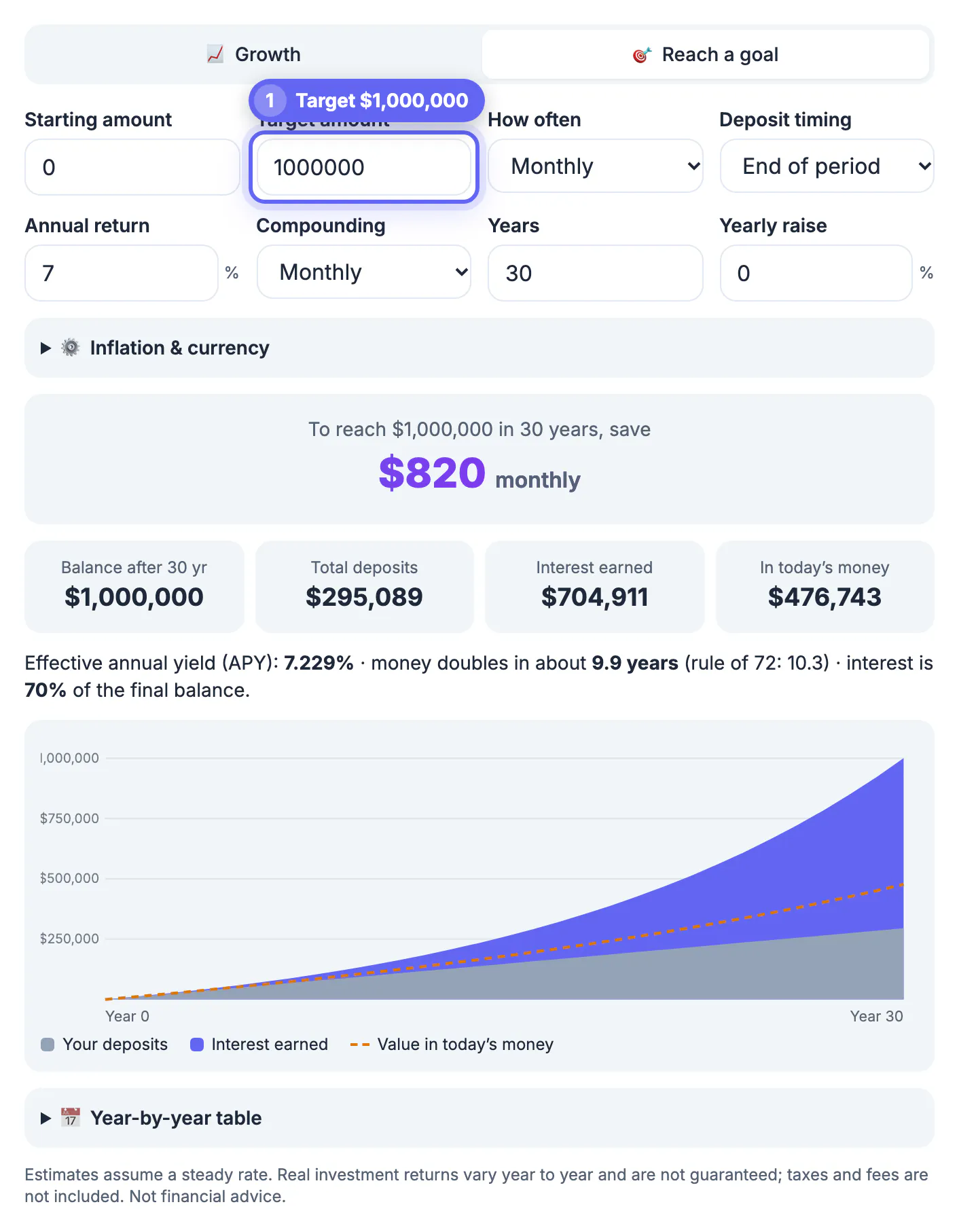
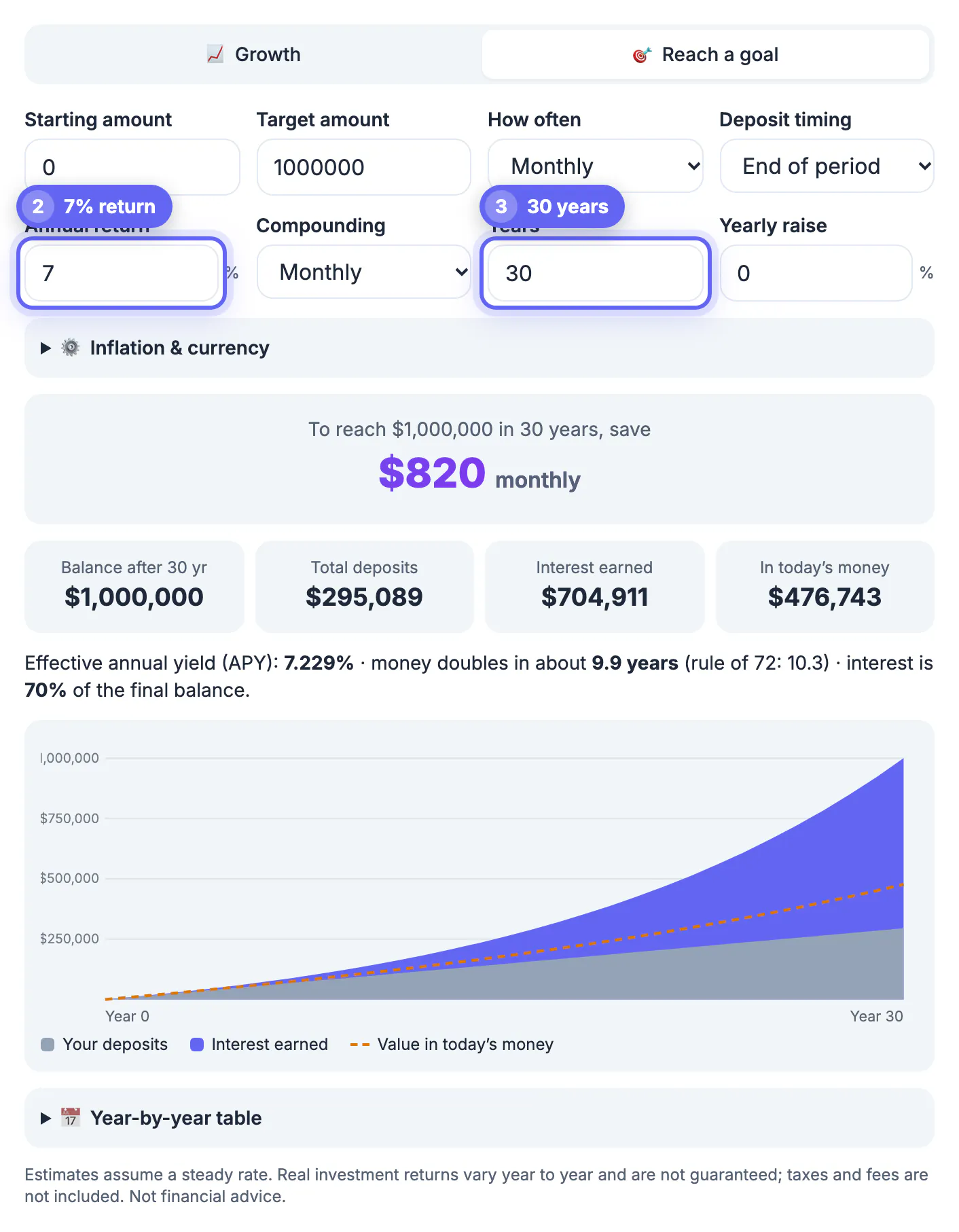
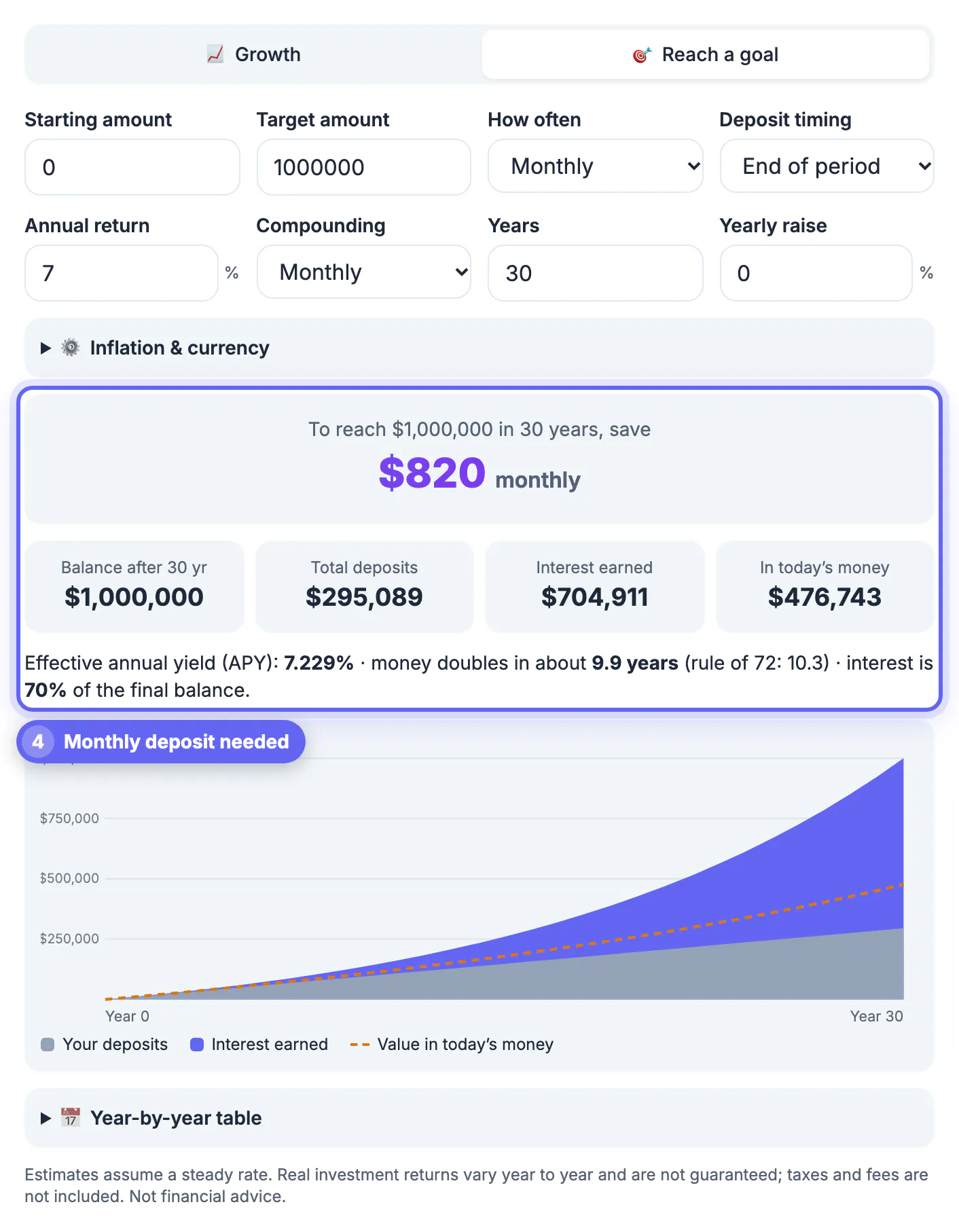
To reach $1 million in 30 years at a 7% average annual return, you need to save about $820 a month; give yourself 40 years and it drops to about $381. How much to save a month to reach $1 million depends almost entirely on two things you control, time and consistency, and one you do not, the return. This guide lays out the monthly amounts for common timelines and returns, shows how a head start changes the math, and explains why a million dollars in the future is worth less than it sounds today.
📈 Try the Compound Interest tool now — freeOpen →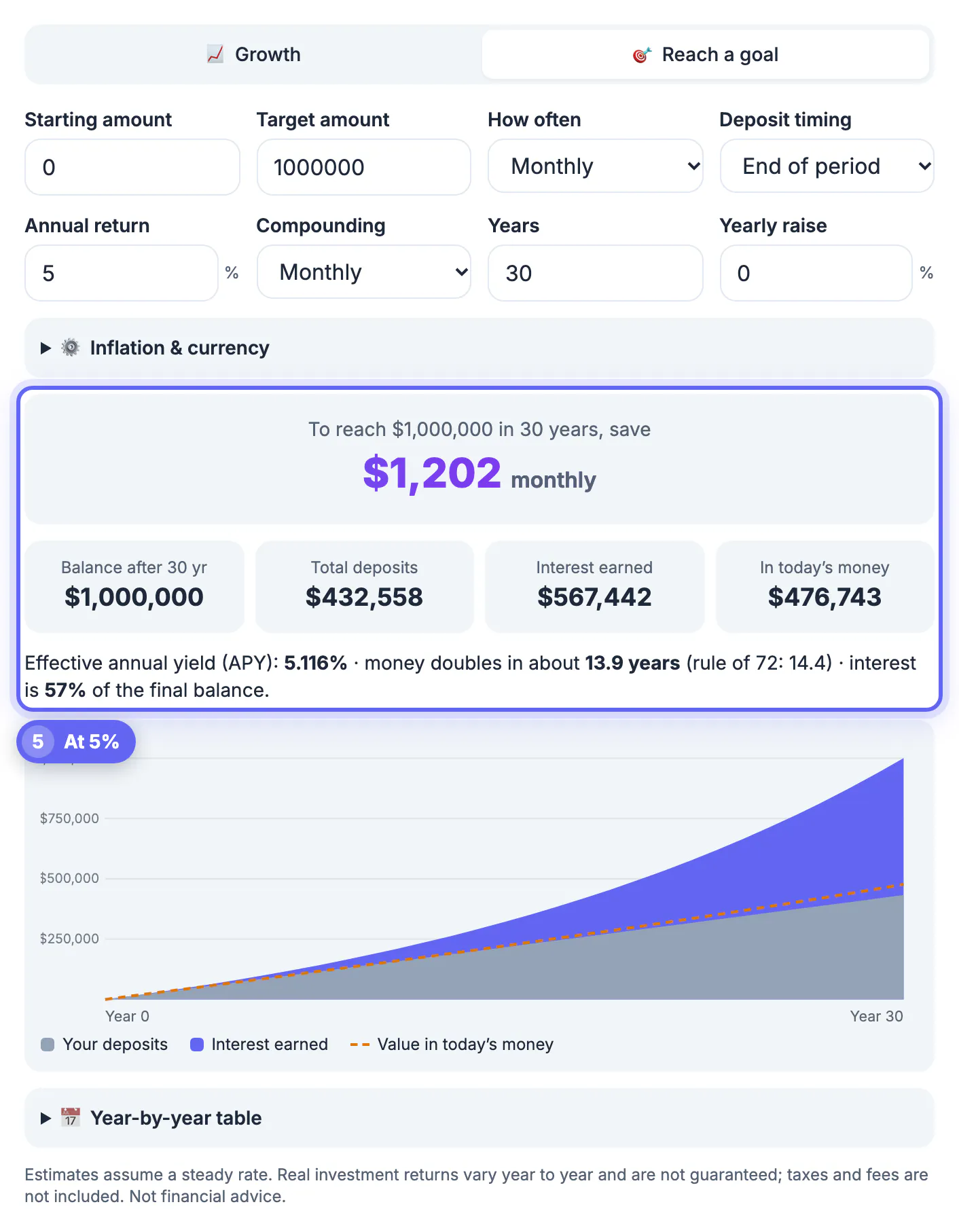
A million dollars feels abstract, so people postpone it. A monthly figure is concrete: it can go into a budget line and an automatic transfer on payday. Seeing the number also reveals the cost of waiting in plain dollars. Someone who starts at 25 might need less than a third of what someone starting at 45 needs each month for the same result, because compounding has more years to do the heavy lifting. The goal stops being a dream and becomes a bill you pay to your future self.
How much to save a month to reach $1 million
These amounts assume you start from zero, contribute at the end of every month, and earn a steady average return compounded monthly. Real markets are bumpy, so treat them as planning estimates, not promises.
- At 7% a year: 40 years $381, 35 years $555, 30 years $820, 25 years $1,234, 20 years $1,920, 15 years $3,155
- At 5% a year: 40 years $655, 30 years $1,202, 20 years $2,433, 15 years $3,741
- At 10% a year: 40 years $158, 30 years $442, 20 years $1,317, 15 years $2,413
The 7% line is a common planning assumption for a diversified stock-heavy portfolio after inflation over long periods, while 10% is closer to historical nominal stock returns and 5% suits a more conservative mix. Run your plan at more than one rate to see the range.
The price of waiting ten years
Delay is the most expensive decision in the table. At 7%, starting with 40 years to go requires $381 a month; starting with 30 years left requires $820, more than double. Over the full period the early starter contributes about $183,000, while the later starter contributes about $295,000 to reach the same $1 million.
- Growth does most of the work late in the plan; in a 30-year plan at 7%, about $705,000 of the $1 million is investment growth
- Saving $500 a month for 40 years at 7% reaches about $1.31 million from only $240,000 of contributions
- Existing savings help: with $50,000 already invested, the 25-year monthly target at 7% falls from $1,234 to about $881
If you are starting later, the lever you can pull is the monthly amount. Raising contributions with each pay increase closes the gap faster than chasing a higher return with riskier investments.
What $1 million will actually buy
Inflation shrinks the target. At 3% average inflation, $1 million in 30 years has the purchasing power of about $412,000 today. That does not make the goal pointless, but it changes how you read the result.
- Planning in real terms: use an after-inflation return, such as 7% instead of 10%, and the answer is already in today's dollars
- A common rule of thumb for withdrawals is around 4% a year, so $1 million supports roughly $40,000 of annual income before taxes
- Taxes differ by account: traditional retirement accounts are taxed on withdrawal, Roth accounts generally are not
- Fees compound too; a 1% annual fee can cut a 40-year result by a large fraction, so compare expense ratios
Making the monthly number happen
The math is simple; the habit is the hard part. The people who get there usually make saving automatic and invisible.
- Automate a transfer or payroll deduction on the day you are paid so the money never reaches your checking account
- Take any employer retirement match first, since it is effectively part of your monthly contribution
- Increase the contribution by 1% of pay every year or whenever you get a raise
- Keep an emergency fund separately so a surprise bill does not force you to sell investments at a bad time
This guide is general education, not personal financial advice. Your own mix of accounts, taxes and risk tolerance may change the right target, so consider a licensed advisor for decisions specific to you.
For long-horizon planning, the Retirement Calculator (401k) adds employer contributions, and the Paycheck & Salary Calculator shows what you can actually set aside.
Step-by-step
Common mistakes to avoid
Pro tips
Frequently asked questions
How much do I need to save a month to be a millionaire by 65
It depends on your age and return. At 7%, starting at 25 takes about $381 a month, starting at 35 about $820, and starting at 45 about $1,920. Any savings already invested lower those figures, sometimes dramatically, so enter your current balance as the starting amount.
Is 7% a realistic return
It is a common long-run planning figure for a stock-heavy portfolio after inflation, but returns vary widely from year to year and are never guaranteed. Test several rates to see a range.
Does the calculator compound monthly
By default, yes: interest compounds monthly and deposits are added at the end of each month. You can switch compounding anywhere from daily to continuous, change the deposit frequency or move deposits to the start of each period, and it shows the final balance, total deposits and interest earned.
Is $1 million enough to retire
For some people it is, for others it is not. Using a 4% withdrawal rule of thumb it supports about $40,000 a year, so compare that with your expected spending plus Social Security or pensions.
Should I pay off debt or invest first
High-interest debt usually comes first because its cost exceeds likely investment returns. Many people still take an employer match while paying debt down, since the match is an immediate return.
Reaching $1 million is mostly a function of time: at 7% it takes about $381 a month over 40 years or $820 over 30, so start as early as you can, automate the transfer, raise it with every raise, and plan in today's dollars so the goal means what you think it means.
Related guides
Browse more: all calculator guides · the Compound Interest tool