mL to fl oz: Exact Ounces for Travel, Labels and Bars
To convert mL to fl oz, divide the milliliters by 29.5735295625, the exact size of a US fluid ounce; for British fluid ounces, divide by 28.4130625. So 100 mL equals 3.3814 US fl oz, which is why the TSA writes its carry-on limit as 3.4 ounces. This guide gives both exact factors, a table for real bottles, cans, droppers and pours, the 30 mL shortcut printed on nutrition labels, how bartenders and pharmacists handle ounces, and how to get either ounce from GrabCast's free Unit Converter in one line.
📏 Try Unit Converter now — freeOpen →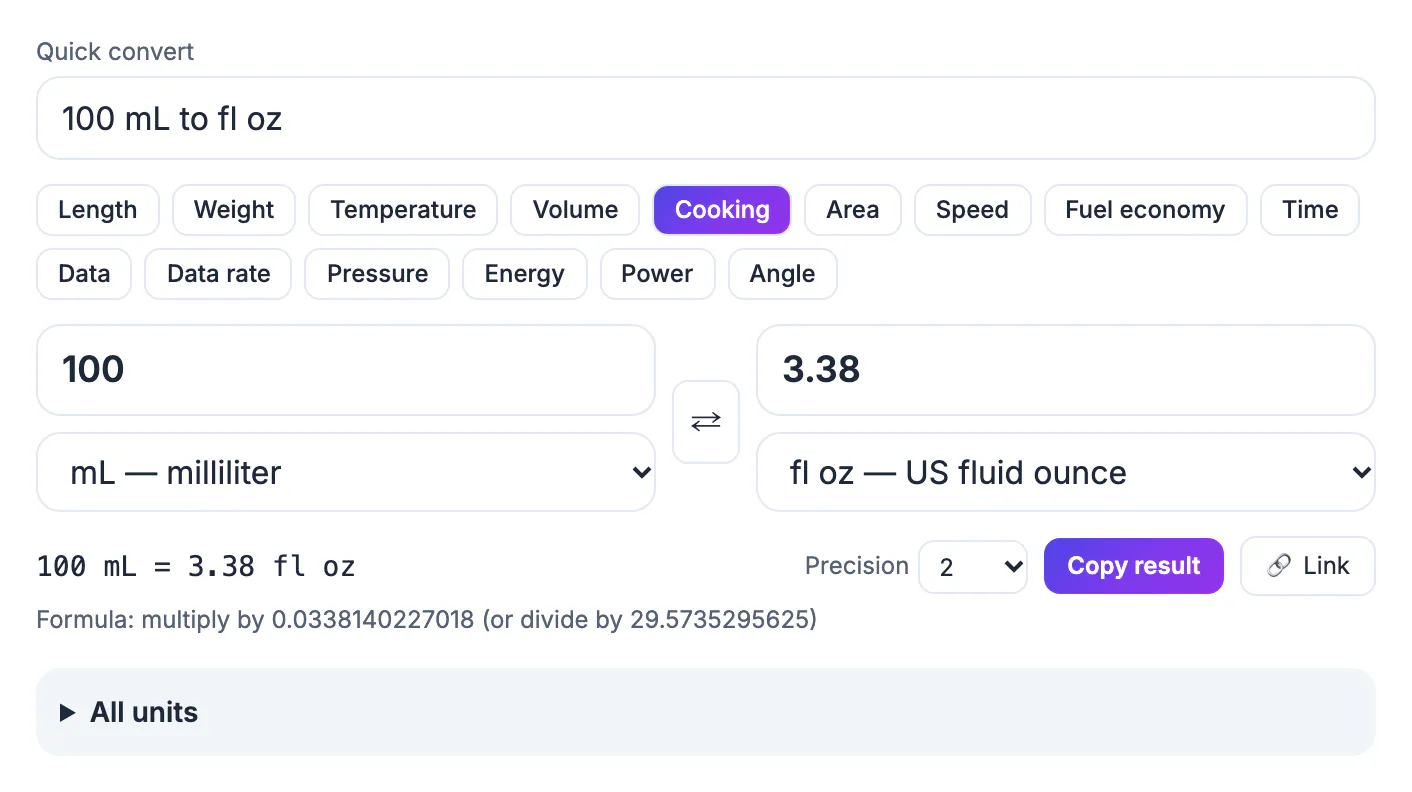
The letters oz can mean a US fluid ounce of 29.57 mL, a UK fluid ounce of 28.41 mL, or a weight ounce of 28.35 grams, which is not a volume at all. Labels, recipes and airport signs rarely say which. A US ounce is 4.08 percent larger than a British one, small per ounce but noticeable across a 20-ounce UK pint. Nutrition panels add a fourth figure by rounding the US ounce to 30 mL. Knowing which one a number means is most of the job; the division afterward is trivial.
Exact mL to fl oz factors
Both fluid ounces are fractions of their own gallon, which is why they differ: the US ounce is 1/128 of a US gallon and the imperial ounce is 1/160 of an imperial gallon.
- 1 US fl oz = 29.5735295625 mL exactly, so 1 mL = 0.033814 US fl oz.
- 1 UK fl oz = 28.4130625 mL exactly, so 1 mL = 0.035195 UK fl oz.
- A US pint holds 16 US fl oz (473.18 mL); an imperial pint holds 20 UK fl oz (568.26 mL).
- 1 liter = 33.814 US fl oz or 35.195 UK fl oz.
For mental math, 30 mL per ounce is close enough for cooking and cocktails: it overstates the US ounce by 1.4 percent. The reverse shortcut, 1 fl oz = 30 mL, is exactly what US labeling rules permit on nutrition panels, so a drink labeled 8 fl oz (240 mL) actually contains 236.6 mL of a true 8 ounces. Neither shortcut is appropriate for medicine, where the dosing cup or syringe in milliliters is the reference and conversion should be avoided altogether.
Spoon measures are the other kitchen trap. A US tablespoon is 14.787 mL, exactly half a US fluid ounce, and a US teaspoon is 4.929 mL, one sixth of an ounce. Australia uses a 20 mL tablespoon while most other metric countries use 15 mL, so a Sydney recipe asking for 2 tablespoons of soy sauce means 40 mL, closer to 3 US tablespoons than 2. The Cooking tab lists US spoon sizes only, so for Australian spoons enter the milliliters directly.
Table for bottles, cans, droppers and pours
Container sizes tend to be round in one system and awkward in the other. These are the exact US figures, with UK ounces where British buyers ask.
- Small: 5 mL = 0.169 fl oz (a US teaspoon is 4.929 mL); 15 mL = 0.507 fl oz; a 30 mL serum dropper bottle = 1.014 fl oz.
- Travel: 50 mL = 1.691 fl oz; 89 mL = 3.009 fl oz, the familiar 3 oz travel size; 100 mL = 3.381 fl oz.
- Drinks: a 330 mL European can = 11.159 fl oz; a US 12 oz can = 354.88 mL; a 500 mL bottle = 16.907 fl oz, printed 16.9.
- Large: a 750 mL wine bottle = 25.36 fl oz; 1 L = 33.81 fl oz; a 1.75 L handle = 59.17 US or 61.59 UK fl oz.
Round numbers on a label usually reveal the system the product was designed in. A 16.9 FL OZ bottle is a half-liter bottle wearing an American label, and a 355 mL can is a US 12-ounce can sold abroad. When comparing value across sizes at the store, convert everything to milliliters, or to price per 100 mL, rather than to ounces, because metric sizes line up with the unit prices printed on most shelf tags outside the US.
Batch cocktails show why the choice of ounce matters at scale. A punch for 20 guests at 2 US fl oz of base spirit each needs 40 fl oz, or 1.18 L; read with British ounces the same recipe calls for 1.14 L, a gap of about 46 mL, roughly one extra shot. For a single drink the difference disappears into the ice, but for batch prep and bar costing it is worth picking the right ounce.
Cooking from an overseas recipe? You may also need Celsius to Fahrenheit for the oven and pounds to kg for the ingredients.
Carry-on liquids, nutrition labels and bar pours
Three places where the mL to fl oz question has practical consequences, and the rule each one actually follows.
- Airport security: the TSA limit is 3.4 oz, or 100 mL, per container, in one quart-size bag; screeners judge the size printed on the container, so a half-empty 150 mL bottle still fails.
- Nutrition panels: US rules let makers round 1 fl oz to 30 mL and 1 cup to 240 mL, so a label conversion may differ from the exact one by about 1.4 percent.
- US bars: a standard drink of 80-proof spirits is 1.5 fl oz, or 44.36 mL; a two-ounce pour is 59.15 mL.
- UK and Irish pubs: a single spirit measure is 25 or 35 mL, which is 0.845 or 1.183 US fl oz.
Baby bottles and formula scoops are usually marked in both ounces and milliliters, but printed ounce marks may be rounded, so follow the formula maker's instructions in the unit they use. For skin care and essential oils, drop counts are unreliable because drop size depends on the dropper and the liquid, which is one more reason to work from the mL figure on the bottle rather than converting through drops or teaspoons.
mL to fl oz in the GrabCast Unit Converter
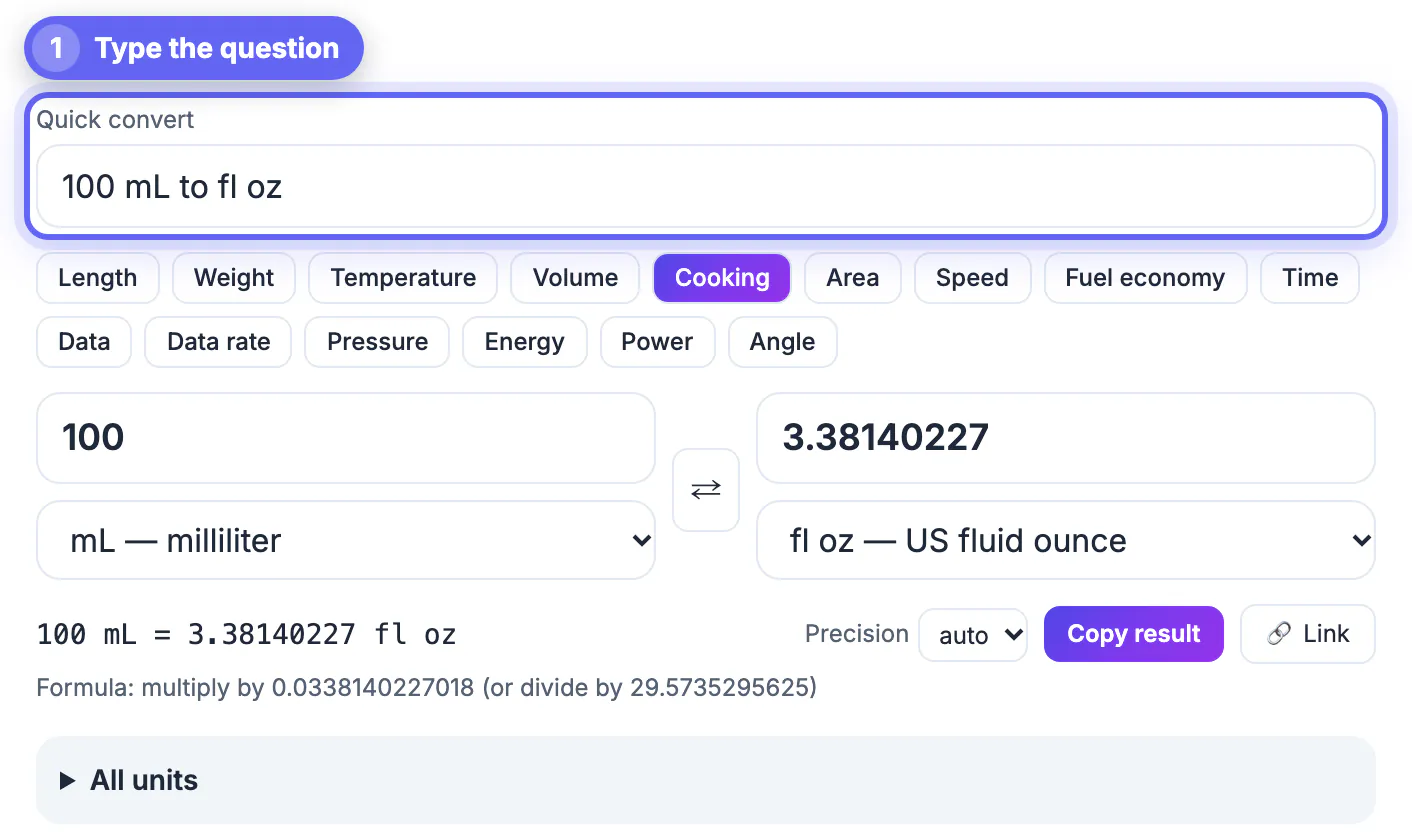
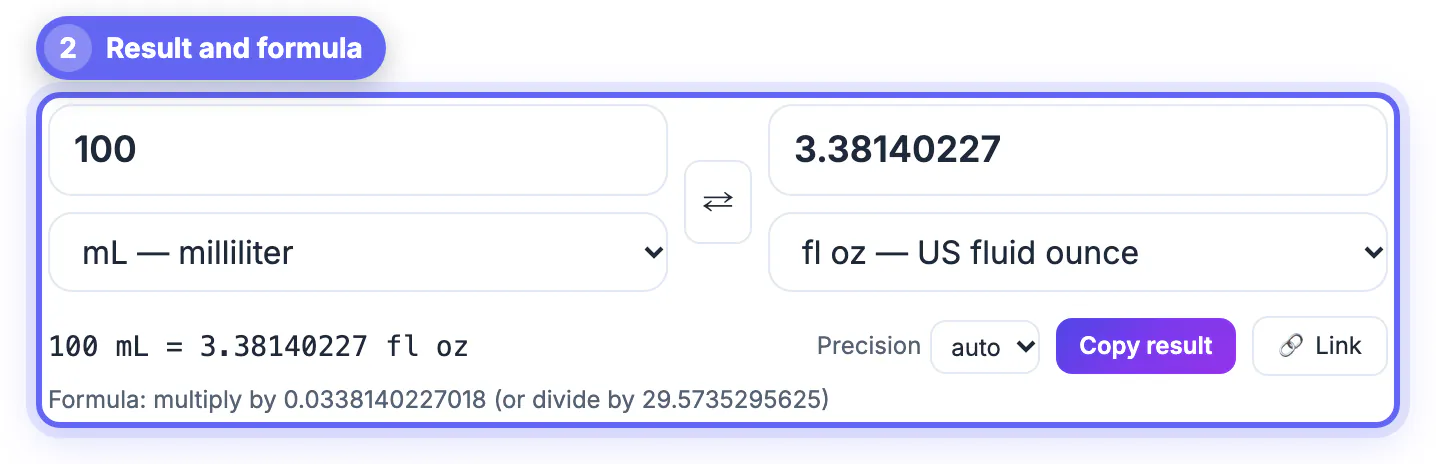
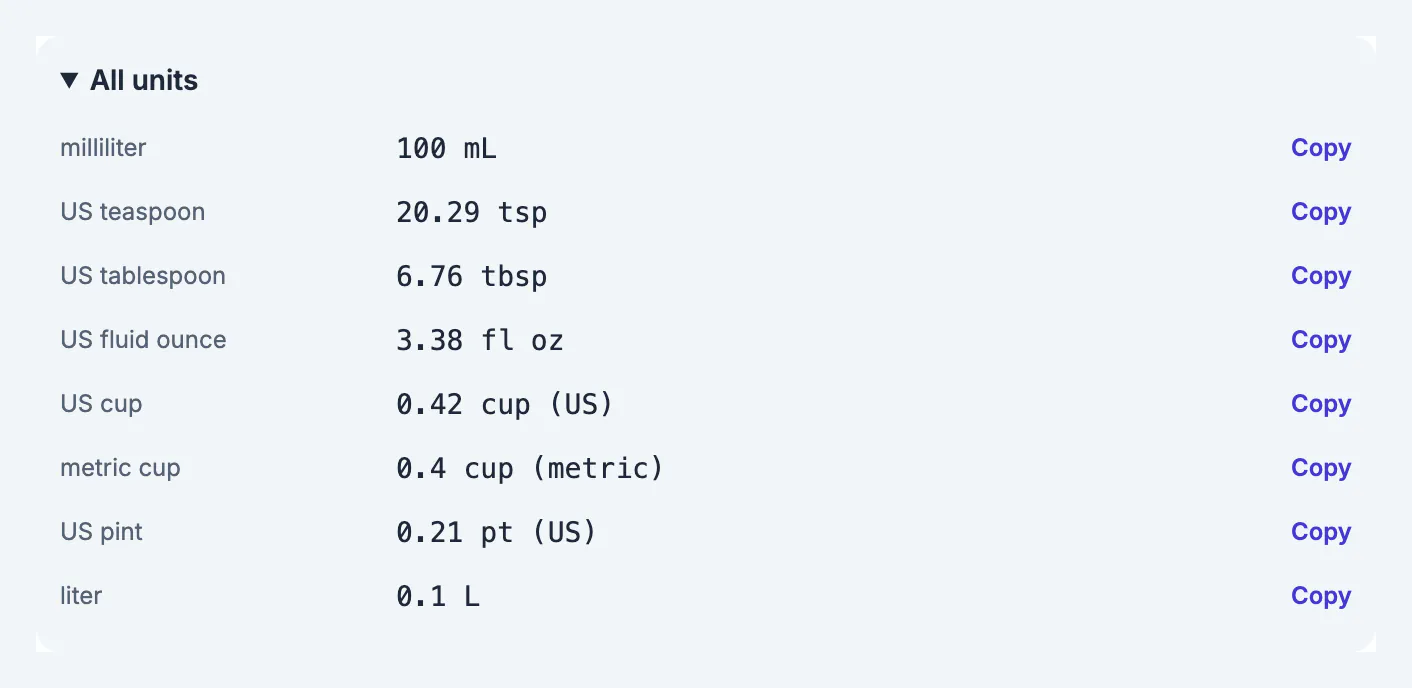
Type 100 mL to fl oz into the Quick convert box and the converter opens the Cooking tab with milliliters and US fluid ounces selected, answering 3.38140227 in auto precision. The formula line says multiply by 0.0338140227018, or divide by 29.5735295625.
- UK ounces: pick fl oz (UK) in the right-hand menu, or type 100 mL to imperial fluid ounces.
- Kitchen measures: the Cooking tab covers US teaspoons, tablespoons, US cups, 250 mL metric cups and US pints.
- Both ways: type ounces in the right box and milliliters update on the left.
- All units lists the amount in every unit of the tab, each with a Copy button; the Volume tab shows US and UK ounces, pints, quarts and liters together.
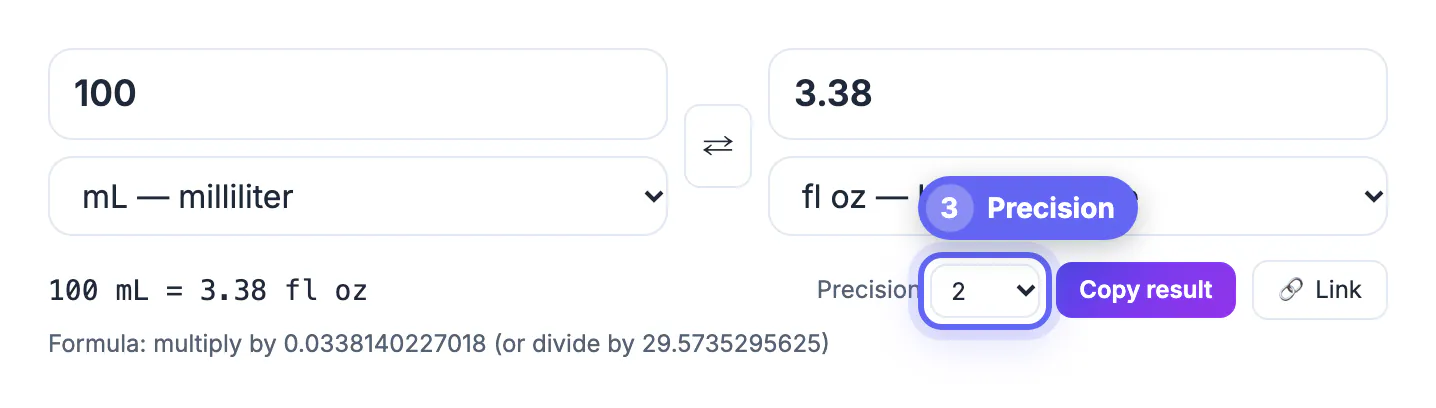
Type fl oz, not just oz, in the Quick convert box: on its own, oz means the weight ounce, and the tool will not convert a volume into a weight because that needs the liquid's density. Set Precision to 2 decimals for label copy, press Copy result, or press Link to share the exact conversion with a coworker preparing a product sheet. The arithmetic runs locally in your browser.
Step-by-step
Common mistakes to avoid
Pro tips
Frequently asked questions
Is 100 mL the same as 3.4 oz?
Almost. 100 mL is 3.3814 US fluid ounces and 3.4 fl oz is 100.55 mL. The TSA rounds its limit to 3.4 ounces so both labels pass.
Why does my label say 1 fl oz is 30 mL?
US nutrition labeling rules let manufacturers round the fluid ounce to 30 mL and the cup to 240 mL. The exact customary ounce is 29.5735 mL.
Are fluid ounces and ounces the same?
No. Fluid ounces measure volume and ounces on a scale measure weight. They roughly match only for water and drift apart for oil, honey or syrup.
How many mL are in a US cup?
A US customary cup is 236.588 mL, a nutrition-label cup is 240 mL and a metric cup is 250 mL. The Cooking tab includes US and metric cups.
Can the tool convert UK fluid ounces?
Yes. Choose fl oz (UK) in the Volume tab, or type imperial fluid ounces in the Quick convert box. One UK ounce is exactly 28.4130625 mL.
Divide milliliters by 29.5735 for US fluid ounces or 28.4131 for British ones, and confirm which ounce, fluid or weight, your source means. Use the 30 mL shortcut for drinks and cooking only, trust container sizes rather than fill levels at the airport, and work in milliliters for anything medical, from infant formula to cough syrup, where the dosing tool supplied with the product is the only reliable measure.
Related guides
Browse more: all calculator guides · Unit Converter