Celsius to Kelvin: Add 273.15, and Why Science Cares
To convert Celsius to Kelvin, add 273.15: 25 °C is 298.15 K, 0 °C is 273.15 K and 100 °C is 373.15 K. Going back, subtract 273.15. There is no multiplication because a kelvin and a Celsius degree are the same size; only the starting point differs, and Kelvin starts at absolute zero. This guide covers the definition behind the number, why gas laws and radiation formulas demand kelvins, where kelvins appear outside a lab, including light bulbs, and how GrabCast's free Unit Converter shows the conversion and its formula.
📏 Try Unit Converter now — freeOpen →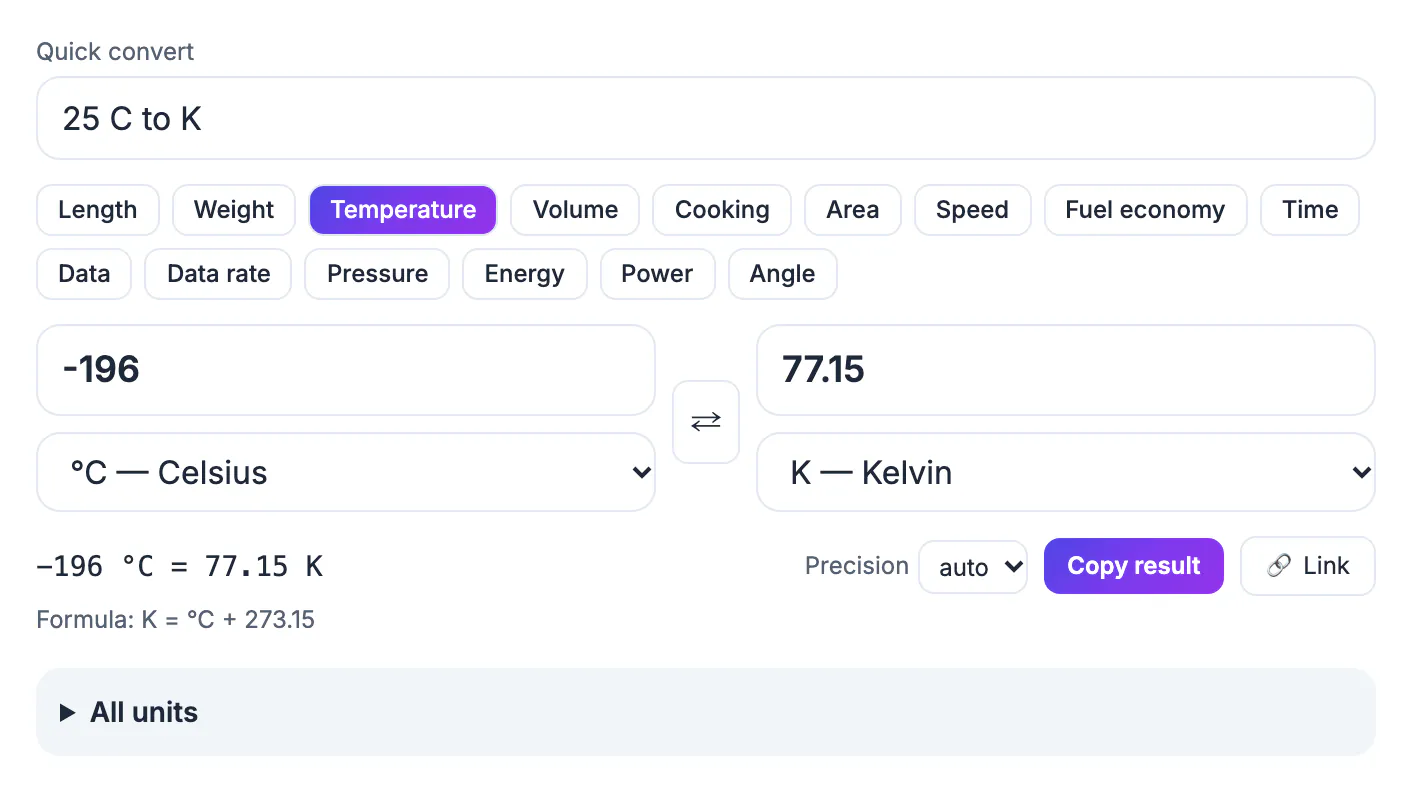
Many physical laws depend on ratios of temperature, and ratios only make sense on a scale whose zero means none. On the Celsius scale, 20 °C is not twice as hot as 10 °C, and dividing by 0 °C is undefined. In kelvins, 293.15 K and 283.15 K compare honestly, and every equation from the ideal gas law to thermal radiation behaves. That is why SI makes the kelvin its base unit of temperature and defines Celsius from it, not the other way around. Engineers meet the same rule in heat-transfer, battery and semiconductor datasheets, where temperature coefficients are quoted per kelvin.
Celsius to Kelvin: one offset, same degree size
The rule is K = °C + 273.15, and the reverse is °C = K − 273.15. Kelvins are written with a plain K and no degree sign, so it is 298.15 K, not 298.15 °K, a style the SI adopted in 1967. Going back is the same move in reverse: 300 K − 273.15 = 26.85 °C, and 77 K − 273.15 = −196.15 °C.
- Freezing water at normal pressure: 0 °C = 273.15 K.
- Standard lab reference: 25 °C = 298.15 K, the temperature most thermodynamic tables assume.
- Human body: 37 °C = 310.15 K.
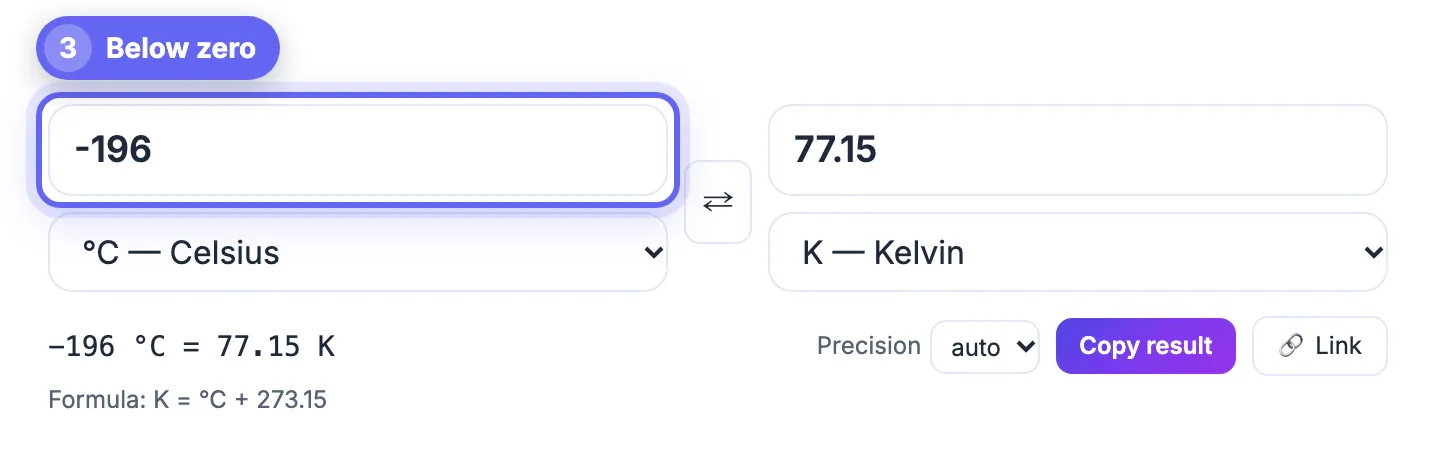
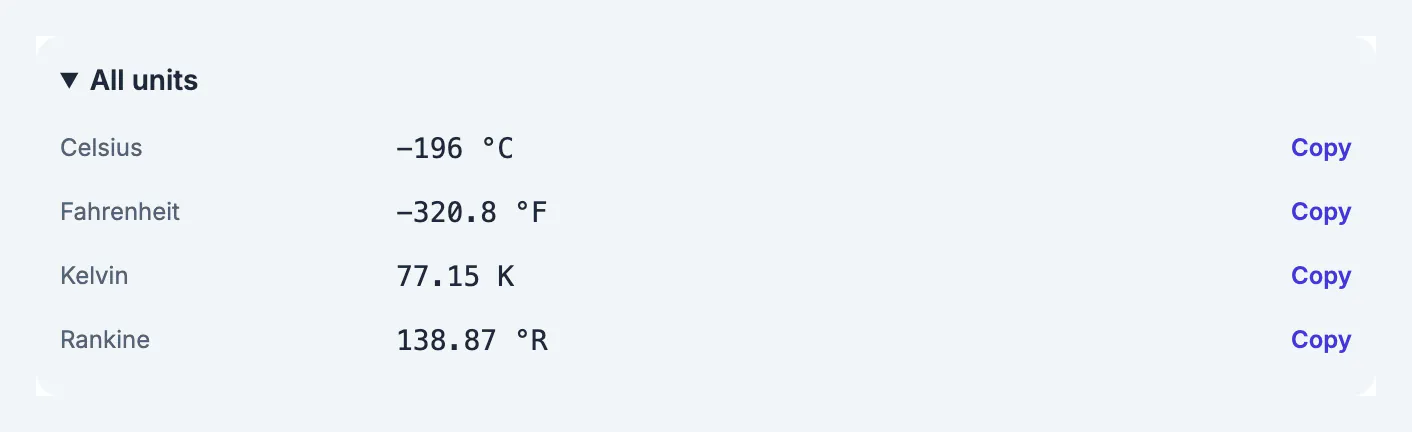
- Liquid nitrogen boiling: about −196 °C, or roughly 77 K; absolute zero is −273.15 °C = 0 K.
Since the 2019 revision of the SI, the kelvin is defined by fixing the Boltzmann constant at exactly 1.380649 × 10⁻²³ J/K, which ties temperature to energy rather than to a sample of water. Before that, the unit was pinned to the triple point of water at 273.16 K, which is 0.01 °C. That is why two slightly different numbers appear in textbooks: 273.16 for the triple point and 273.15 for the offset used in every conversion.
Where equations go wrong without kelvins
The offset is easy; forgetting to apply it is the expensive part, especially in chemistry and physics homework.
- Charles's law: heating a gas from 20 °C to 40 °C does not double its volume; in kelvins it goes from 293.15 to 313.15, a 6.8 percent increase.
- Radiation: emitted power scales with the fourth power of absolute temperature, so plugging in Celsius gives nonsense, and zero for anything at 0 °C.
- Differences are safe: a rise of 15 °C is a rise of exactly 15 K, so specific heat in J/(kg·K) equals J/(kg·°C).
- Significant figures: using 273 instead of 273.15 shifts results by 0.15 K, acceptable in some intro courses but not in lab reports.
A quick way to catch the slip is to look at the magnitude: ordinary temperatures in kelvins are three-digit numbers near 300. If a gas-law answer implies a temperature of 25 or 40 in the denominator, Celsius was used by mistake. If you type a value below −273.15 °C, the converter still shows the arithmetic but flags it on the formula line with a warning that the value is below absolute zero and not a physical temperature, so treat that warning as your signal that the input is wrong.
Chemistry problems often combine both needs in a single line. With the ideal gas law, PV = nRT and R = 8.314 J/(mol·K), one mole of gas at 25 °C and 1 atm occupies about 24.5 liters. Enter 25 in place of 298.15 and the volume collapses to roughly 2 liters, an answer that should look suspicious immediately to anyone who remembers the 22 to 25 liter range for a mole of gas near room conditions.
Kelvins outside the lab: bulbs, cameras and stars
Kelvins show up on shopping shelves and in photo apps, usually as color temperature rather than heat.
- LED and fluorescent bulbs: 2,700 K reads as warm white, 4,000 K as neutral and 5,000 to 6,500 K as daylight.
- Camera white balance: setting 5,500 K tells the camera to treat midday sun as neutral.
- Astronomy: the Sun's effective surface temperature is 5,772 K, and the cosmic microwave background is about 2.7 K.
- US engineering: the Rankine scale uses Fahrenheit-sized degrees from absolute zero, so 0 K = 0 °R = −459.67 °F.
Color temperature describes the color of light an ideal glowing object would emit at that temperature; it is not how hot the bulb gets, and converting 2,700 K to 2,426.85 °C is arithmetically correct but physically meaningless for an LED that runs barely warm. Rankine still appears in some American thermodynamics courses and aerospace data, and converting to it is the same idea as Kelvin with Fahrenheit degrees: °R = °F + 459.67.
Weather and climate data use K as well. Satellite sea-surface products and reanalysis files frequently store temperatures in K, so a value of 288 in a downloaded dataset means 14.85 °C, not a glitch. Subtract 273.15 before charting such data for a general audience, and label the axis clearly so nobody mistakes a 288 for a typo.
For lab data, the Scientific Calculator is useful once temperatures are in kelvins, and this guide to converting units correctly covers other measures you may meet in the same work.
Convert Celsius to Kelvin in GrabCast's Unit Converter
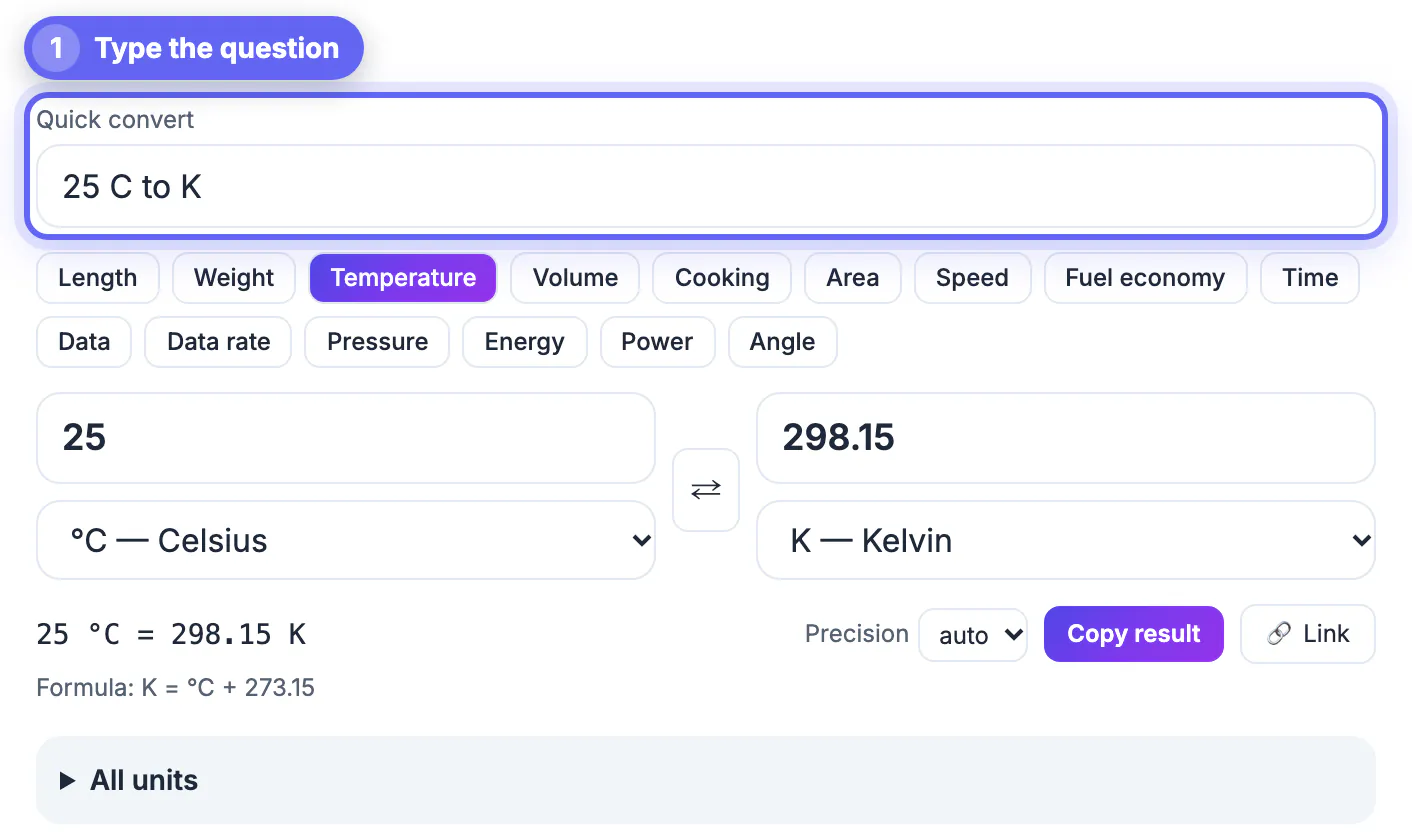
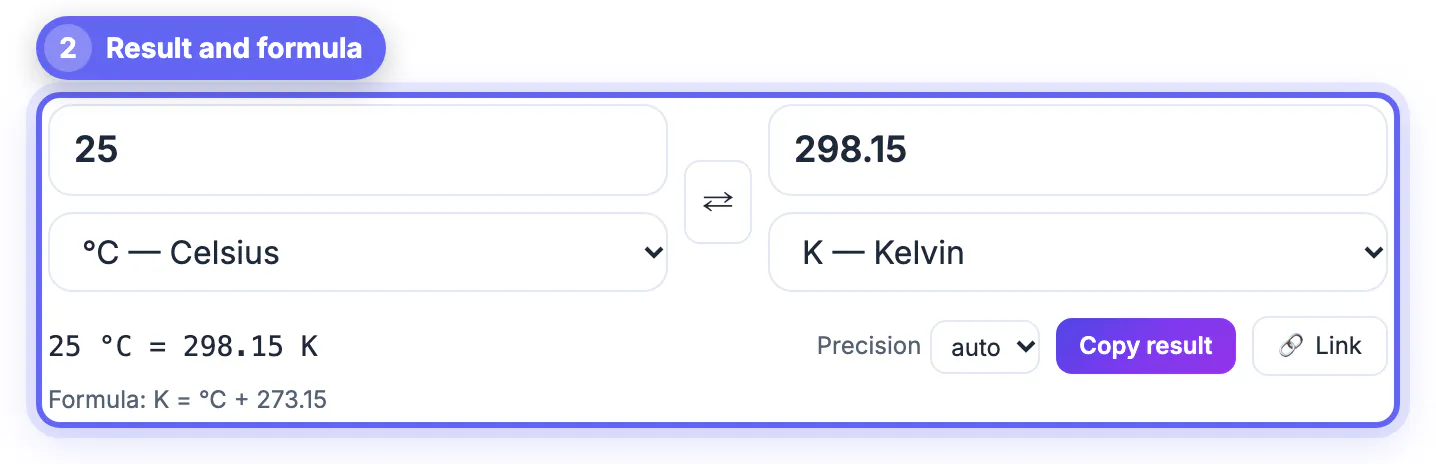
Type 25 C to K in the Quick convert box, or open the Temperature tab and pick K in the right-hand menu. The formula line prints K = °C + 273.15, and the result appears as 298.15 without rounding noise.
- Two-way entry: type a K value in the right box to get °C back.
- All units shows the same reading in °C, °F, K and °R, each with a Copy button.
- Precision can be fixed at 2, 4, 6 or 10 decimals to match your lab's reporting rules.
- Link copies a URL that reopens the same conversion for a lab partner or a student.
The converter is free with no sign-up and runs in your browser, so it works offline once the page has loaded, a useful trait in a lab without guest Wi-Fi. For Kelvin to Fahrenheit or Rankine, pick those units directly; the formula line prints the rule for every temperature pair, for example K = (°F − 32) × 5/9 + 273.15 and °R = °F + 459.67, which makes it easy to copy the working into a lab notebook.
Step-by-step
Common mistakes to avoid
Pro tips
Frequently asked questions
What is the Celsius to Kelvin formula?
K = °C + 273.15. The degree size is identical, so there is no multiplication. For example, 20 °C is 293.15 K.
What is absolute zero?
0 K, which is −273.15 °C or −459.67 °F. It is the lowest possible temperature, approached in experiments but never reached.
Can Kelvin be negative?
Not for ordinary thermodynamic temperatures, since the scale starts at absolute zero. A negative result from a conversion means the input was below −273.15 °C, so recheck the source value or its sign.
Why is it 273.15 and not 273.16?
273.16 K is the triple point of water, 0.01 °C. The offset between the scales is 273.15, which is what every conversion uses.
How do I convert Kelvin back to Celsius?
Subtract 273.15. For example, 300 K is 26.85 °C and 373.15 K is 100 °C. The Temperature tab also covers °F and Rankine (°R) if you need those from the same kelvin reading.
Add 273.15 to go from Celsius to Kelvin and subtract it to go back, with no degree sign on the K. Use kelvins in any equation built on ratios, remember that temperature differences are identical on both scales, and treat a negative kelvin figure as a sign to recheck the input. When a lab handout or dataset specifies decimals, keep the full 273.15 offset throughout and round only the final reported value.
Related guides
Browse more: all calculator guides · Unit Converter