Liters to Gallons: Exact US and Imperial Conversions
To convert liters to US gallons, divide by 3.785411784, or multiply by 0.264172. For imperial gallons, divide by 4.54609 instead. A 60-liter car tank therefore holds 15.85 US gallons but only 13.20 imperial ones. Below you will find the exact legal definitions, a lookup table for jugs, tanks, aquariums and drums, the fuel-economy math that links L/100 km with miles per gallon, and a walkthrough of GrabCast's free Unit Converter, which now lists US and imperial gallons side by side and has a dedicated fuel-economy tab.
📏 Try Unit Converter now — freeOpen →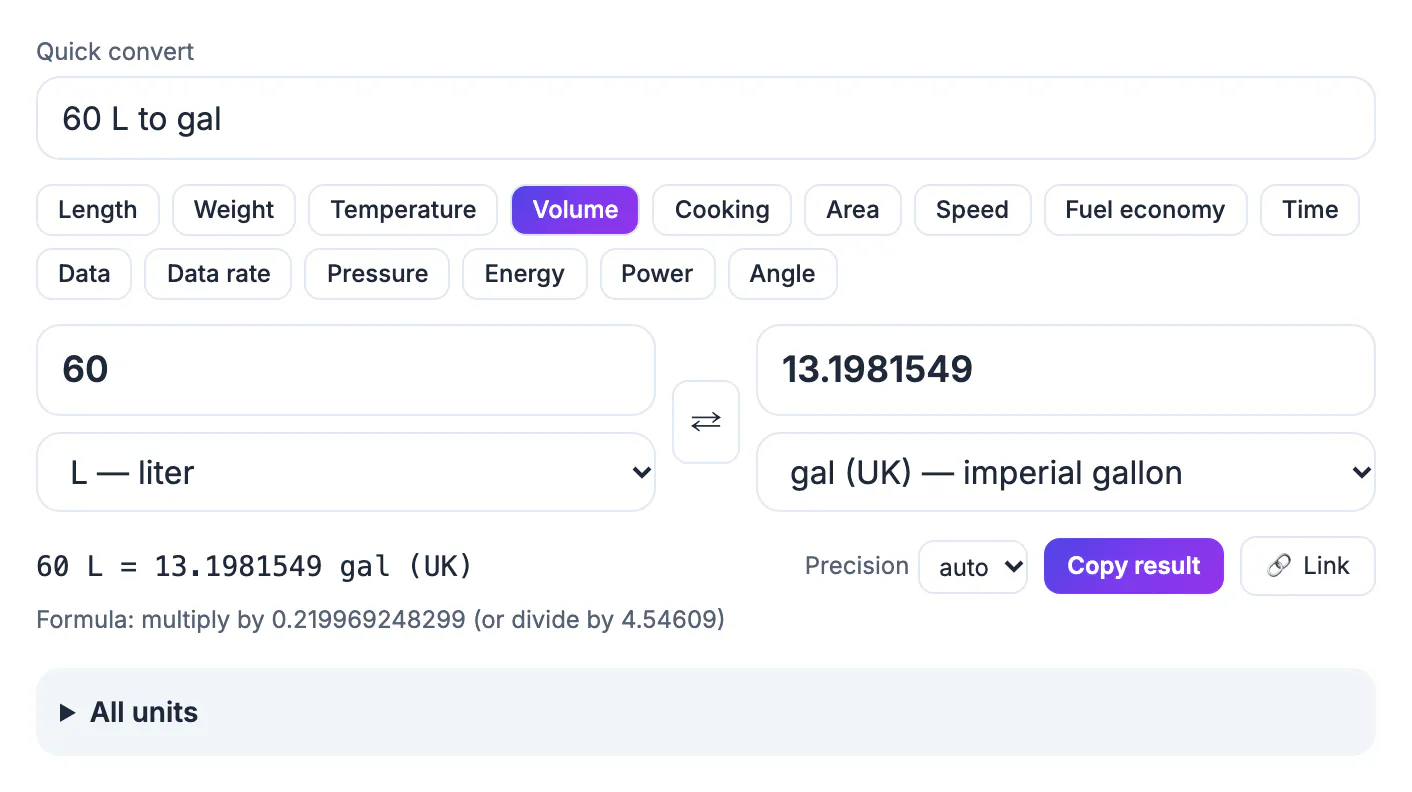
The US gallon descends from an 18th-century wine gallon and is defined as exactly 231 cubic inches, which works out to 3.785411784 liters. Britain replaced its patchwork of ale, wine and corn gallons in 1824 with the imperial gallon, now defined as exactly 4.54609 liters. The imperial one is 20.1 percent larger, and people in the UK and Canada still use it in everyday speech even though pumps there sell by the liter. That is why a British classic car manual, a Canadian boat spec and a US garden sprayer can all say 10 gallons and mean different amounts. Aviation adds another wrinkle, since avgas is sold by the liter or the US gallon depending on the airport, and pilots plan fuel by weight.
Exact liters to gallons factors
Because both gallons are defined in liters, every factor below is exact or a direct consequence of an exact definition.
- 1 US gallon = 3.785411784 L, so 1 L = 0.264172 US gal.
- 1 imperial gallon = 4.54609 L, so 1 L = 0.219969 imperial gal.
- 1 imperial gallon = 1.20095 US gal; 1 US gallon = 0.832674 imperial gal.
- Smaller steps: a US quart is 0.946352946 L and an imperial quart 1.1365225 L; a US pint is 0.473176473 L and an imperial pint 0.56826125 L.
For a quick mental estimate, divide liters by 4 for US gallons: 10 L ÷ 4 = 2.5 against an exact 2.64, so the shortcut runs about 5 percent low. The same 10 liters is 2.20 imperial gallons, and a 50-liter tank is 13.2 US gallons. A US gallon is a bit under 3.8 liters and a liter is a little over a quarter of a US gallon. For precise work, such as mixing a concentrate or billing a customer for fuel, keep the full factor and round once at the end; rounding the factor to 3.8 already introduces a 0.4 percent error, which on a 1,000-liter tote is more than a gallon.
Table for jugs, tanks, aquariums and drums
Container sizes are often round numbers in one system and awkward decimals in the other. These are the conversions people look up most.
- Bottles and jugs: 1 L = 0.2642 US gal; 4 L = 1.0567 US gal; a 5-gallon US water-cooler jug holds 18.93 L.
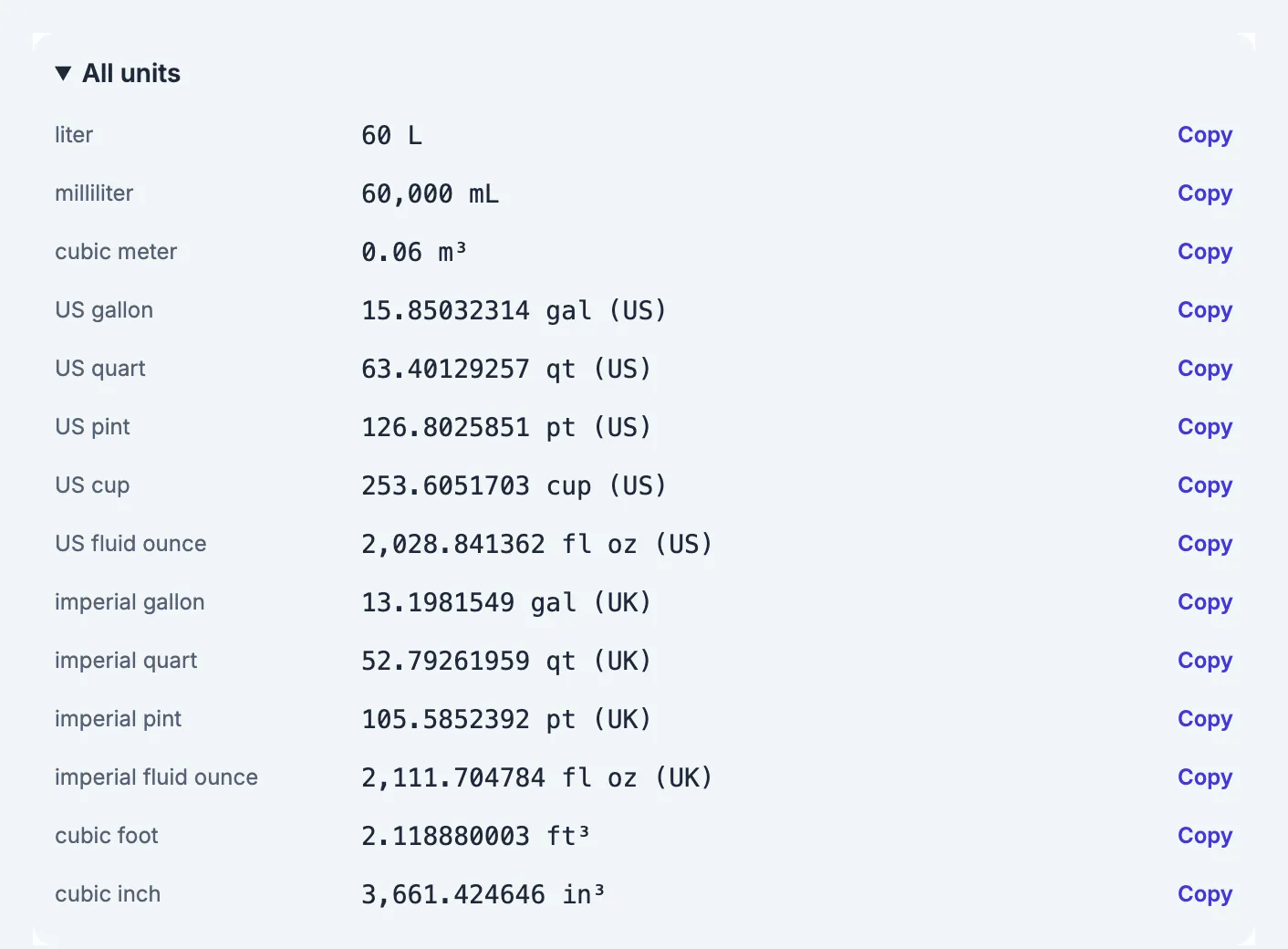
- Fuel cans and tanks: a 20 L jerrycan is 5.2834 US or 4.3994 imperial gallons; a 60 L car tank is 15.8503 US or 13.1982 imperial.
- Aquariums: a tank sold as 20 US gallons holds 75.7 L; a 100 L tank is 26.4172 US gallons.
- Drums and totes: a 55 US gallon drum is 208.2 L; a 200 L drum is 52.8344 US gallons; a 1,000 L IBC tote is 264.172 US gallons.
Two real-world notes. Nominal sizes are rarely brimful: drums and jerrycans are filled below the rim to leave headspace, so the usable volume can be a few percent under the label. And aquarium or pond volumes quoted by retailers are usually the outer dimensions, before gravel, rock and the gap at the top, which matters when you dose medication or water treatment by liters. Measure the actual water if the dose is sensitive.
Weight is the other planning number. Fresh water weighs about 1 kg per liter, and a US gallon of it about 8.34 pounds, so a 200 L aquarium puts roughly 200 kg of water on its stand before glass, rock and gravel are added, which is why larger tanks call for a check of the floor beneath them.
Liters to gallons in the GrabCast Unit Converter
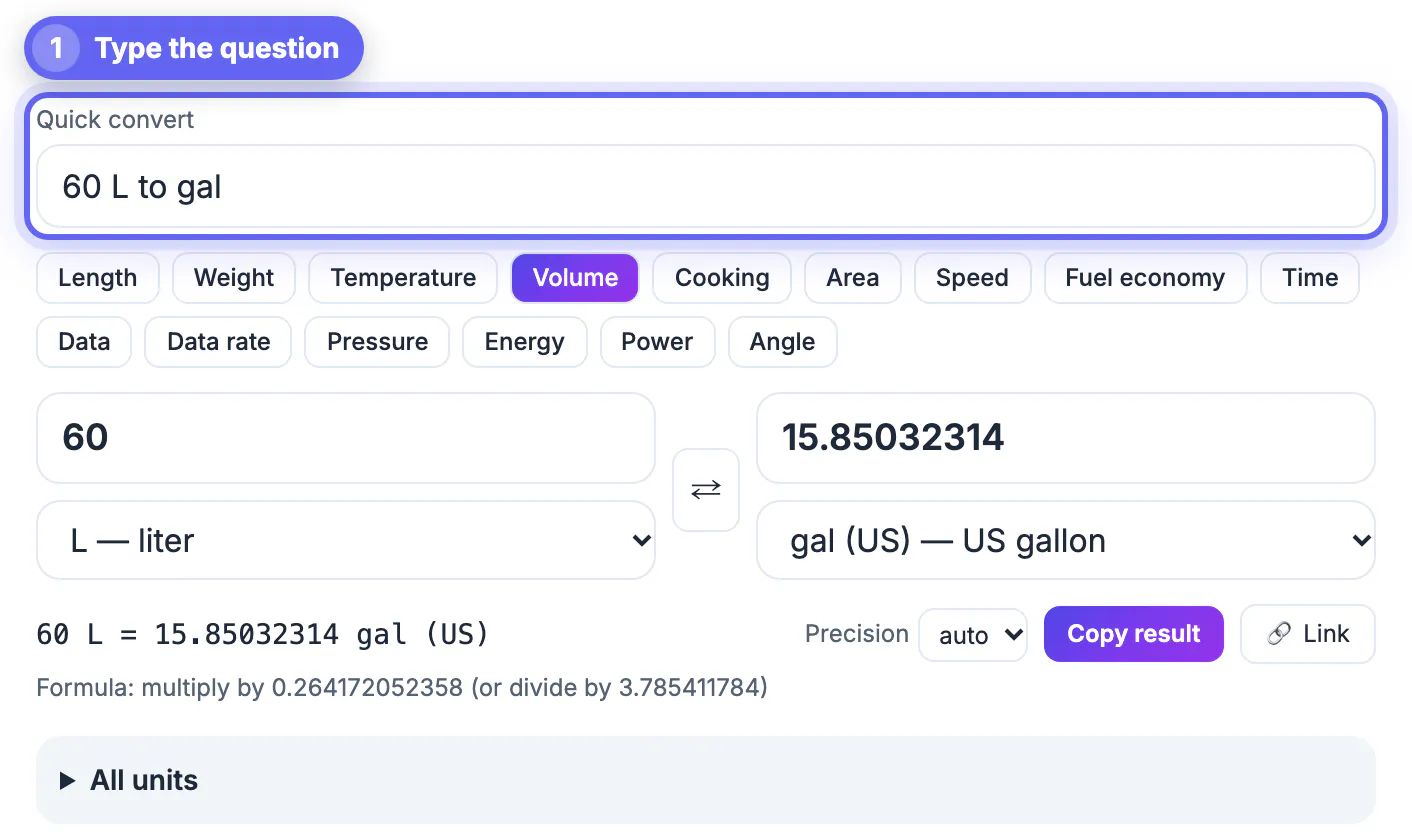
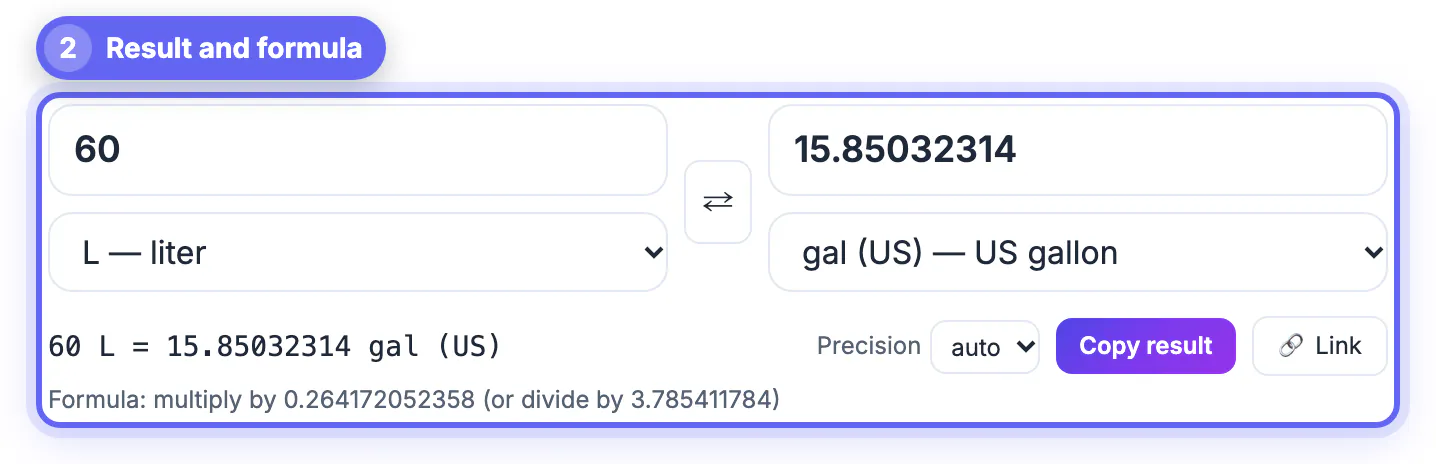
Open the Volume tab and the converter starts at L to gal (US), so you only type the liters. Every unit uses the exact legal definition, and the formula line reads multiply by 0.264172052358 (or divide by 3.785411784).
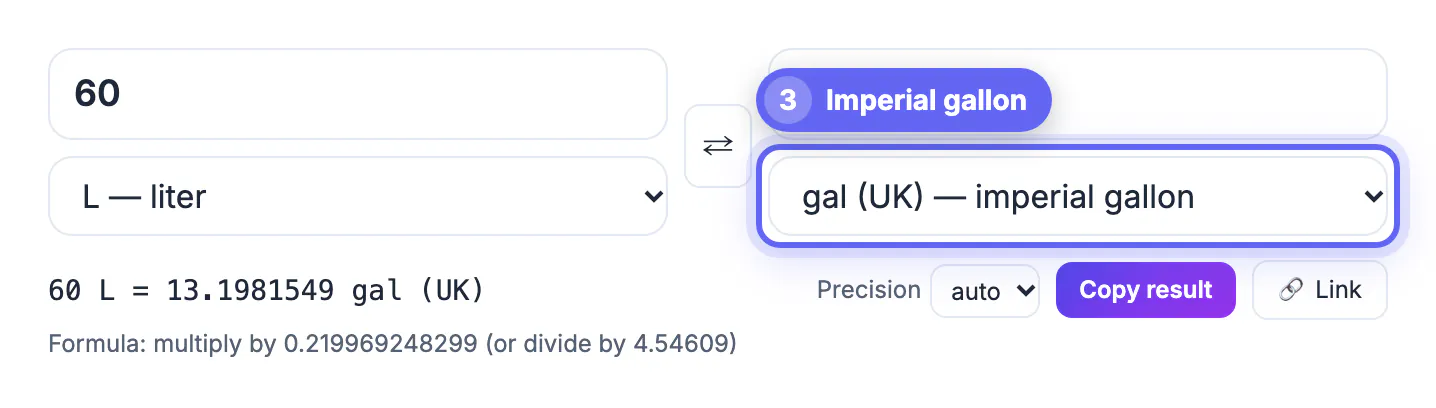
- Imperial results: choose gal (UK) in the right-hand menu, or type 60 L to imperial gallons in the Quick convert box.
- Both at once: open All units to see the US and imperial gallon figures, quarts, pints, fluid ounces, cubic feet and cubic meters for the same amount, each with Copy.
- Backward: type a gallon figure in the right-hand box and the liter box updates, no swapping needed.
- Quick phrases such as 20 liters to gallons default to the US gallon, matching American usage.
Precision can stay on auto, which shows up to 10 significant digits, or be fixed at 2 decimals for a price sheet. The Link button copies a URL holding the category, both units and your value, useful for sending a tank spec to a supplier. The converter is free, needs no sign-up, and everything is computed in your browser. One limit to keep in mind: gallons here are volume only; converting to weight needs the liquid's density, and gasoline, diesel and water all differ.
Fuel economy: L/100 km, mpg (US) and mpg (UK)
Fuel economy is where the two gallons cause the most confusion, because a UK mpg figure is about 20 percent higher than a US one for the same car, and the metric world measures the inverse quantity.
- US mpg = 235.215 ÷ L/100 km, so 6 L/100 km is 39.2 US mpg.
- UK mpg = 282.481 ÷ L/100 km, so the same 6 L/100 km is 47.1 UK mpg.
- L/100 km = 235.215 ÷ US mpg, so 30 US mpg is 7.84 L/100 km.
- To compare a UK rating with a US sticker, divide the UK figure by 1.20095.
GrabCast's Fuel economy tab handles all of this without the constants: pick mpg (US), mpg (UK), L/100 km or km/L, or type 30 mpg to L/100km in the Quick convert box. A note under the result reminds you that L/100 km is the inverse of distance per volume, so lower is better. That inversion also means savings are not linear: moving from 20 to 25 US mpg saves more fuel per mile than moving from 40 to 50, a point worth remembering when comparing cars.
Buying fuel abroad? Convert the price into your own currency too, and note that a liter of water weighs about a kilogram, which is where pounds to kg comes in.
Step-by-step
Common mistakes to avoid
Pro tips
Frequently asked questions
How many gallons are in 1 liter, and how many liters in a gallon?
One liter is 0.264172 US gallons or 0.219969 imperial gallons. In reverse, a US gallon is exactly 3.785411784 liters and an imperial gallon exactly 4.54609 liters, about 20 percent more.
Is a 5-gallon water jug 20 liters?
No. A US 5-gallon cooler bottle holds 18.93 liters, and 20 liters is 5.28 US gallons. Bottlers in metric markets often sell a 19 or 20 liter size instead.
Does the GrabCast converter have imperial gallons?
Yes. The Volume tab lists gal (UK), qt (UK), pt (UK) and fl oz (UK) next to the US versions, and All units shows both systems at once.
How many liters are in a 55-gallon drum?
A 55 US gallon drum holds 208.2 liters. Drums sold in metric markets are usually labeled 200 liters, which is 52.83 US gallons.
Why do UK cars report higher mpg than US cars?
UK figures use the larger imperial gallon. Divide a UK mpg number by 1.20095 to compare it fairly with a US rating, or use the Fuel economy tab.
Divide liters by 3.785411784 for US gallons or by 4.54609 for imperial, and always confirm which gallon your source means. For cars, work in L/100 km or use the Fuel economy tab rather than juggling constants, and treat container labels as nominal until you have measured the real contents.
Related guides
Browse more: all calculator guides · Unit Converter