Celsius to Fahrenheit: Formula, Oven Chart and Fevers
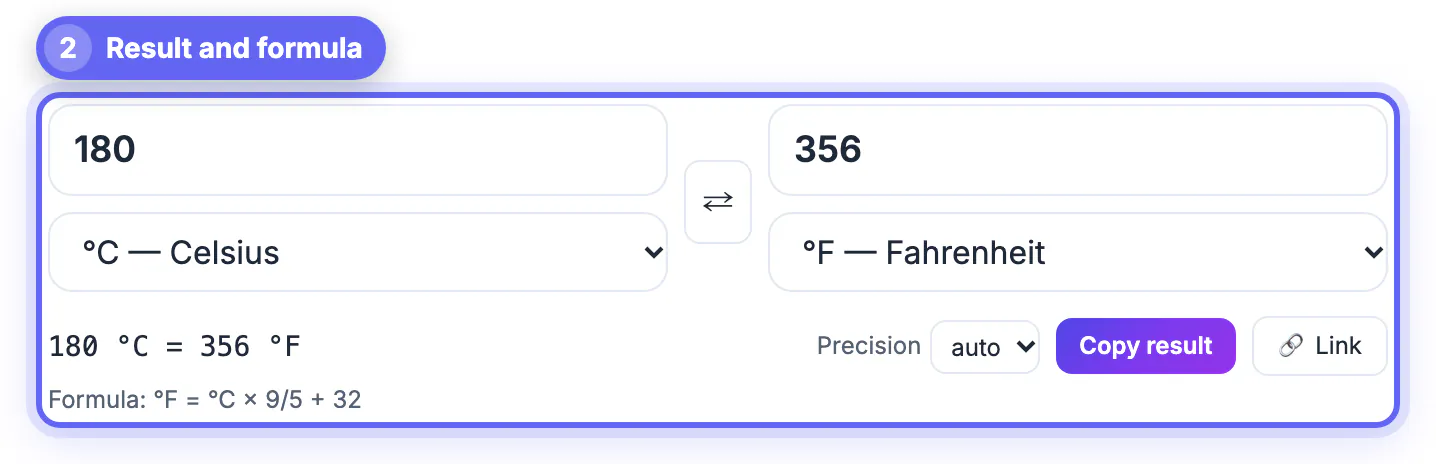
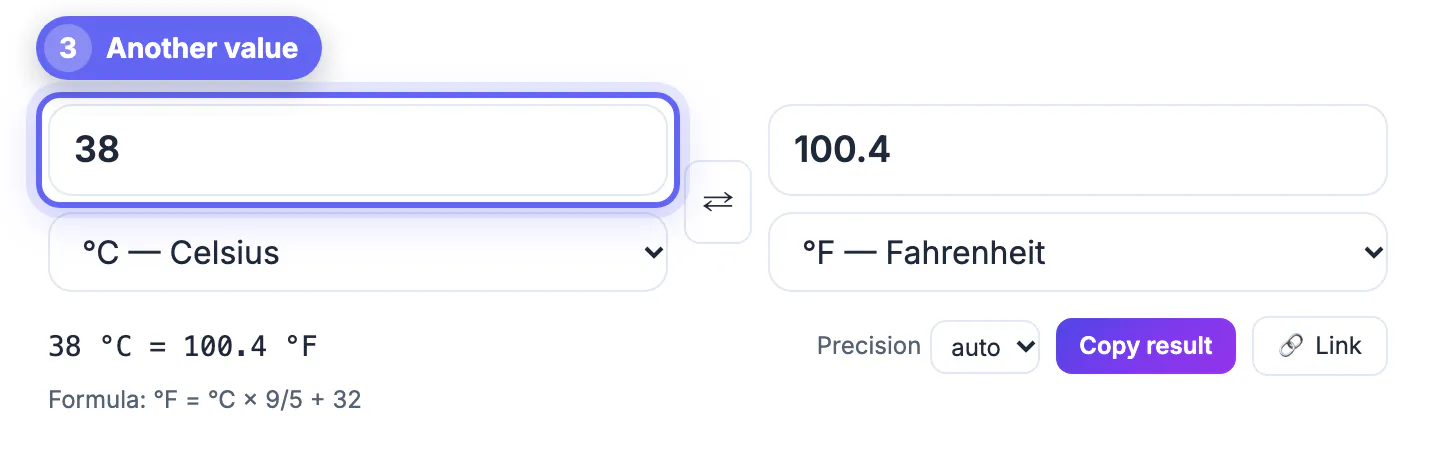
To convert Celsius to Fahrenheit, multiply by 9/5 (that is, 1.8) and then add 32: 180 °C × 1.8 = 324, and 324 + 32 = 356 °F. The same rule turns a thermometer reading of 38 °C into 100.4 °F and a mild 20 °C spring day into 68 °F. Below you will find why the formula has two steps, an oven chart that shows how recipe writers round, fever and weather anchors, where the popular double-and-add-30 shortcut goes wrong, and how GrabCast's free Unit Converter gives exact answers with the formula printed beside them.
📏 Try Unit Converter now — freeOpen →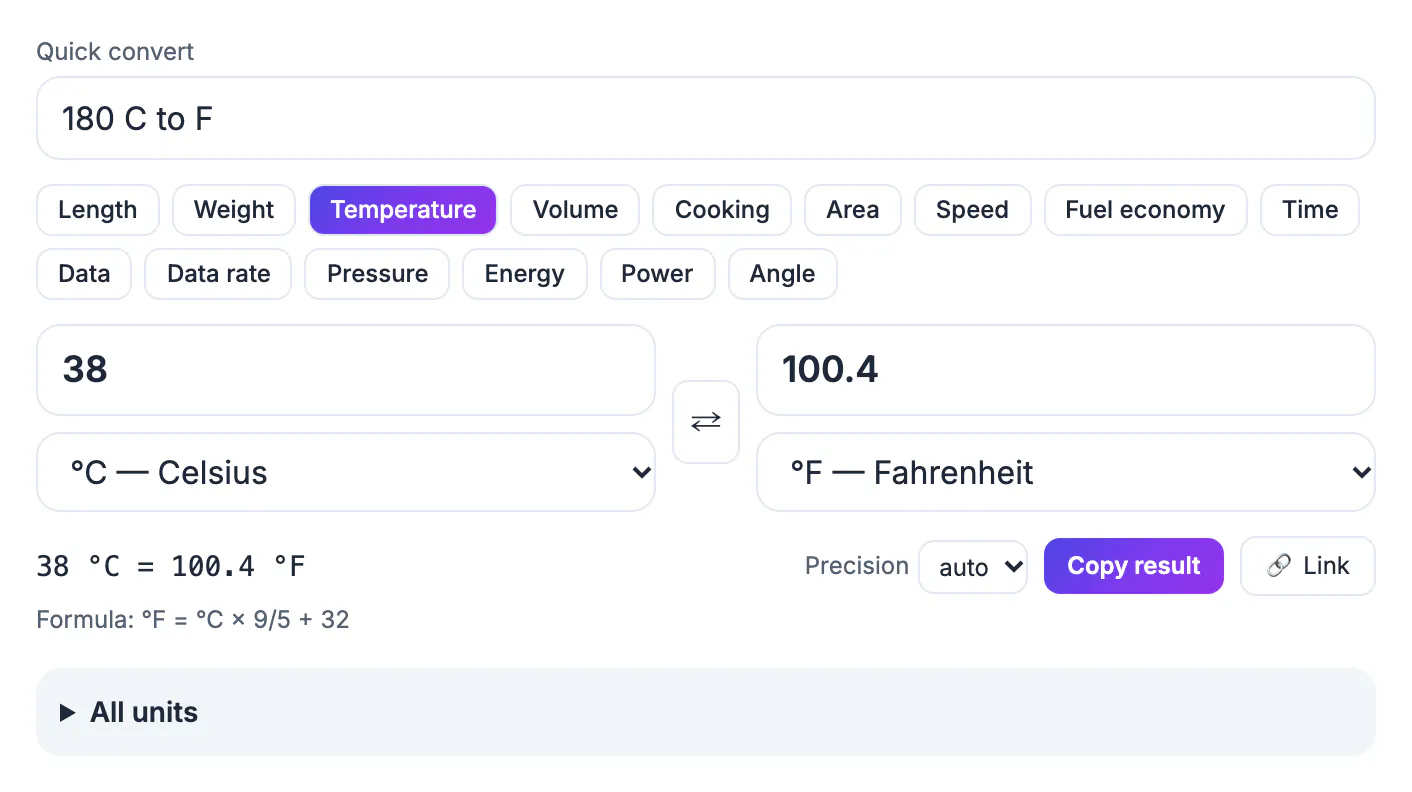
Outdoors, being off by two or three degrees changes nothing: you still pick the same jacket. In an oven or a pan, the tolerance is tighter. A European sponge baked at 180 °C needs a US dial set near 350 °F, not 180 °F, which is only 82 °C and will never set the batter. Food safety uses fixed thresholds too: the USDA's 165 °F for poultry is 73.9 °C, and its 145 °F for whole cuts of beef and pork is 62.8 °C, so metric recipes that say 74 °C and 63 °C are rounding up by a hair. Medicine is the third place where decimals count, because 38.0 °C, the usual fever cutoff, is exactly 100.4 °F. Even appliances labeled in both scales round aggressively; many air fryers print 200 °C beside 400 °F, eight degrees off the exact 392 °F.
Why the Celsius to Fahrenheit formula has two steps
Water freezes at 0 °C and 32 °F and boils, at sea-level pressure, at 100 °C and 212 °F. The 100-degree Celsius span therefore covers 180 Fahrenheit degrees, so each Celsius degree is 180/100 = 9/5 of a Fahrenheit degree. The scales also start at different zeros, which is where the 32 comes from: scale first, then shift.
- 25 °C: 25 × 1.8 = 45, plus 32 = 77 °F, a comfortable room.
- −10 °C: −10 × 1.8 = −18, plus 32 = 14 °F, a hard winter morning.
- 37 °C: 37 × 1.8 = 66.6, plus 32 = 98.6 °F, the classic body-temperature figure.
- 200 °C: 200 × 1.8 = 360, plus 32 = 392 °F, a hot roasting oven.
An equivalent version avoids the odd 32 entirely: add 40, multiply by 1.8, subtract 40. For 180 °C that is 220 × 1.8 = 396, minus 40 = 356 °F. It works because −40 is the one temperature where both scales agree, so shifting to that point and back gives the same result. Going the other way reverses both steps in the opposite order: subtract 32 first, then multiply by 5/9. So 68 °F − 32 = 36, and 36 × 5/9 = 20 °C; 212 °F − 32 = 180, and 180 × 5/9 = 100 °C. Whichever version you use, keep the order. Adding 32 before multiplying turns 20 °C into 93.6 °F instead of 68 °F, an error big enough to cook a roast twice as fast as planned.
Oven temperatures: exact values and recipe rounding
Oven dials in the US step in 25 °F increments, so recipe writers translate metric figures to the nearest friendly number. The exact conversions show how much slack that rounding hides.
- 150 °C = 302 °F, printed as 300 °F; 160 °C = 320 °F, often printed as 325 °F.
- 175 °C = 347 °F and 180 °C = 356 °F, both usually printed as 350 °F.
- 190 °C = 374 °F, printed as 375 °F; 200 °C = 392 °F, printed as 400 °F.
- 220 °C = 428 °F, printed as 425 °F; 230 °C = 446 °F, printed as 450 °F.
Those gaps of 3 to 8 degrees sit inside the swing of a typical home thermostat, so they rarely matter for a casserole. Two cases need more care. Fan or convection instructions are usually quoted about 20 °C lower than conventional ones, and that 20 is a difference, worth 36 °F, not 68 °F. Sugar work is the other: a syrup at 115 °C is 239 °F, and candy stages are only a few degrees wide, so use the exact value and a probe thermometer. British recipes may also give a gas mark; gas mark 4 corresponds to roughly 180 °C or 350 °F, but gas marks are not a unit the converter offers.
Deep frying deserves the same precision. Candy and frying thermometers sold in the US are often marked only in °F, so oil at 170 °C needs 338 °F on the dial and oil at 180 °C needs 356 °F. Frying is less forgiving than baking: oil running 15 degrees cool soaks into the batter and turns it greasy, while oil running hot browns the crust before the middle is cooked through.
Fever, weather and the double-plus-30 shortcut
For forecasts, a quick mental estimate is enough, and many people double the Celsius figure and add 30. That is exact at 10 °C and drifts as you move away from it.
- At 30 °C the shortcut gives 90 °F against an exact 86 °F, four degrees high.
- At −10 °C it gives 10 °F against an exact 14 °F, four degrees low.
- At 180 °C it gives 390 °F against 356 °F, 34 degrees high, so never use it for ovens.
- Weather anchors: 0 °C = 32 °F, 10 °C = 50 °F, 20 °C = 68 °F, 30 °C = 86 °F, 40 °C = 104 °F.
For body temperature, skip shortcuts completely. A European thermometer reading of 38.5 °C is 101.3 °F, 39 °C is 102.2 °F and 40 °C is 104 °F. The famous 98.6 °F is a 19th-century average; several modern studies put typical healthy readings slightly lower, and normal values vary by person, time of day and where the thermometer sits. The conversion itself is exact, but what counts as a fever and when to call a clinician are medical questions for your doctor or local health guidance, not for a calculator.
Convert Celsius to Fahrenheit in GrabCast's Unit Converter
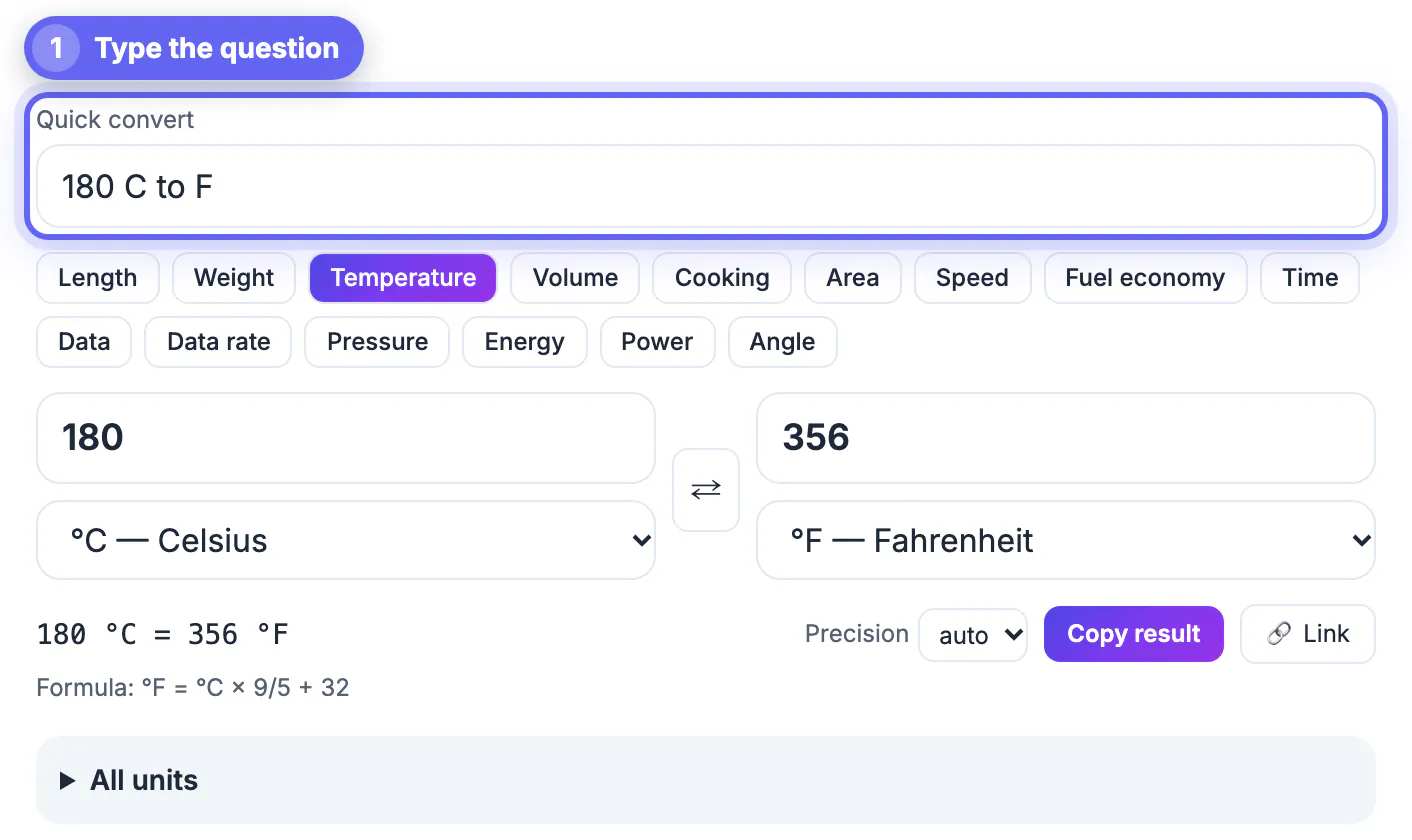
The Temperature tab opens with °C on the left and °F on the right, so the most common case needs one click and one number. You can also type 180 C to F straight into the Quick convert box at the top and the tool switches to Temperature on its own.
- The formula line under the result prints °F = °C × 9/5 + 32, so you can show your working on homework.
- Both boxes are live: type a Fahrenheit value on the right and the Celsius box updates.
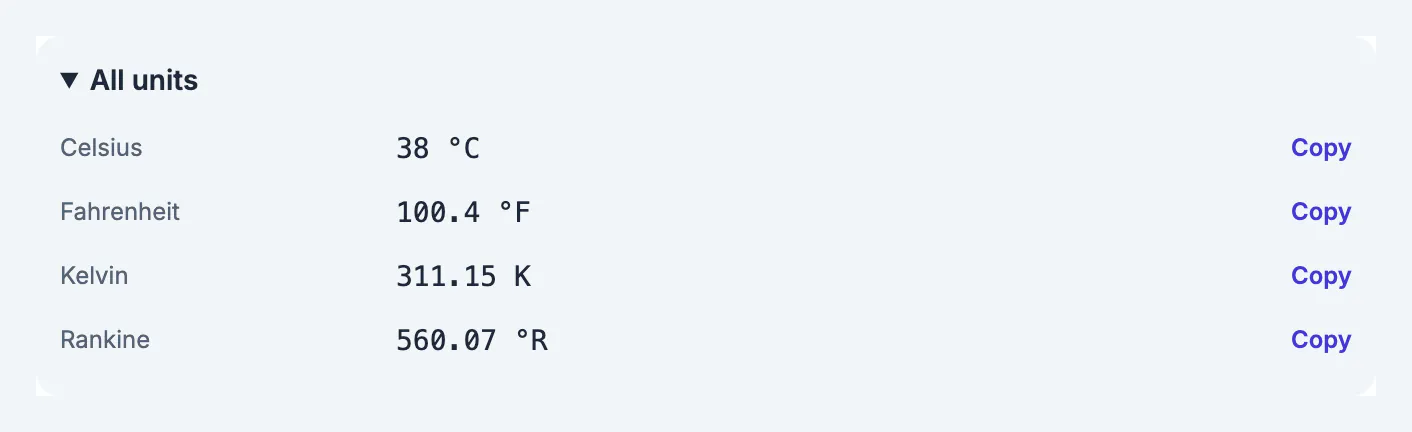
- The All units panel lists Kelvin and Rankine too, each with its own Copy button.
- Precision can stay on auto or be fixed at 2, 4, 6 or 10 decimals for lab notes.
Copy result puts the Fahrenheit figure on your clipboard for a recipe card, and the Link button copies a URL with the category, units and value built in, handy when sending a translated recipe to a relative in the US. The converter is free, needs no sign-up, and the math runs entirely in your browser. The tool converts temperature readings; for a difference, such as turning the oven down by 20 degrees, multiply by 1.8 without adding 32.
Using Celsius abroad? Feet to meters and recipe volumes in mL to fl oz are the next conversions people often need.
Step-by-step
Common mistakes to avoid
Pro tips
Frequently asked questions
What is the Celsius to Fahrenheit formula?
°F = °C × 9/5 + 32. Multiply by 1.8 first, then add 32. For example, 25 °C × 1.8 = 45, and 45 + 32 = 77 °F.
What is 180 °C in Fahrenheit?
Exactly 356 °F. American recipes round it to 350 °F, which is 176.7 °C, and the difference is smaller than most home ovens' own temperature swing, so either setting bakes the same cake.
Is 38 °C a fever in Fahrenheit?
38 °C equals 100.4 °F, the threshold many health agencies use. Whether a reading needs attention depends on age and symptoms, so follow medical advice.
How accurate is double the Celsius and add 30?
It is exact at 10 °C, about four degrees off at 30 °C or −10 °C, and 34 degrees off at 180 °C. Use it for weather only.
How do I convert Fahrenheit back to Celsius?
Subtract 32, then multiply by 5/9 (about 0.5556). 68 °F becomes 36 × 5/9 = 20 °C, and 350 °F becomes 176.7 °C. In the converter, just type in the right-hand °F box and the Celsius side updates.
Multiply by 1.8, then add 32, and keep the decimals where they matter: ovens, candy, meat and fevers. Use the double-plus-30 trick only for forecasts, remember that temperature differences skip the 32, and let the converter's printed formula confirm the arithmetic when accuracy counts, especially for anything you will serve, bake or report to a doctor.
Related guides
Browse more: all calculator guides · Unit Converter