Fahrenheit to Celsius: Formula, Chart and Travel Anchors
To convert Fahrenheit to Celsius, subtract 32 first and then multiply by 5/9: 72 °F − 32 = 40, and 40 × 5/9 = 22.2 °C. That covers a US thermostat, a forecast you are forwarding to friends in Europe, or a lab result reported in American units. This guide explains why the order matters, gives a chart of household, travel and health temperatures, shows how to convert a change of degrees correctly (a different job from converting a reading), and walks through GrabCast's free Unit Converter, which accepts typing on either side.
📏 Try Unit Converter now — freeOpen →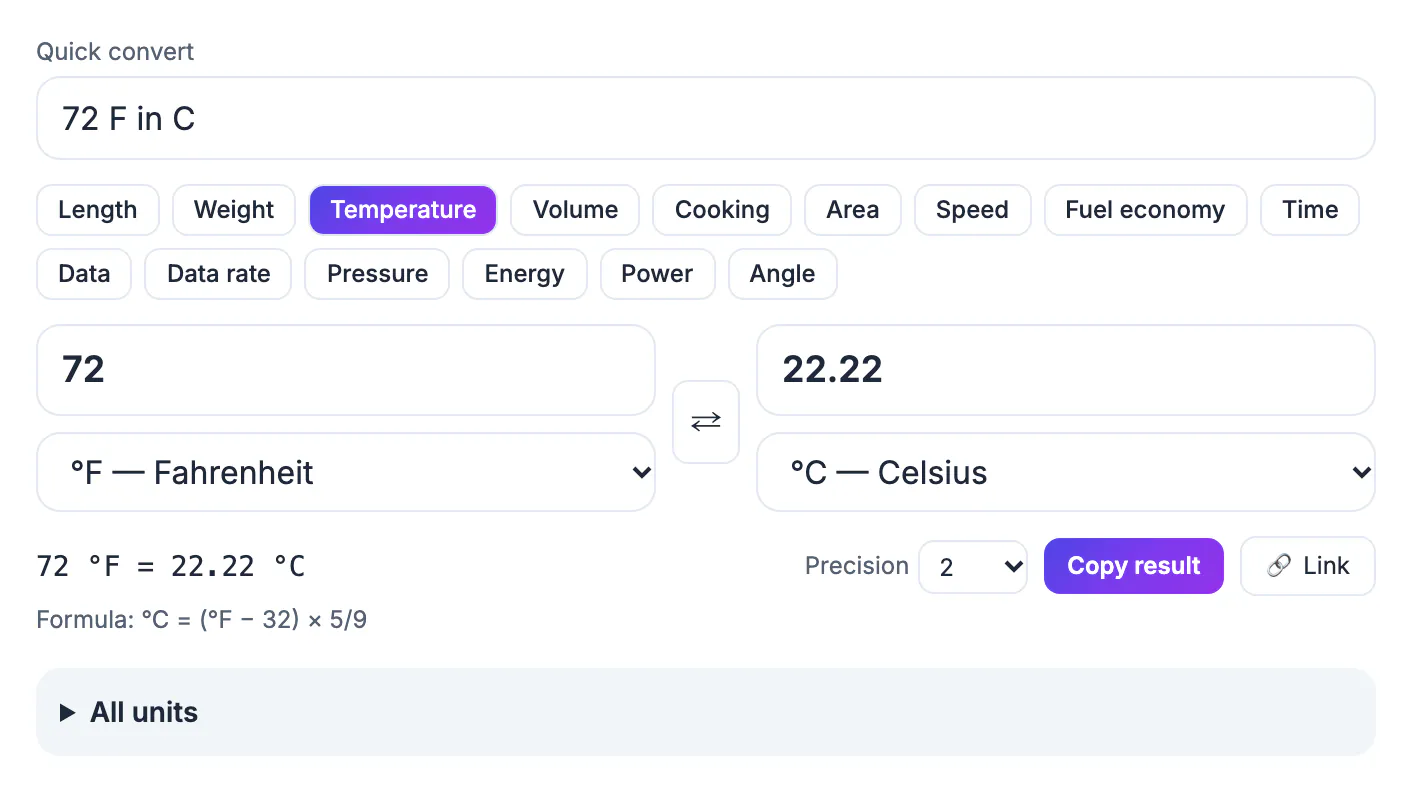
Most of the world reports weather, fridge settings, pool heat and fevers in Celsius, while US appliances, recipes and many engineering datasheets still speak Fahrenheit. A family relocating to Germany has to reset every mental reference: 72 °F feels like home, and the radiator dial says 22. A US researcher submitting to an international journal must restate a 98 °F incubation temperature as 36.7 °C. Travelers packing for a trip meet it too, since a Lisbon forecast of 30 means a hot day, not a chilly one. Getting the direction and the order right avoids errors that are often 20 degrees or more, and it spares you the awkward moment of telling a European colleague that the office is a chilly 72 degrees.
The Fahrenheit to Celsius formula, step by step
The formula is °C = (°F − 32) × 5/9. The 32 is the gap between the two freezing points, so it has to come off before the scale factor is applied; 5/9, about 0.5556, is the ratio of degree sizes, because 100 Celsius degrees span the same range as 180 Fahrenheit degrees.
- 72 °F: 72 − 32 = 40, then 40 × 5/9 = 22.22 °C.
- 14 °F: 14 − 32 = −18, then −18 × 5/9 = −10 °C.
- 0 °F: 0 − 32 = −32, then −32 × 5/9 = −17.78 °C, colder than water's freezing point.
- 350 °F: 350 − 32 = 318, then 318 × 5/9 = 176.67 °C, a standard baking heat.
Doing the steps in the wrong order is the classic slip. Multiplying 72 by 5/9 first and then subtracting 32 yields 8 °C, a number that would have you packing a coat for a mild day. If subtracting 32 feels awkward, an equivalent route is to add 40, multiply by 5/9 and subtract 40; for 72 °F that is 112 × 5/9 = 62.22, minus 40 = 22.22 °C. Results below freezing simply come out negative, and there is nothing special to do with the sign.
Match the precision of the source when you restate a value. A thermostat set to 72 °F carries two significant figures, so 22 °C is honest, while an incubator logged at 98.6 °F should be reported as 37.0 °C rather than 37.00 °C. Adding decimals the original instrument never measured implies an accuracy that does not exist, which reviewers and teachers both notice.
Reference chart for home, travel and health
These pairs cover the Fahrenheit numbers most people meet in a week, rounded to one decimal.
- Home: thermostat 68 °F = 20 °C, 72 °F = 22.2 °C, 78 °F = 25.6 °C; fridge at 40 °F = 4.4 °C, freezer at 0 °F = −17.8 °C.
- Weather: 32 °F = 0 °C, 50 °F = 10 °C, 90 °F = 32.2 °C, 100 °F = 37.8 °C, 104 °F = 40 °C.
- Water: pool at 80 °F = 26.7 °C; hot tubs top out at 104 °F = 40 °C under US safety guidance.
- Health: 98.6 °F = 37 °C, 100.4 °F = 38 °C, 102 °F = 38.9 °C, 103 °F = 39.4 °C.
The fridge and freezer lines are worth taping inside a kitchen cupboard if you move abroad. US food-safety advice asks for a refrigerator at or below 40 °F and a freezer at 0 °F, which appliances sold in Europe label as roughly 4 °C and −18 °C. A European fridge set to 5 °C is running at 41 °F, a hair above the US target, so a notch colder is sensible. For fever readings, keep the decimal: 101 °F is 38.3 °C, and doctors in Celsius countries read that tenth of a degree.
Travel packing is the other everyday use. A week of Paris forecasts reading 59 to 77 °F means 15 to 25 °C, light-jacket weather, while a Phoenix high of 110 °F is 43.3 °C, dangerous heat by any standard. Hotel and rental-car thermostats abroad often step in half degrees, and each half degree Celsius is 0.9 °F, so nudging a room from 21 to 22 °C is like moving a US dial from about 70 to 72 °F.
Planning a trip? You might also need liters to gallons for fuel and miles to kilometers for road signs.
Converting a change in degrees, not a reading
A temperature change needs a different rule. When a forecast says tomorrow will be 20 degrees Fahrenheit colder, that is a gap between two readings, and the 32-degree offset cancels out. Only the 5/9 scale applies.
- A drop of 20 °F is a drop of 20 × 5/9 = 11.1 Celsius degrees, not −6.7.
- An oven running 25 °F hot is running 13.9 Celsius degrees hot.
- A 9 °F rise in a lab log equals a 5 °C rise, which is also exactly 5 kelvins.
- Climate targets work the other way: 1.5 °C of warming is 2.7 °F of warming.
Mental estimation follows the same idea. Subtracting 30 and halving is a popular trick; it is exact at 50 °F, reads low above that (90 °F gives 30 °C against a true 32.2 °C, 350 °F gives 160 °C against 176.7 °C) and reads high below it (0 °F gives −15 °C against −17.8 °C). It is fine for deciding on a sweater and not fine for baking or dosing. For anything measured, use the exact formula or the converter.
Fahrenheit to Celsius with GrabCast's Unit Converter
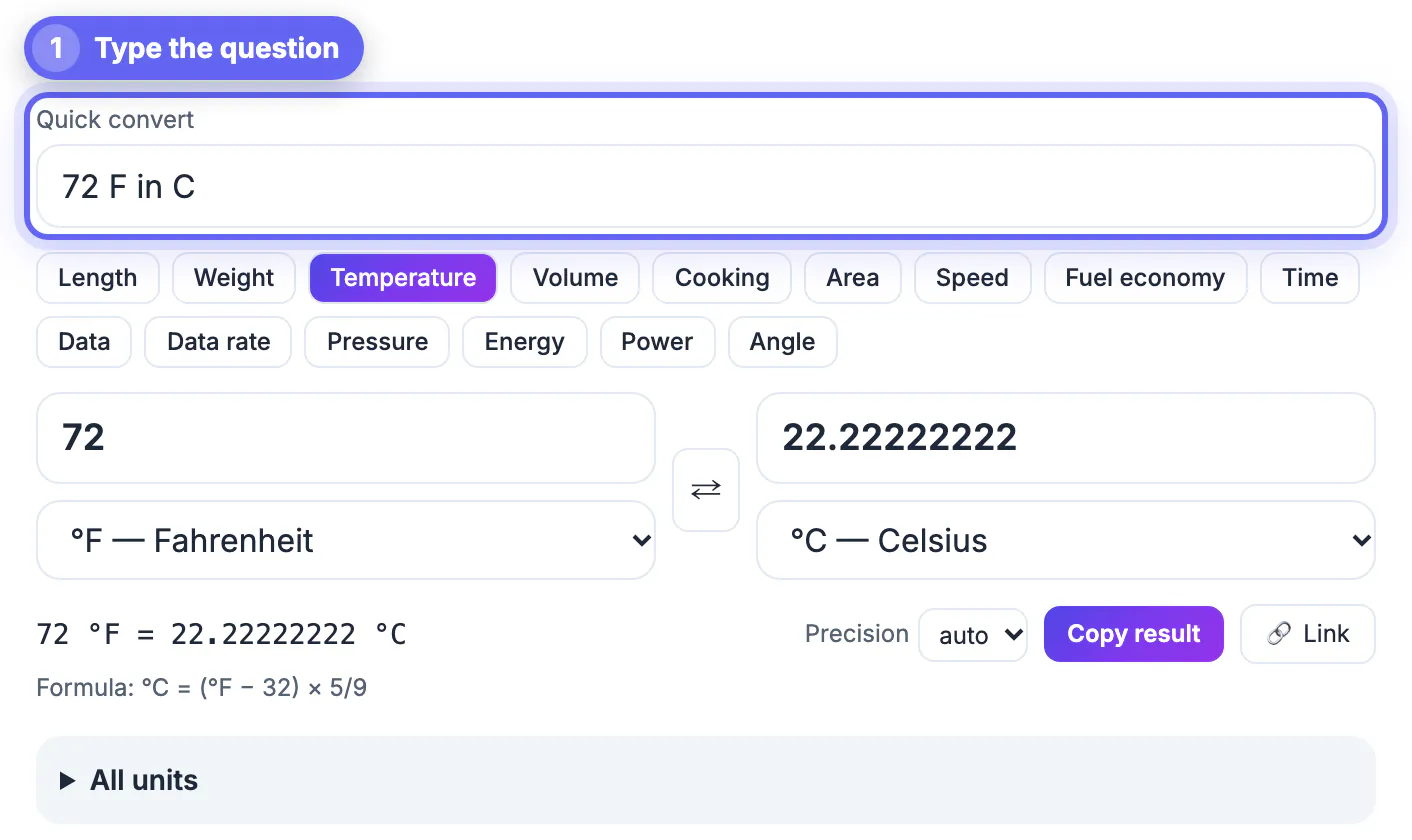
The quickest route is the Quick convert box: type 72 F in C, or 350 F to C, and the Temperature tab opens with both units chosen and the answer filled in. From there you can keep editing the number.
- Two-way boxes: the Temperature tab starts with °C on the left, so you can simply type Fahrenheit into the right-hand box.
- The swap button flips °F to the left if you prefer reading left to right.
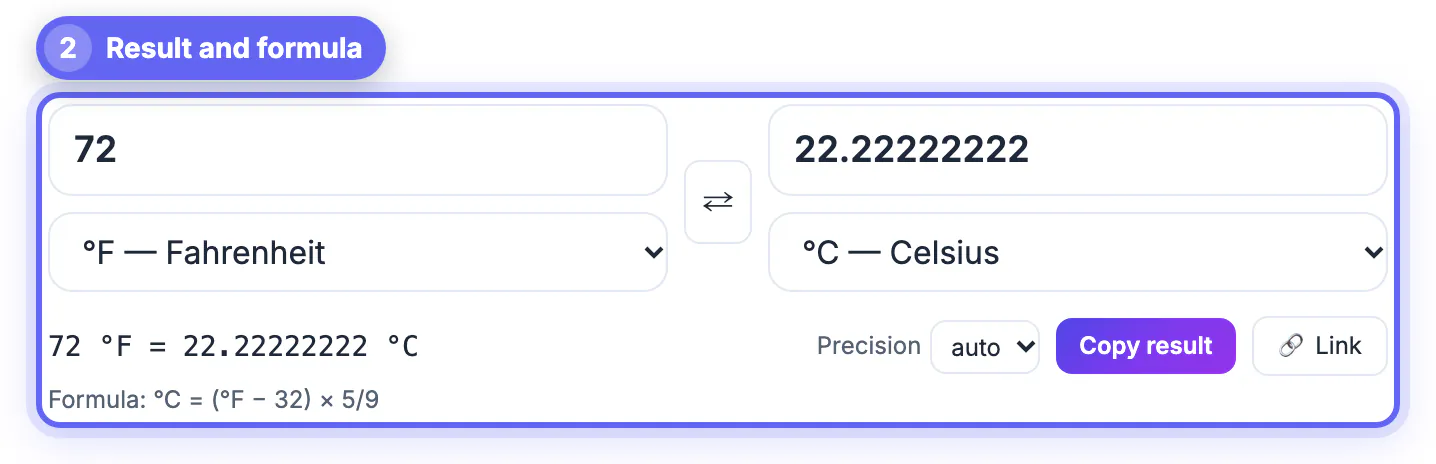
- The formula line shows °C = (°F − 32) × 5/9 for this pair, matching the math above.
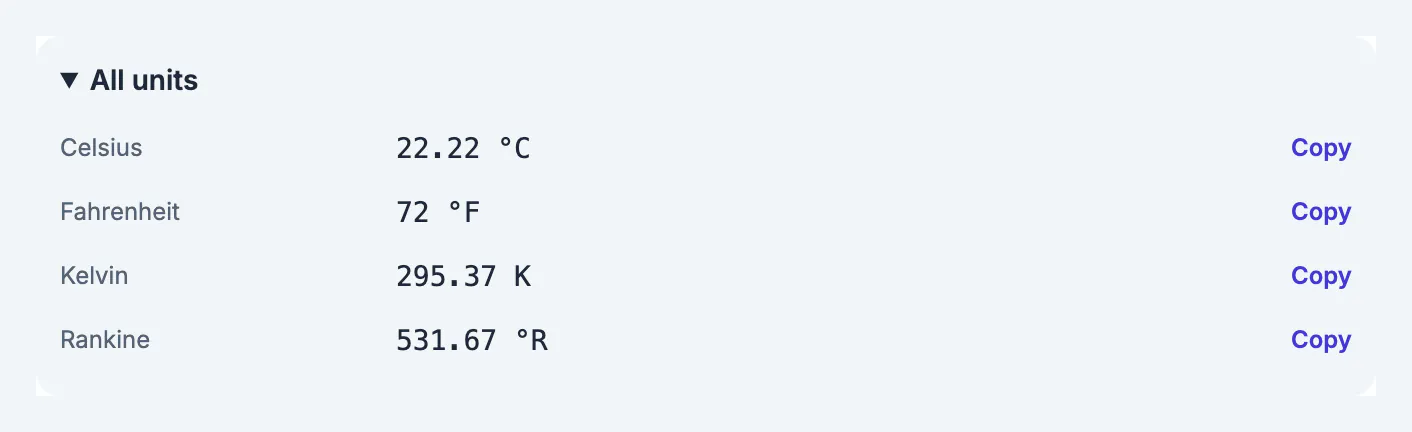
- All units lists Kelvin and Rankine as well, each with a Copy button.
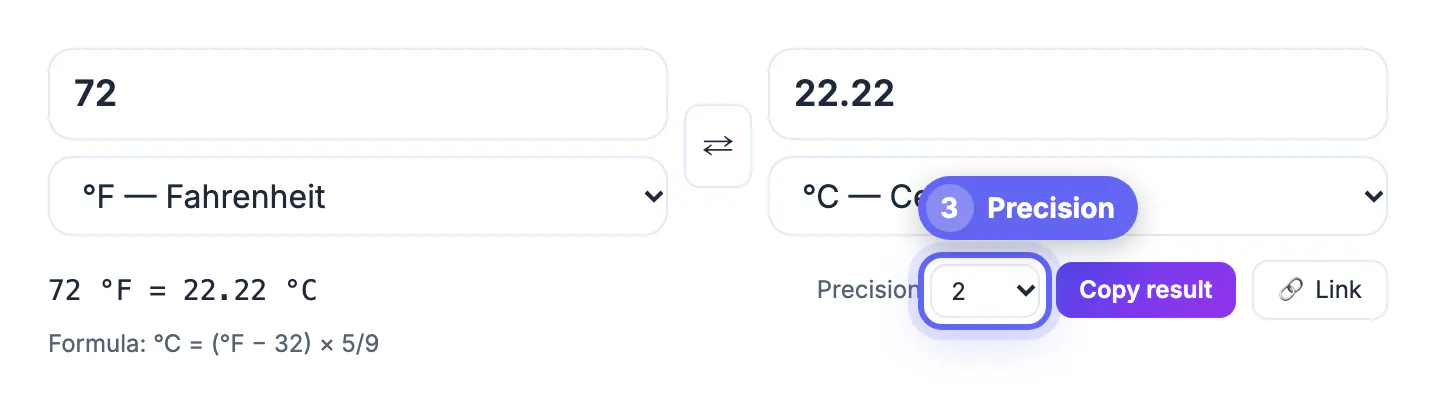
Precision defaults to auto, which trims trailing zeros, so 68 °F shows a clean 20 while 72 °F shows 22.22222222. Set Precision to 2 for a tidy 22.22 before pressing Copy result. The Link button copies a URL that reopens the same numbers, useful for a shared trip itinerary. Calculations never leave the browser tab. As explained above, the tool converts readings; for a change in degrees, multiply by 5/9 yourself.
Students can use the printed formula as a homework check: enter the given value, compare the tool's figure with the answer worked by hand, and if they disagree look for the usual culprits, subtracting after multiplying or a dropped minus sign. Engineers restating a column of datasheet values will find the All units panel faster than retyping, because each row copies a clean figure without thousands separators.
Step-by-step
Common mistakes to avoid
Pro tips
Frequently asked questions
What is the Fahrenheit to Celsius formula?
°C = (°F − 32) × 5/9. Subtract 32 first, then multiply by 5 and divide by 9. For 50 °F that gives 18 × 5/9 = 10 °C.
What is 100 °F in Celsius?
37.78 °C. That is a hot summer day outdoors and, as a body temperature, slightly below the common 38 °C fever threshold of 100.4 °F.
Why must I subtract 32 before multiplying?
The 32 is an offset between the freezing points of the two scales, so it has to be removed before the 5/9 ratio of degree sizes is applied.
How do I convert a temperature change?
Multiply the Fahrenheit difference by 5/9 and do not subtract 32. A 10 °F warm-up is 5.6 Celsius degrees, and a 30 °F overnight drop is 16.7 Celsius degrees.
Can the converter go from Celsius back to Fahrenheit?
Yes. Both boxes accept typing, so enter a Celsius value on the left or a Fahrenheit value on the right, or press swap.
Subtract 32, then multiply by 5/9, in that order, and keep one decimal for anything medical or culinary. Treat temperature changes separately with 5/9 alone, lean on a few memorized anchors for forecasts, and use the two-way converter whenever the number actually has to be right, whether that is a fridge setting, a lab log or a child's thermometer reading.
Related guides
Browse more: all calculator guides · Unit Converter