Free BMI Calculator: Metric and Imperial Formulas
BMI, or body mass index, is your weight in kilograms divided by your height in meters squared; in US units it is pounds divided by inches squared, times 703. Someone 5 feet 9 inches tall who weighs 160 pounds has a BMI of about 23.6, inside the 18.5 to 24.9 range considered healthy for adults. This guide shows how to calculate BMI by hand in both unit systems, how to read the adult categories and find the weight range that matches your height, and where the number misleads, including muscular builds, older adults and children. The free GrabCast BMI Calculator does the math in your browser in US or metric units, shows your category and healthy weight range, and never sends your height or weight to a server.
⚖️ Try BMI Calculator now — freeOpen →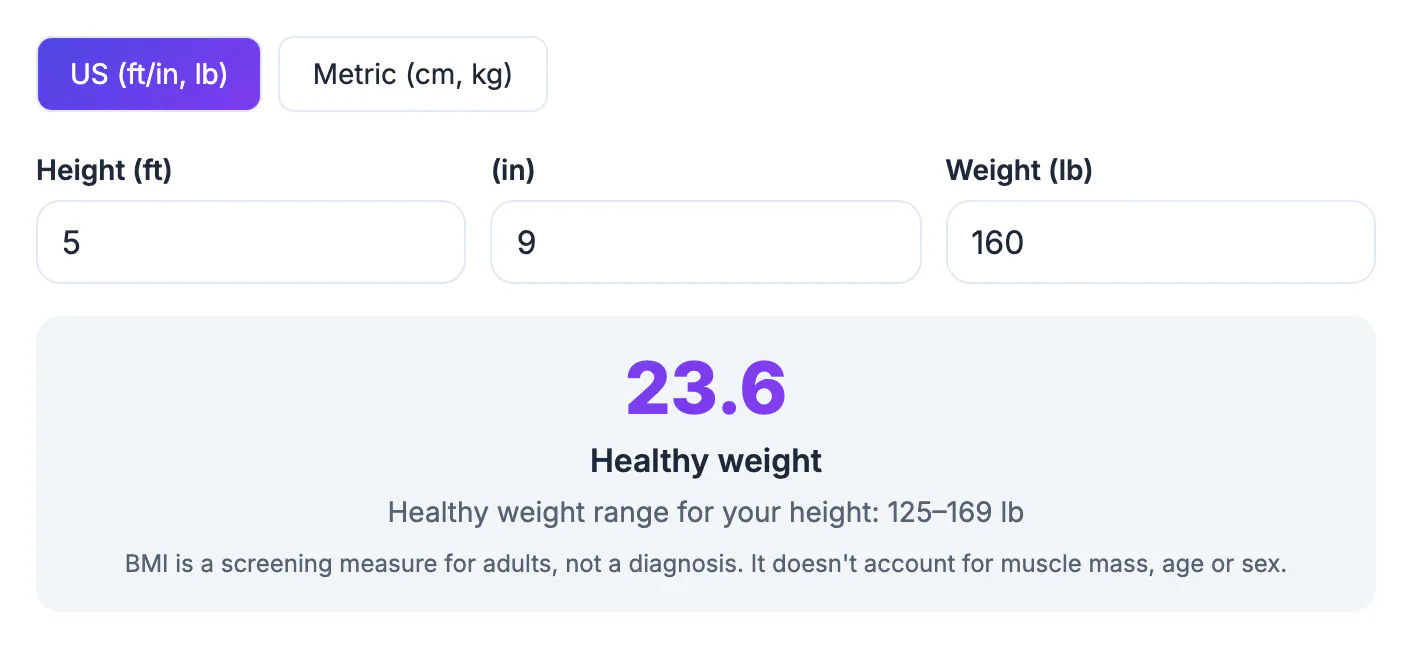
BMI is popular with doctors and public-health agencies because it needs only two measurements and correlates reasonably well with body fat across large groups of people. That makes it a useful first screen: a reading well outside the typical range is a reason to look closer, and tracking it over months can show a trend. It is not a diagnosis. BMI cannot tell muscle from fat, does not show where fat is stored, and uses the same cutoffs for everyone regardless of age, sex or ethnicity. Treat it as one data point alongside waist size, blood pressure, blood tests, activity and how you feel, and discuss any concerns with a clinician rather than acting on the number alone. Knowing the formula yourself also lets you check any app or clinic figure and see how a change in weight would move your number. For children and teens, pediatricians use growth-chart percentiles instead, since healthy body composition changes quickly with age. Pregnancy is another case where the standard adult categories do not apply.
How to calculate BMI in metric units
The metric formula is BMI = kg / m². Convert centimeters to meters first by dividing by 100.
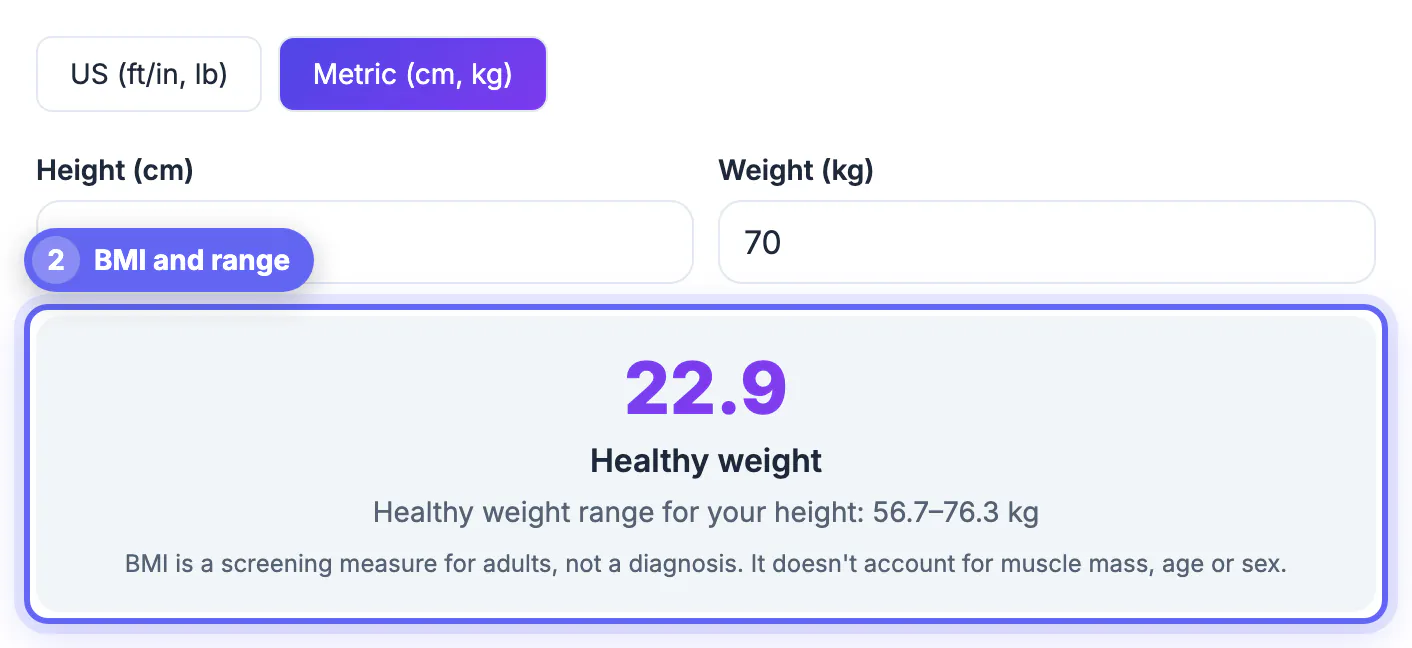
- 70 kg at 175 cm: 1.75 x 1.75 = 3.0625, and 70 / 3.0625 = 22.9.
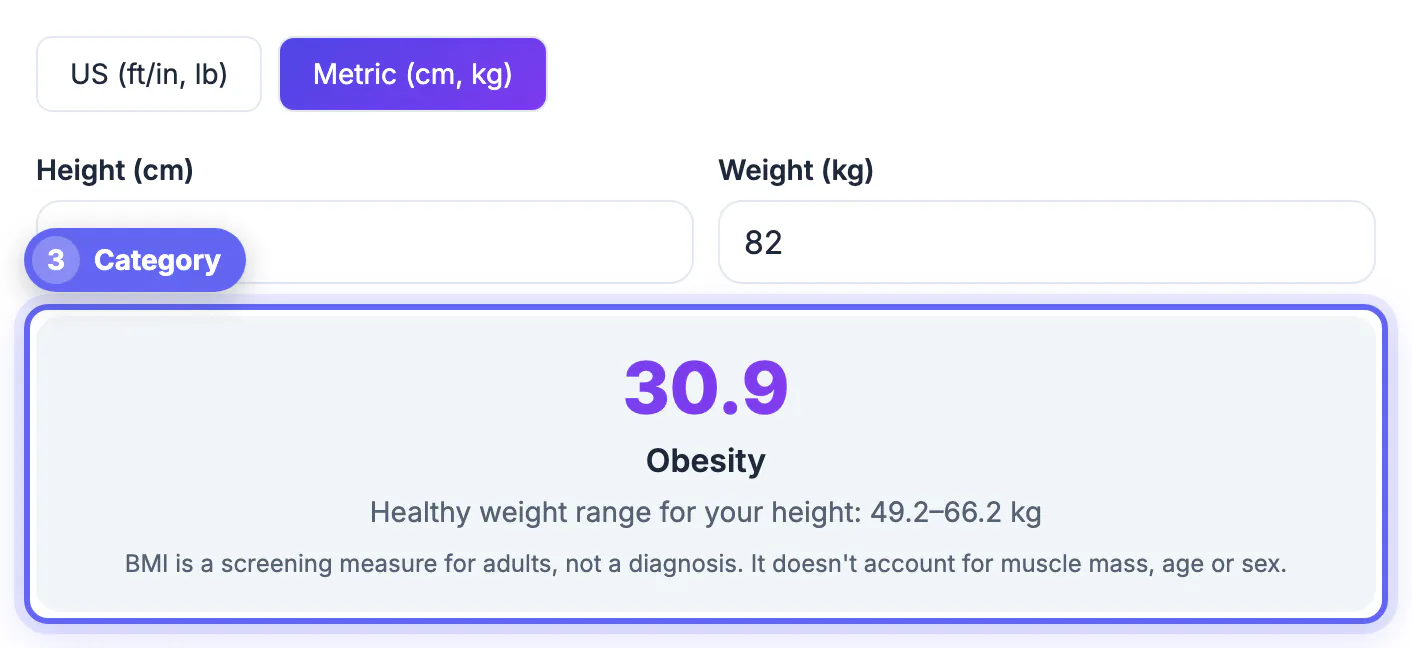
- 82 kg at 163 cm: 1.63 x 1.63 = 2.6569, and 82 / 2.6569 = 30.9.
- 58 kg at 168 cm: 1.68 x 1.68 = 2.8224, and 58 / 2.8224 = 20.5.
- In the BMI Calculator, tap Metric (cm, kg), enter height in centimeters and weight in kilograms, and the result appears instantly.
Keep all the decimal places until the end. Rounding 1.63 m to 1.6 m in the second example would change the BMI from 30.9 to 32.0, a jump across a category boundary.
How to calculate BMI in imperial (US) units
The imperial formula is BMI = lb / in² x 703. Convert your height to total inches first: 5 feet 9 inches is 69 inches.
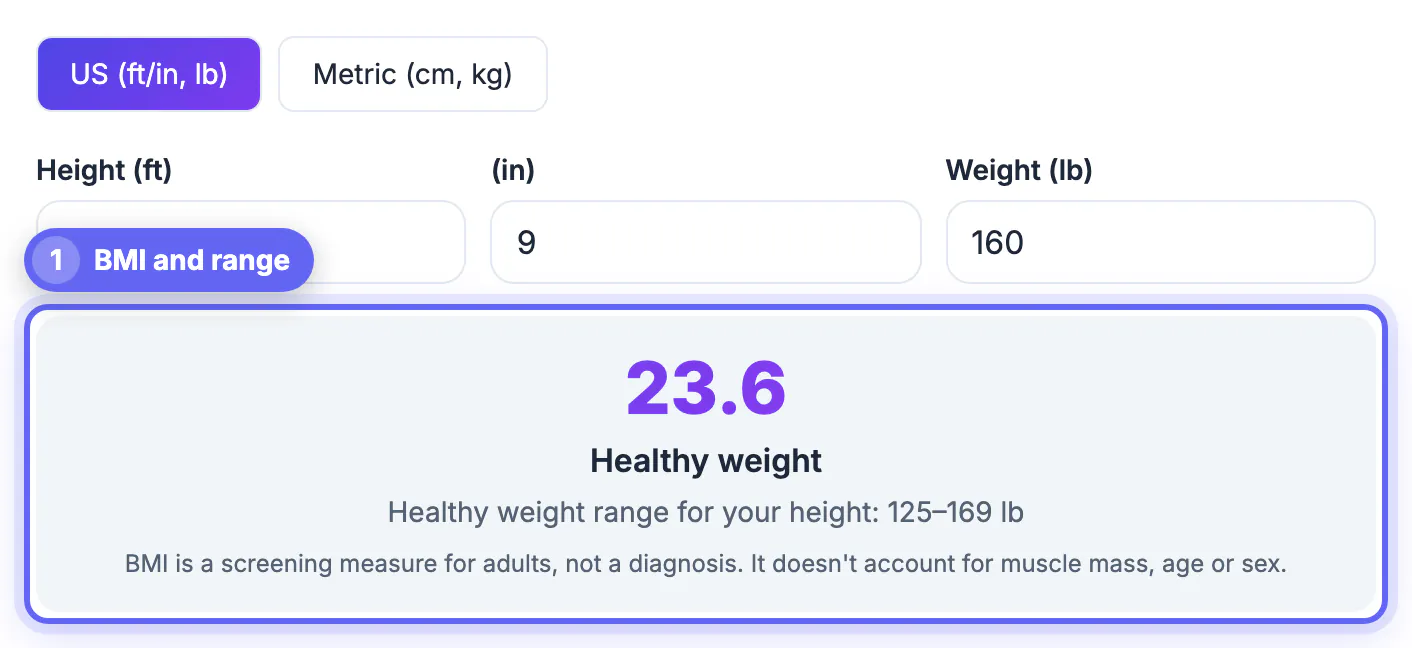
- 160 lb at 5 ft 9 in: 69 x 69 = 4,761, and 160 / 4,761 x 703 = 23.6.
- 180 lb at 5 ft 4 in (64 in): 64 x 64 = 4,096, and 180 / 4,096 x 703 = 30.9. That is the same person as the 82 kg, 163 cm example, rounded.
- The 703 factor converts pounds per square inch into kilograms per square meter, so both systems give the same BMI.
- The calculator's US mode takes feet, inches and pounds directly and converts them for you, which avoids the most common slip.
If you only know your height in centimeters but prefer pounds, convert one measurement so both are in the same system: 1 inch is exactly 2.54 cm, and 1 kg is about 2.2046 lb.
Adult BMI categories and your healthy weight range
For adults 20 and older, the standard categories used by the CDC and the World Health Organization are:
- Under 18.5: underweight.
- 18.5 to 24.9: healthy weight.
- 25 to 29.9: overweight.
- 30 and above: obesity, sometimes split into classes starting at 30, 35 and 40.
To find the weight range that matches your height, reverse the formula. At 5 ft 9 in, 18.5 x 4,761 / 703 is about 125 lb and 24.9 x 4,761 / 703 is about 169 lb, so roughly 125 to 169 pounds. At 175 cm, the range is about 57 to 76 kg. The GrabCast calculator shows this range under your result.
Numbers close to a boundary deserve extra caution. A BMI of 25.1 and one of 24.8 describe nearly identical bodies, so look at the trend and other measures rather than the label alone.
What BMI cannot tell you
BMI is a screening number with known blind spots, which is why clinicians pair it with other measures.
- Muscle vs fat: a muscular athlete at 5 ft 10 in and 200 lb reads about 28.7, overweight, while carrying little fat.
- Fat location: fat around the waist carries more health risk. A waist over about 40 inches for men or 35 inches for women is a common warning sign in US guidance.
- Age, sex and ethnicity: older adults lose muscle, women carry more fat at the same BMI, and some health bodies use lower cutoffs for people of Asian descent.
- Children and teens: adult categories do not apply. Under 20, BMI is judged with age- and sex-specific percentiles, so ask a pediatrician.
None of this makes BMI useless. It is a quick, repeatable screen that costs nothing, and paired with a waist measurement and a regular checkup it gives a reasonable first picture.
For a fuller picture, try the Calorie Calculator and the Body Fat Calculator, which look at different measures than height and weight alone.
Step-by-step
Common mistakes to avoid
Pro tips
Frequently asked questions
How do I calculate my BMI by hand?
Divide weight in kilograms by height in meters squared. In US units, divide pounds by inches squared and multiply by 703. For 160 pounds at 5 feet 9 inches, 160 / 4,761 x 703 is about 23.6. In metric, 70 kilograms at 1.75 meters gives 70 / 3.0625, which is about 22.9.
What is a healthy BMI for adults?
For most adults, 18.5 to 24.9 is considered healthy. Under 18.5 is underweight, 25 to 29.9 is overweight and 30 or above is in the obesity range. The calculator also shows the weight range in pounds or kilograms that corresponds to 18.5 to 24.9 for your height.
Why do my metric and imperial BMI results differ slightly?
Usually rounding during conversion. One inch is exactly 2.54 cm and one kilogram is about 2.2046 pounds; rounding either one can shift the result by a tenth or two.
Is BMI accurate for athletes and older adults?
Not always. It cannot separate muscle from fat, so muscular people can read overweight, and older adults with less muscle can read healthy while carrying more fat. Use it as a screen, not a verdict. A waist measurement, blood pressure and blood tests fill in much of what BMI misses.
Does the GrabCast BMI Calculator store my height and weight?
No. BMI is calculated in your browser and your measurements are never sent to a server. Only your unit preference, US or metric, is saved in your own browser so it opens the same way next time. It picks US units by default for US English browsers and remembers your choice after that.
BMI is weight divided by height squared: kilograms over meters squared, or pounds over inches squared times 703. Adults read 18.5 to 24.9 as healthy, and reversing the formula gives your healthy weight range. Remember its blind spots, including muscle, waist fat, age, ethnicity and children, and use the free GrabCast BMI Calculator in US or metric units as a quick private screen, not a diagnosis.
Related guides
Browse more: all calculator guides · BMI Calculator