Percent of a Number: X% of Y and X Is What % of Y
To find a percent of a number, turn the percent into a decimal and multiply: 18% of 240 is 0.18 times 240, or 43.2. To find what percent one value is of another, divide and multiply by 100: 45 out of 60 is 75%. Those two formulas cover nearly every shopping, grading, tipping and commission question. This guide walks through both with real figures, shows mental shortcuts for checking results, and explains what the free GrabCast Percentage Calculator does in each case.
% Try Percentage Calculator now — freeOpen →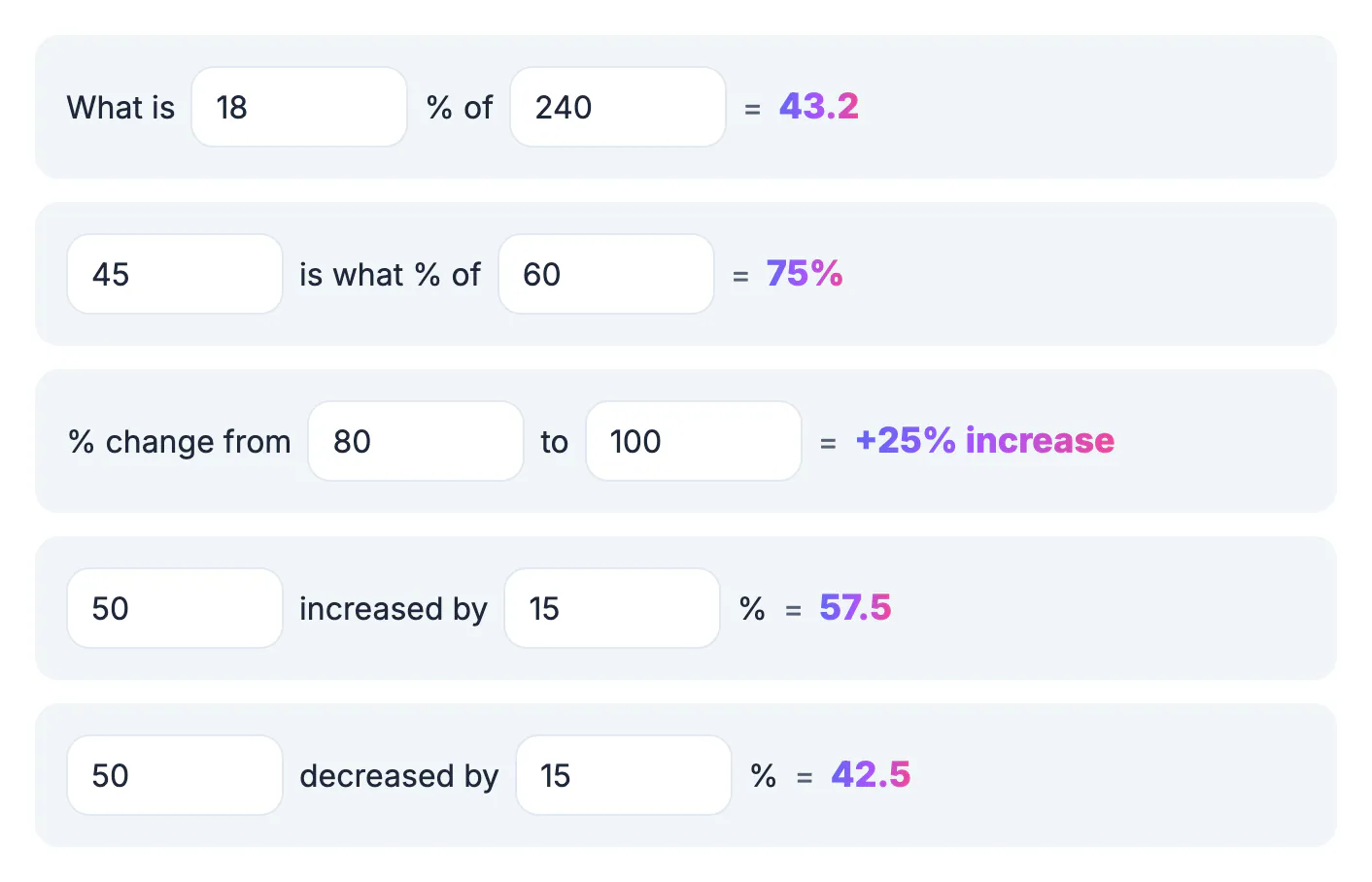
Every percent question has a whole, the value that follows the word of. Get that base wrong and the answer can be off by a factor of four: 30 is 25 percent of 120, while 120 is 400 percent of 30. Before touching a calculator, name the whole in plain words, such as the pre-tax price, the total questions on a test or the full savings goal. Then decide whether you already know the percent and want an amount, or know both amounts and want the percent. Those two cases need opposite operations. A short habit fixes it: underline the word of and circle the value next to it. That circled value is always the whole, so it goes on the bottom of a division or into the multiplication as the base. Once the base is clear, the arithmetic is one line either way, and the only remaining risk is a misplaced decimal point, which a rough mental estimate catches almost every time.
Formula 1: finding X percent of Y
Move the decimal point two places left, then multiply by the whole. That single step handles taxes, deposits and commissions.
- 7.25% sales tax on $86.40 = 0.0725 x 86.40 = $6.26
- 20% down payment on a $32,500 car = $6,500
- 6% commission on a $410,000 home sale = $24,600
- 12.5% of a 64 GB phone = 8 GB
To get a total that includes the percentage, multiply by one plus the rate: $86.40 x 1.0725 = $92.66 with tax. For a discount, multiply by one minus the rate, so 30% off $59.99 is $59.99 x 0.70 = $41.99.
Tips follow the same pattern. For 18% on a $64 dinner, multiply 0.18 by 64 to get $11.52; at 20% the tip is $12.80. Whether you tip on the pre-tax or after-tax total is a personal choice, but pick one and stick with it. Payroll deductions, retirement contributions and cash-back rewards are all the same multiplication with a different rate.
Discount stacking is the classic place this goes wrong. A 20% sale followed by an extra 10% at checkout is not 30% off: multiply 0.80 by 0.90 to get 0.72, so the true discount is 28%. On a $150 jacket that is $108, not $105.
Formula 2: what percent X is of Y
Divide the part by the whole, then multiply by 100. The result can exceed 100 when the part is bigger than the base.
- 45 correct out of 60 questions = 75%
- 38 of 52 = 73.08%
- $1,150 saved toward a $4,000 goal = 28.75%
- 2,340 opens from 18,000 emails sent = 13%
- 150 sign-ups against a target of 120 = 125%
When grades or ratios matter, keep two decimals until the end. Rounding 38 of 52 to 73% before averaging several tests can shift a final grade across a letter boundary.
This formula also turns raw counts into fair comparisons. A rep who closed 14 of 40 leads converted 35%, while one who closed 21 of 75 converted 28%, so the smaller count is actually the stronger result. Budgets work the same way: $1,650 rent out of $5,200 monthly take-home pay is 31.73% for housing.
Grades are the most common use. With 17 of 20 on a quiz, 42 of 50 on a test and 88 of 100 on a final, the individual scores are 85%, 84% and 88%, and a weighted grade applies the course weights to those percentages rather than to the raw points.
Mental shortcuts that catch typos
A rough answer in your head is the fastest way to spot a slipped decimal on any device.
- 10% moves the decimal one place left: 10% of 86.40 is 8.64
- 5% is half of 10%, and 15% is the two added together
- 1% moves the decimal two places left, handy for 3% or 7% tax
- Percents swap: 8% of 25 equals 25% of 8, which is 2
- 25% is a quarter and 50% is a half, good anchors for estimates
If your careful answer and the rough one disagree by more than a little, re-read which value is the base before anything else.
Percentage points are a related trap. If a savings rate rises from 4% to 5%, that is one percentage point but a 25% increase in the rate itself. Headlines and loan offers mix the two, so check which one is quoted before comparing offers.
What the GrabCast Percentage Calculator covers
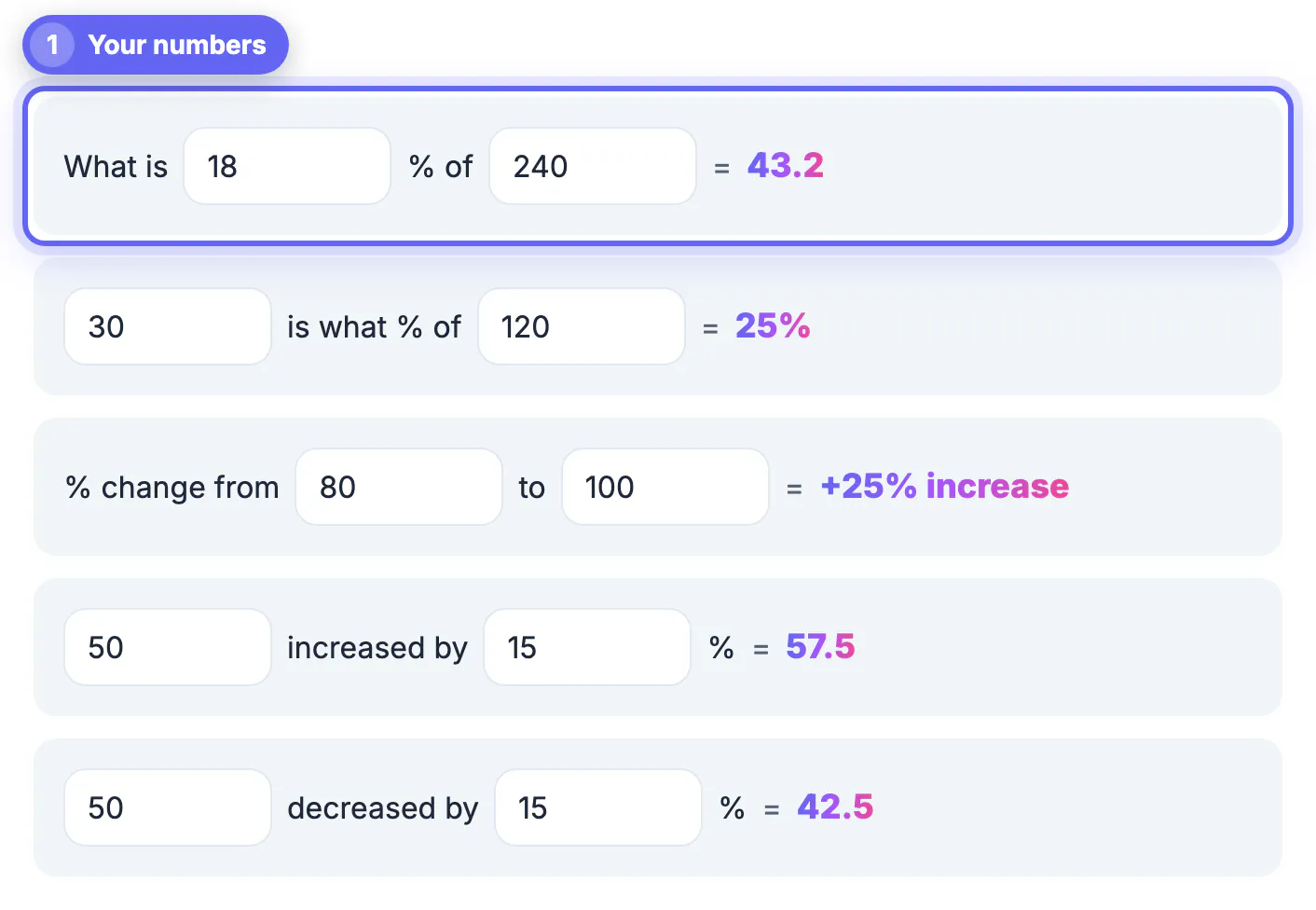
The calculator shows five sentences with editable fields, and each one solves itself as you type.
- What is A% of B, which is formula 1
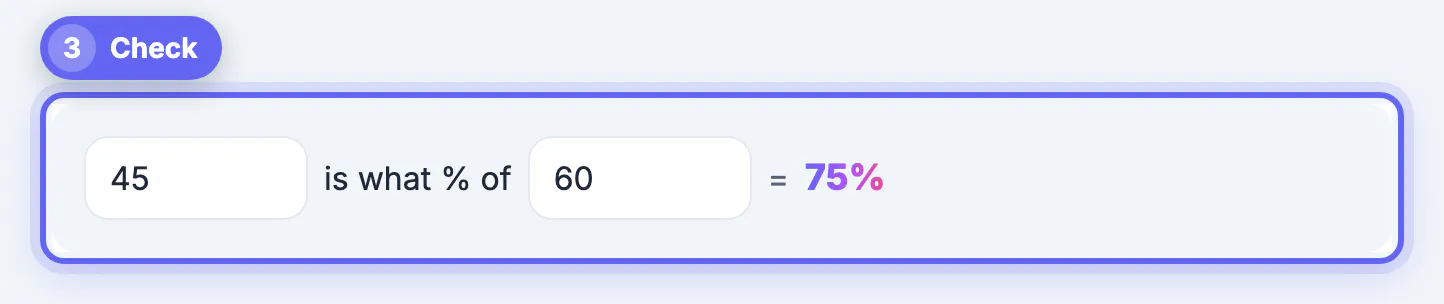
- A is what % of B, which is formula 2
- Percent change from A to B, labeled as an increase or decrease
- A increased by B% and A decreased by B%
- Answers are rounded to four decimal places, and a dash appears when a division by zero would occur
It does not solve reverse questions such as the original price before a 20% discount; divide the sale price by 0.80 for that. It also leaves money unrounded, so round to cents yourself. Everything runs inside the browser tab.
Because each row updates as you type, the calculator is handy for side-by-side comparisons: change only the rate in the first row to see 15, 18 and 20% tips in turn, or change only the total in the second row to watch a score shift as more questions are added. Nothing needs to be submitted or reset between tries.
The same arithmetic powers how to calculate a tip, where the shortcut is simply 10 percent plus half of it.
Step-by-step

Common mistakes to avoid
Pro tips
Frequently asked questions
What is 20 percent of 50?
Multiply 0.20 by 50 to get 10. A quick check: 10 percent of 50 is 5, and doubling gives 10. For 20 percent of any amount, you can also take 10 percent and double it.
How do I work out what percent a score is?
Divide the points earned by the points possible and multiply by 100. A score of 43 out of 50 is 0.86 times 100, or 86 percent. Keep two decimals if the result feeds a weighted average. For a class that weights tests differently, calculate each percentage first, then apply the weights.
Is percent of the same as percent off?
No. Twenty percent of $80 is $16, the discount amount. Twenty percent off $80 is the price you pay, $64. To get the sale price directly, multiply $80 by 0.80.
How do I find the original value from a percent?
Divide the known amount by the rate as a decimal. If $12 is 15 percent of a bill, the bill was $12 divided by 0.15, or $80. The same method recovers a pre-tax price: divide the total by 1 plus the tax rate.
Does the calculator keep my numbers?
No. The Percentage Calculator computes in your browser, and nothing you type is sent to a server. You can close the tab and nothing is kept.
Two formulas cover almost every case: multiply by the decimal for X% of Y, and divide then times 100 for X as a percent of Y. Name the base first, sanity-check with 10 percent, and use the calculator for speed.
Related guides
Browse more: all calculator guides · Percentage Calculator