Convert CET to EST: 6 Hours, Except a Few Weeks
To convert CET to EST, subtract 6 hours: 15:00 in Berlin or Paris is 9:00 AM in New York. The gap drops to 5 hours for a few weeks each year, because the US changes its clocks on different Sundays than Europe. Learn those two windows, the business-hours overlap and the exceptions for the UK, Portugal and Arizona, and you will not miss another transatlantic call.
🕒 Try Time Zone Converter now — freeOpen →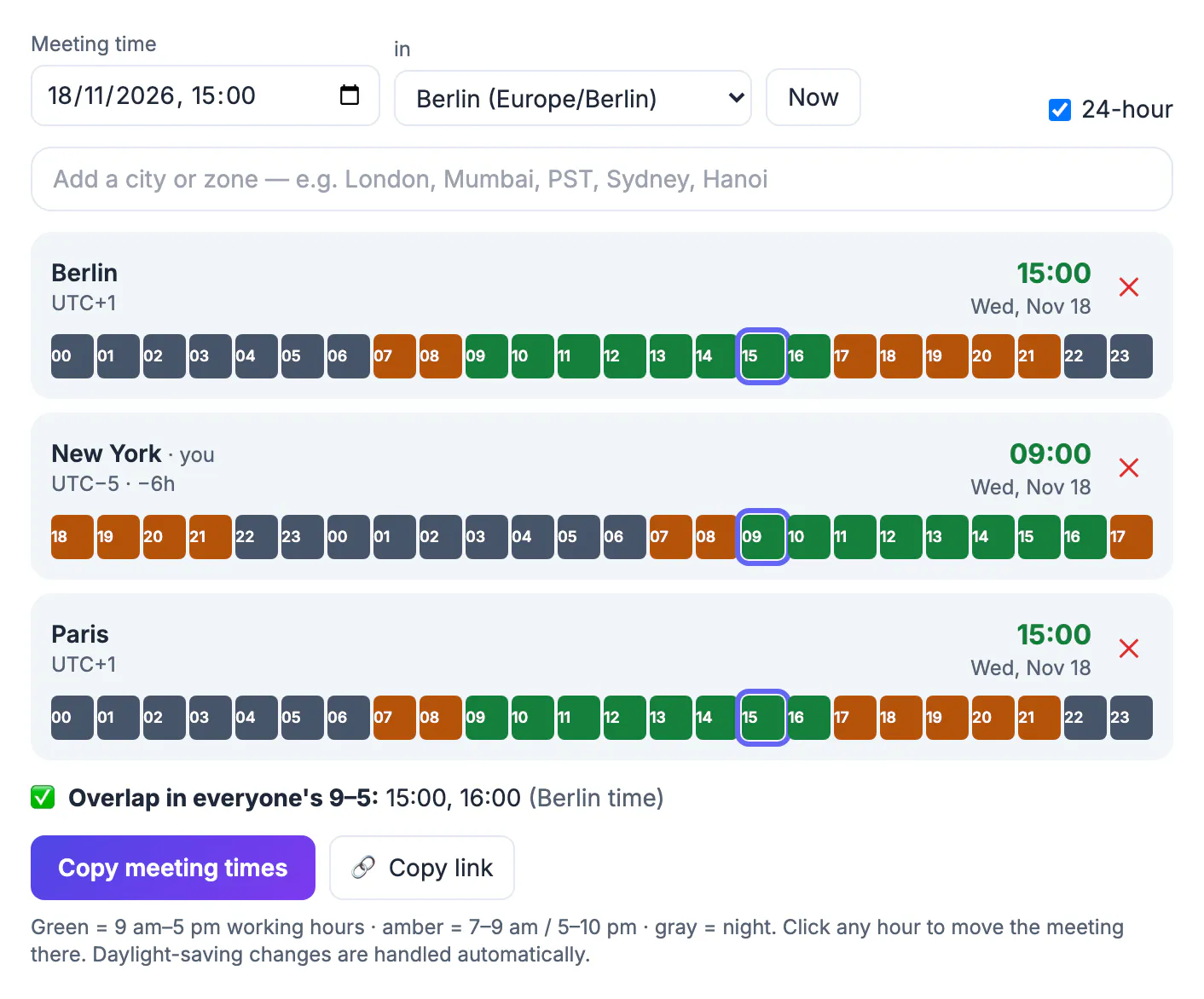
The rule is dependable most of the year, so teams stop checking. Then a weekly 15:00 call from Amsterdam lands at 10:00 instead of 9:00 in New York, because the regions change clocks on different weekends. Calendars adjust; hand-typed times in emails and event listings do not.
The CET to EST rule, with a quick chart
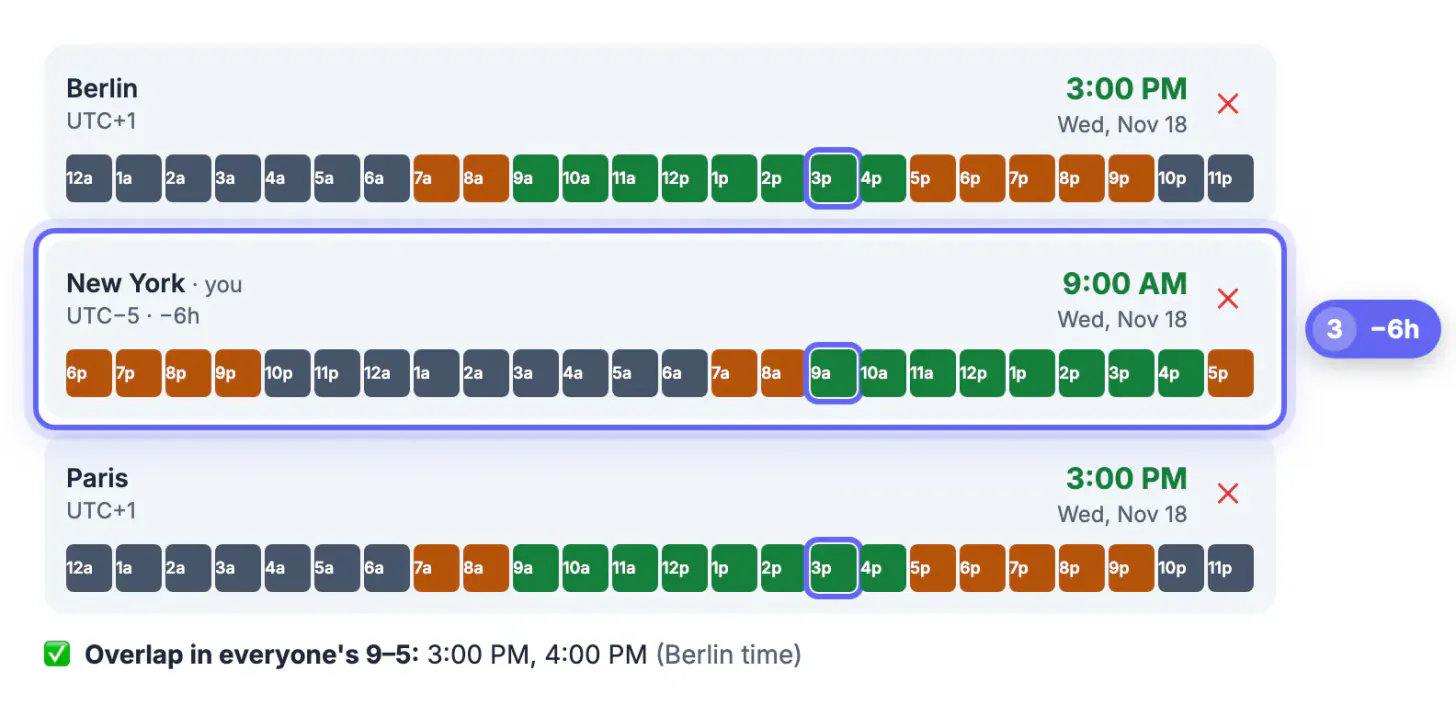
Central European Time is UTC+1 and Eastern Standard Time is UTC−5, a 6-hour gap. In summer Europe uses CEST (UTC+2) and the US East Coast uses EDT (UTC−4), which is still 6 hours. Subtract 6 to go from Central Europe to New York; add 6 to go back.
- 09:00 CET = 3:00 AM ET.
- 14:00 CET = 8:00 AM ET.
- 15:00 CET = 9:00 AM ET, the start of the US East Coast workday.
- 17:00 CET = 11:00 AM ET, when many European offices close.
- 18:00 CET = 12:00 PM ET.
- 23:00 CET = 5:00 PM ET.
Central European Time covers Germany, France, Spain, Italy, the Netherlands, Poland, Sweden and most neighbors. Eastern Time covers New York, Washington, Miami and Toronto.
The weeks when the gap is only 5 hours
Use the rules, not a list of dates, because the Sundays shift every year:
- United States and Canada: clocks go forward on the second Sunday in March and back on the first Sunday in November, at 2:00 AM local time.
- European Union, UK and most of Europe: clocks go forward on the last Sunday in March and back on the last Sunday in October, at 01:00 UTC everywhere at once.
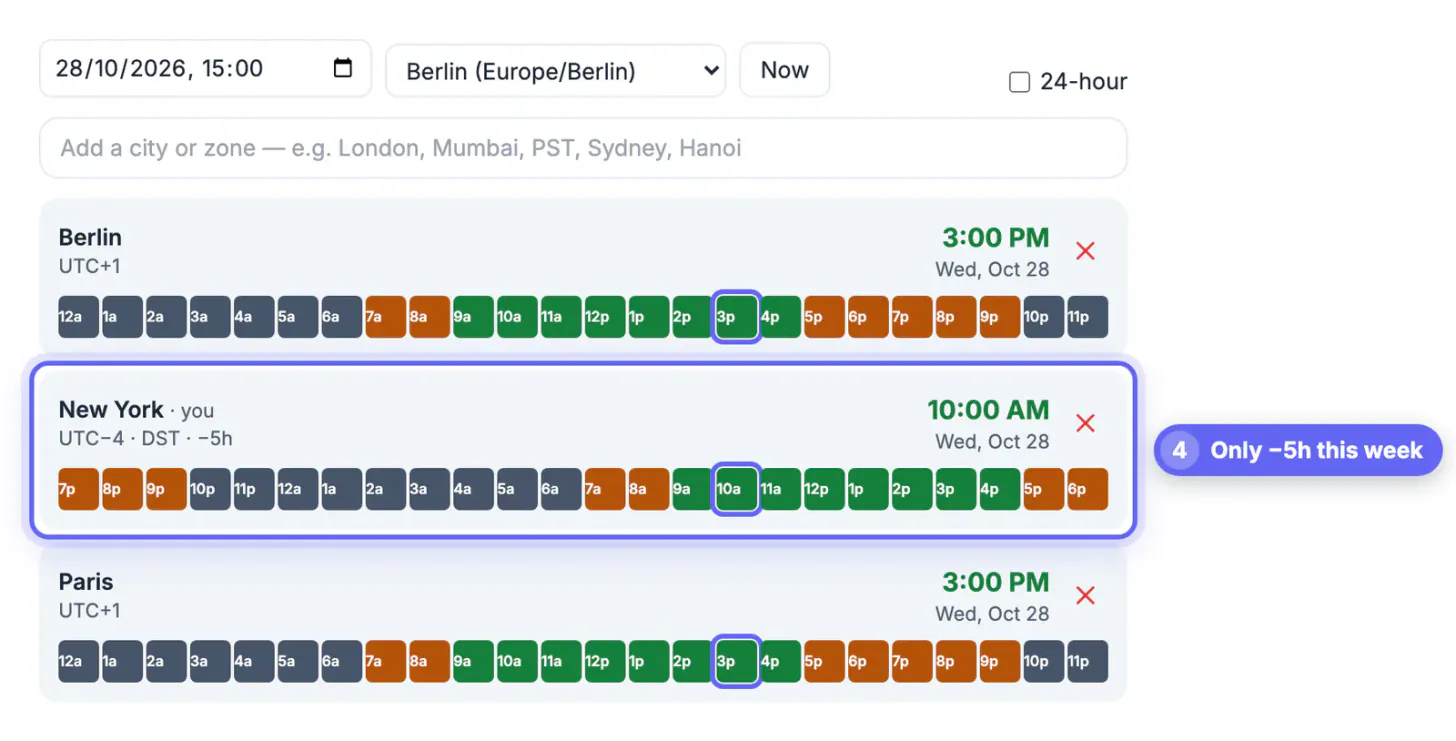
- Spring gap: from the second Sunday in March until Europe's last Sunday in March, usually two or three weeks, New York is only 5 hours behind. 15:00 CET is then 10:00 AM EDT.
- Autumn gap: from Europe's last Sunday in October until the US's first Sunday in November, usually one week, the gap is also 5 hours. 15:00 CET is then 10:00 AM EDT.
Recurring meetings shift by an hour for one side during these weeks, so warn attendees.
Business-hours overlap and the exceptions
With a 6-hour gap, a 9-to-5 day in both places overlaps for just 2 hours: 15:00 to 17:00 CET, which is 9:00 to 11:00 AM in New York. In the 5-hour weeks it widens to 3 hours, 14:00 to 17:00 CET. Many teams settle on 15:00 or 16:00 CET as a standing slot.
- UK, Ireland and Portugal are on GMT or WET, one hour behind CET, so London is 5 hours ahead of New York most of the year and 4 hours during the same mismatch weeks.
- US Central Time is 7 hours behind CET; Pacific Time is 9.
- Arizona mostly stays on Mountain Standard Time all year, so it is 8 hours behind CET in winter and 9 hours behind CEST in summer.
- Eastern Europe (Athens, Helsinki) is 7 hours ahead of New York.
Checking CET to EST with GrabCast's converter
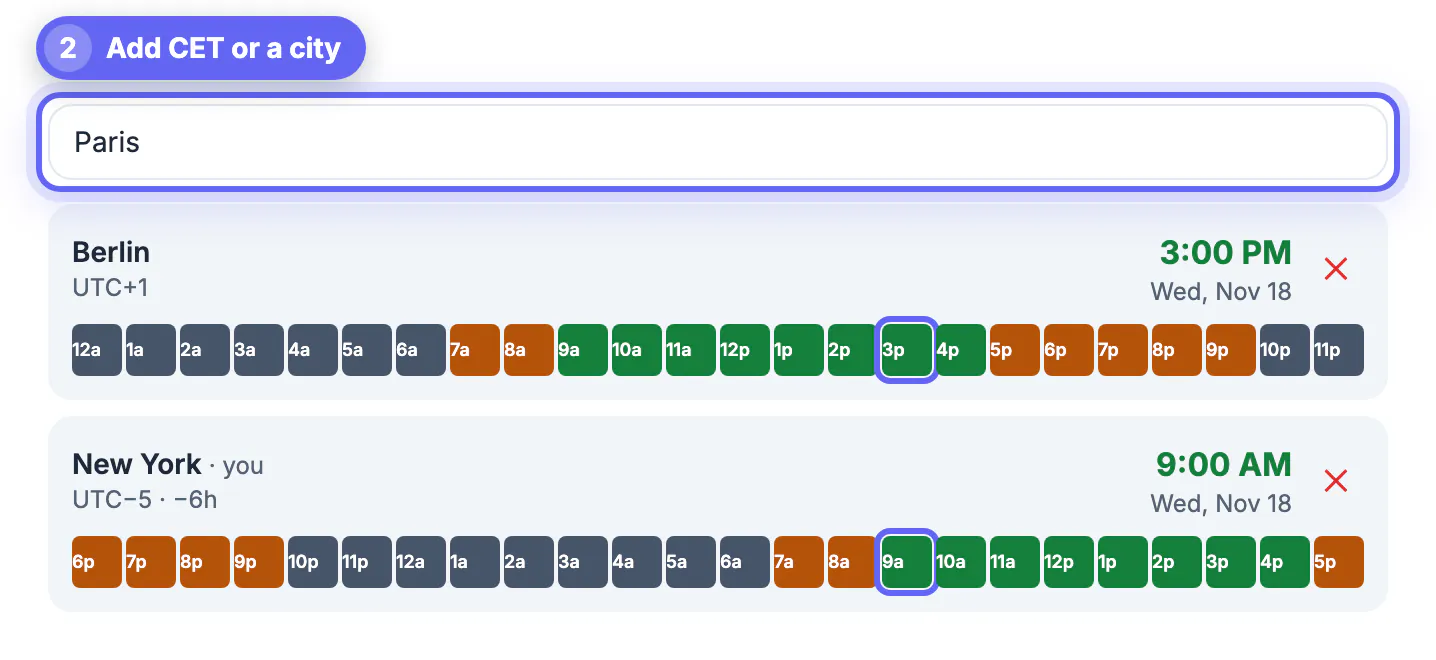
Near a clock change, let the Time Zone Converter do the work. Set the meeting time and base zone, then type CET or a city like Paris into the add box; EST, EDT or ET map to New York. Each row shows local time, UTC offset, a DST marker and the hour difference.
A 24-hour grid colors working hours green and lists the hours inside everyone's 9 to 5. Click an hour to move the meeting, switch to 24-hour display, then copy the times or a share link. Daylight saving comes from your browser's time zone data, so the 5-hour weeks are caught automatically.
Scheduling tips for a transatlantic team
Most confusion happens in the weeks when only one side has changed its clocks. A few habits remove the guesswork.
- Write meeting times with both zones, for example 16:00 CET / 10:00 AM ET.
- Send calendar invitations rather than plain text so each person's calendar converts the time.
- Avoid scheduling recurring meetings at the edge of working hours, since a clock change can push them outside it.
- Check the dates of the two clock changes each year and flag them in the team calendar.
For multi-city planning, converting meeting times across time zones explains how to find an overlap for a whole team, and the Unix timestamp converter is useful when systems store times in UTC.
Other European and US zone pairs
The same method works for other pairs. London on GMT is 5 hours ahead of New York, and Paris and Berlin sit on CET, so they match. Chicago, on Central Time, is 7 hours behind CET, and Los Angeles, on Pacific Time, is 9 hours behind. Remember that the UK changes its clocks on the same dates as the EU, but the US changes earlier in spring and later in autumn.
Writing times that cannot be misread
Prefer the 24-hour clock for European audiences, include the date and zone abbreviation, and avoid ambiguous phrases such as this Friday at 4 without a zone. If a call is critical, ask participants to reply with the local time they expect, which catches mistakes before anyone joins the wrong meeting.
Daylight saving traps to watch for
The short mismatch periods catch many teams out. In March the United States moves its clocks about two to three weeks before Europe, and in autumn Europe moves back first, a week or so before the US. During those weeks, the New York offset shrinks to five hours. Put both dates in a shared calendar each year and double check recurring meetings that cross them. Also remember that some places, such as Arizona, do not change their clocks at all, and that Asia and the Southern Hemisphere follow entirely different schedules, so never assume the same gap applies to every city.
Step-by-step

Common mistakes to avoid
Pro tips
Frequently asked questions
Is CET always 6 hours ahead of EST?
Most of the year. For a few weeks in March and about a week around late October, it is 5 hours.
What is 3 PM CET in EST?
9:00 AM Eastern most of the year, or 10:00 AM during the mismatch weeks.
What is the difference between CET and CEST?
CET is winter time at UTC+1. CEST is summer time at UTC+2, used from the last Sunday in March to the last Sunday in October.
Is London on CET?
No. The UK uses GMT in winter and BST in summer, one hour behind Central Europe all year.
When do US clocks change?
The second Sunday in March and the first Sunday in November, at 2:00 AM local time.
Central Europe to New York is minus 6 hours, except a few weeks in March and around late October when it is minus 5. Aim for 15:00 to 17:00 CET and write both zones in every invite.
Related guides
Browse more: all calculator guides · Time Zone Converter