Convert PST to EST: The 3-Hour Rule and DST Traps
To convert PST to EST, add 3 hours: 9:00 AM Pacific is 12:00 PM Eastern, and 5:00 PM Pacific is 8:00 PM Eastern. The rule holds all year, because both coasts change clocks on the same Sundays. The catches are labels (summer is really PDT and EDT), a couple of overnight hours on changeover nights, and Arizona, which stays put while California moves.
🕑 Try Time Zone Converter now — freeOpen →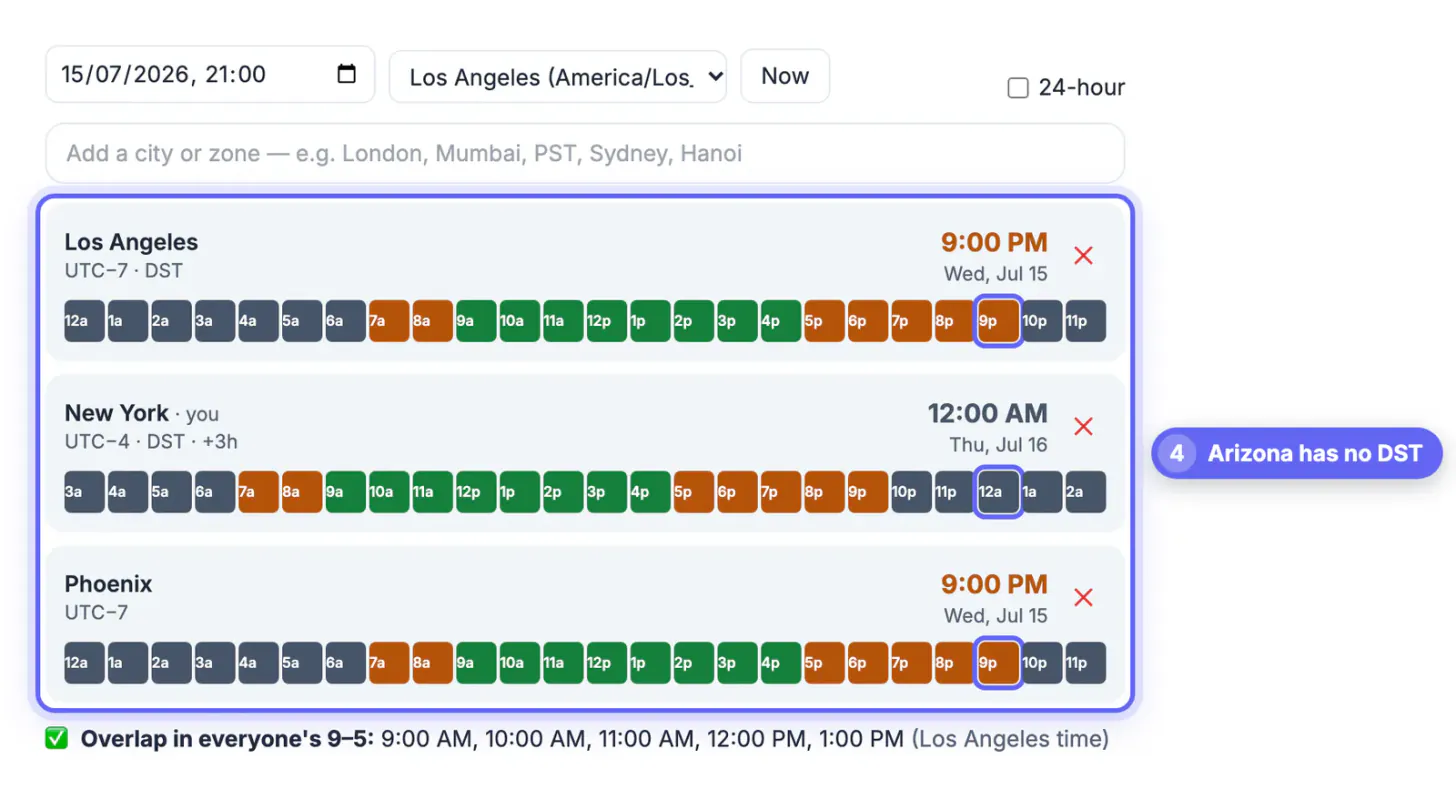
Coast-to-coast scheduling is the most common conversion in the US, and it still goes wrong daily. A Los Angeles manager books a 9 AM standup that lands at noon in Boston, right in the lunch hour. A New York livestream promoted for 8 PM starts at 5 PM for viewers in Seattle, halfway through their commute. Travelers land after a red-eye and miss connections because their phone had not updated. The rule is easy; applying it with the right label and the right date is where attention pays off. Remote teams, sales reps covering both coasts and families spread between California and Florida all run into it weekly.
The PST to EST rule, with a quick chart
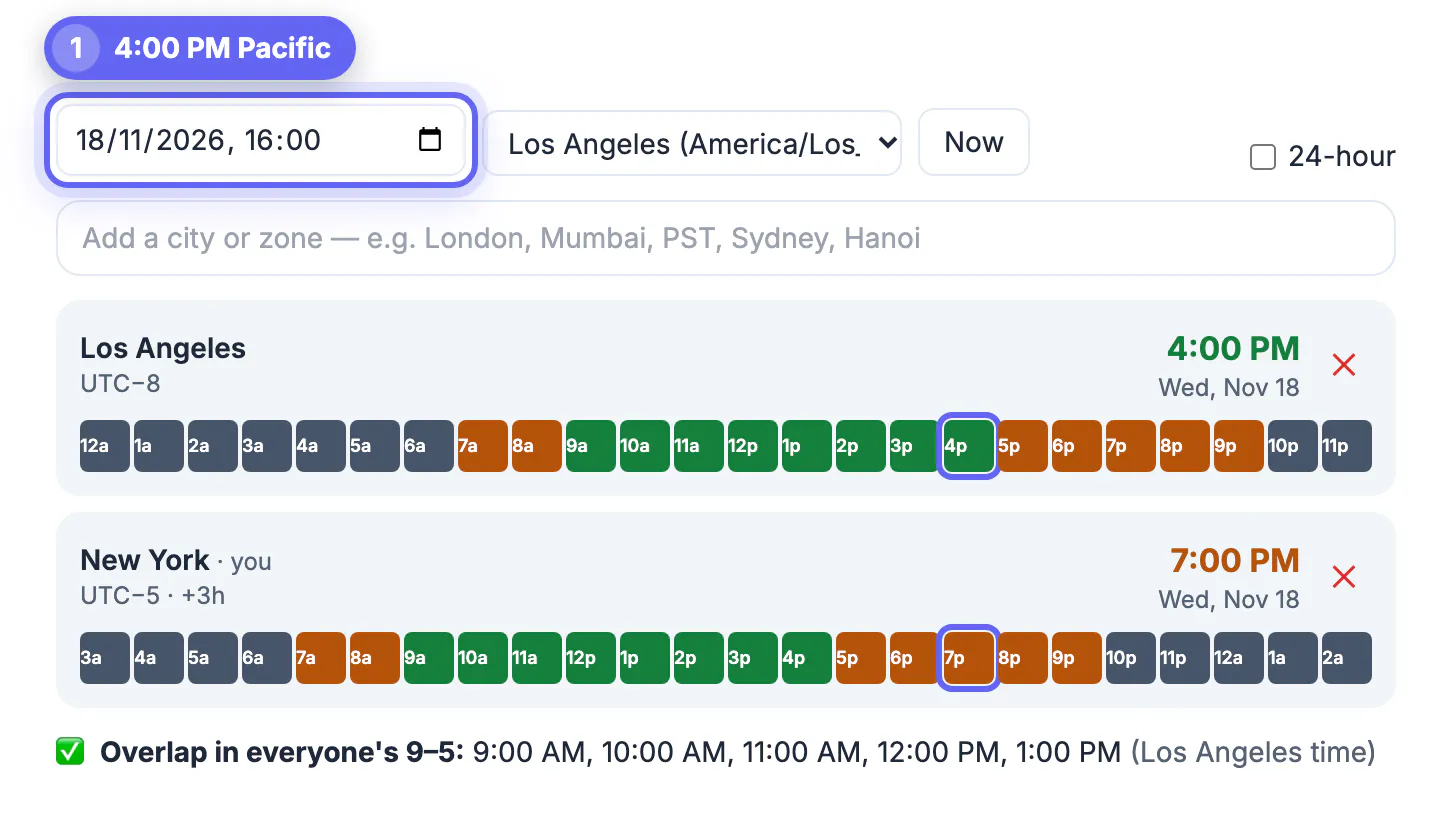
Pacific Standard Time is UTC−8 and Eastern Standard Time is UTC−5, so Eastern clocks read 3 hours later. Add 3 to go from Pacific to Eastern; take 3 away to go back.
- 6:00 AM Pacific = 9:00 AM Eastern, the start of the East Coast workday.
- 9:00 AM Pacific = 12:00 PM Eastern.
- 12:00 PM Pacific = 3:00 PM Eastern.
- 2:00 PM Pacific = 5:00 PM Eastern, when East Coast offices wind down.
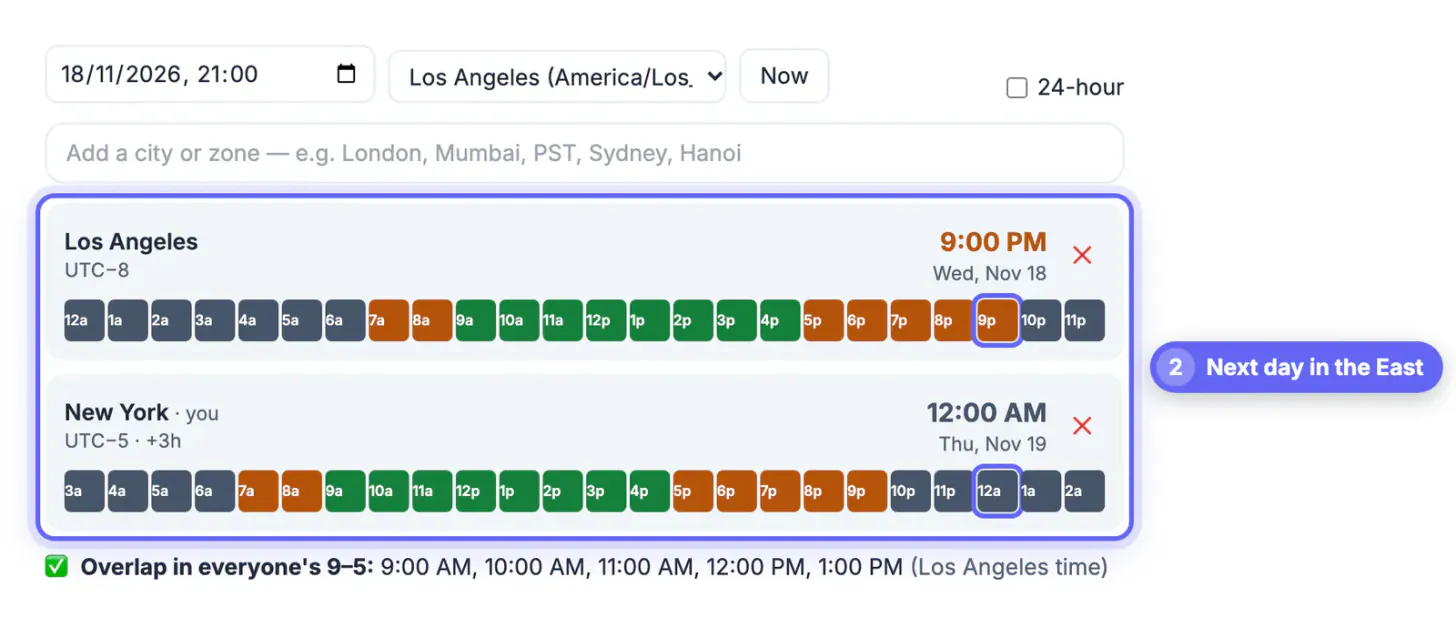
- 9:00 PM Pacific = 12:00 AM Eastern, already the next calendar day.
The shared workday is only five hours: 9 AM to 2 PM Pacific overlaps 12 PM to 5 PM Eastern. That is why coast-to-coast teams tend to put calls between 10 AM and 1 PM Pacific, which is 1 PM to 4 PM on the Atlantic side.
Broadcast schedules show the rule in action. National TV networks often air a prime-time show at 8 PM on the Atlantic coast and delay the feed so it also airs at 8 PM on the Pacific coast, while live sports and award shows go out simultaneously: an 8 PM ET kickoff is a 5 PM PT kickoff. Streaming premieres usually drop at midnight Pacific, which is 3 AM for New York viewers, or at 3 AM Eastern, which is midnight in Los Angeles. Product launches, ticket sales and online exams listed with only one zone deserve a second look before you set an alarm.
Flights are the other everyday case. Airline schedules list departure and arrival in local clocks, so a nonstop from LAX at 7:00 AM that lands at JFK at 3:30 PM is really about five and a half hours in the air, not eight and a half. Going west, the same trip seems to take barely two hours on paper. Add or subtract the 3-hour offset before you plan a connection or a pickup.
PST vs PDT: which label is right in summer
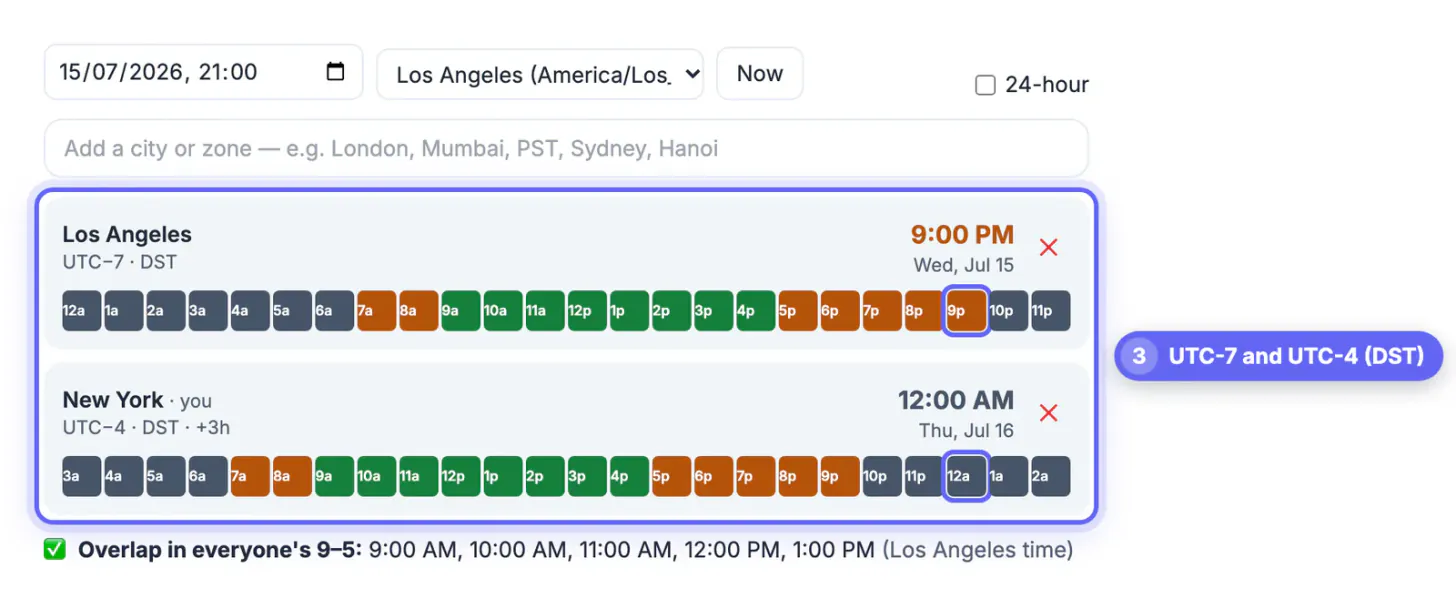
From the second Sunday in March to the first Sunday in November, the Pacific coast runs on PDT (UTC−7) and the Atlantic side on EDT (UTC−4). Both jump together, so the gap stays 3 hours. Strictly, writing PST in July is wrong, although almost everyone understands what you mean.
- Use PT and ET when you want to be correct in every season; they simply mean local Pacific and Eastern clocks.
- Use PST and EST only between November and March, when standard rules apply.
- In legal notices, contracts and ticket sales, write the full label, for example 10:00 AM PT (UTC−7), to avoid any argument.
- Calendar software converts correctly either way, as long as the event is created in the right zone.
Other US zones slot in between: Mountain is 1 hour ahead of Pacific and Central is 2 hours ahead, so a 9:00 AM Pacific call is 10:00 AM in Denver and 11:00 AM in Chicago.
Overnight changeover hours and the Arizona exception
Clocks change at 2:00 AM local, and the Atlantic side gets there 3 hours sooner. For a few overnight hours the gap is not 3:
- Spring-forward night (second Sunday in March): from 2:00 AM Eastern until Pacific switches at 2:00 AM Pacific, Eastern is 4 hours ahead.
- Fall-back night (first Sunday in November): after Eastern falls back and before Pacific does, the gap is only 2 hours.
- Both windows fall roughly between 11 PM and 5 AM, so ordinary meetings are not affected; overnight shifts, server jobs and red-eye flights can be.
Arizona is the bigger trap. Most of the state does not observe daylight saving, so it stays on MST (UTC−7) all year. In summer Phoenix shows the same clock as Los Angeles and is 3 hours behind New York; in winter Phoenix matches Denver and is only 2 hours behind New York. The Navajo Nation in northeastern Arizona does change its clocks, which confuses even locals. Hawaii (UTC−10) never changes either: it is 2 hours behind California in winter and 3 hours behind in summer, and 5 or 6 hours behind New York.
Checking PST to EST with GrabCast's converter
For a single hour, adding 3 is enough. When a date near a clock change is involved, or you need Pacific, Eastern and a few more cities together, GrabCast’s Time Zone Converter & Meeting Planner saves effort. Type PST or PT and EST or ET into the search box; both map to Los Angeles and New York, so summer dates correctly show PDT and EDT offsets with a DST badge.
- Each row shows the local hour, weekday, UTC offset and the hour difference from your base zone.
- A 24-hour strip per row marks 9-to-5 in green and evenings in amber; click any cell to move the meeting there.
- Add Phoenix or Honolulu to see the Arizona and Hawaii offsets for your date instead of guessing.
- Copy the result as text for an invite, or copy a link that reopens the same view.
It runs in the browser with no sign-up and uses the zone rules your browser ships with, so the March and November changeover dates are applied automatically.
If you schedule posts across the US, find your best posting time and use the Social Media Scheduler with the right zone.
Step-by-step
Common mistakes to avoid
Pro tips
Frequently asked questions
Is EST always 3 hours ahead of PST?
Yes, apart from a few overnight hours on the two changeover nights, when the gap is briefly 4 hours in March and 2 hours in November.
What is 12 PM PST in EST?
12:00 PM Pacific is 3:00 PM Eastern. Add 3 hours to any Pacific hour.
What is the difference between PST and PDT?
PST is winter time at UTC−8. PDT is summer time at UTC−7, used from the second Sunday in March to the first Sunday in November. The gap to Eastern stays 3 hours either way.
Is Arizona on Pacific or Mountain time?
Mountain Standard Time all year, except the Navajo Nation. In summer that matches Pacific clocks; in winter it matches Denver.
Does the converter know about daylight saving?
Yes. It applies the offset for the date you enter and shows a DST badge, so you do not have to track the March and November switches yourself.
Pacific to Eastern is plus 3 hours, all year. Use PT and ET to stay correct in every season, remember the day change after 9 PM Pacific, and double-check anything involving Arizona, Hawaii or the overnight changeover hours.
Related guides
Browse more: all calculator guides · Time Zone Converter