Convert Between Time Zones: The Two-Step UTC Method
To convert between time zones, turn the source clock reading into UTC using that place's offset on that date, then apply the destination offset: 9:00 AM in Los Angeles on a June Tuesday (UTC−7) is 16:00 UTC, which is 12:00 PM in New York, 5:00 PM in London and 1:00 AM Wednesday in Tokyo. The arithmetic is easy; the offsets are the hard part, because daylight saving moves them on different dates in different countries.
🌐 Try Time Zone Converter now — freeOpen →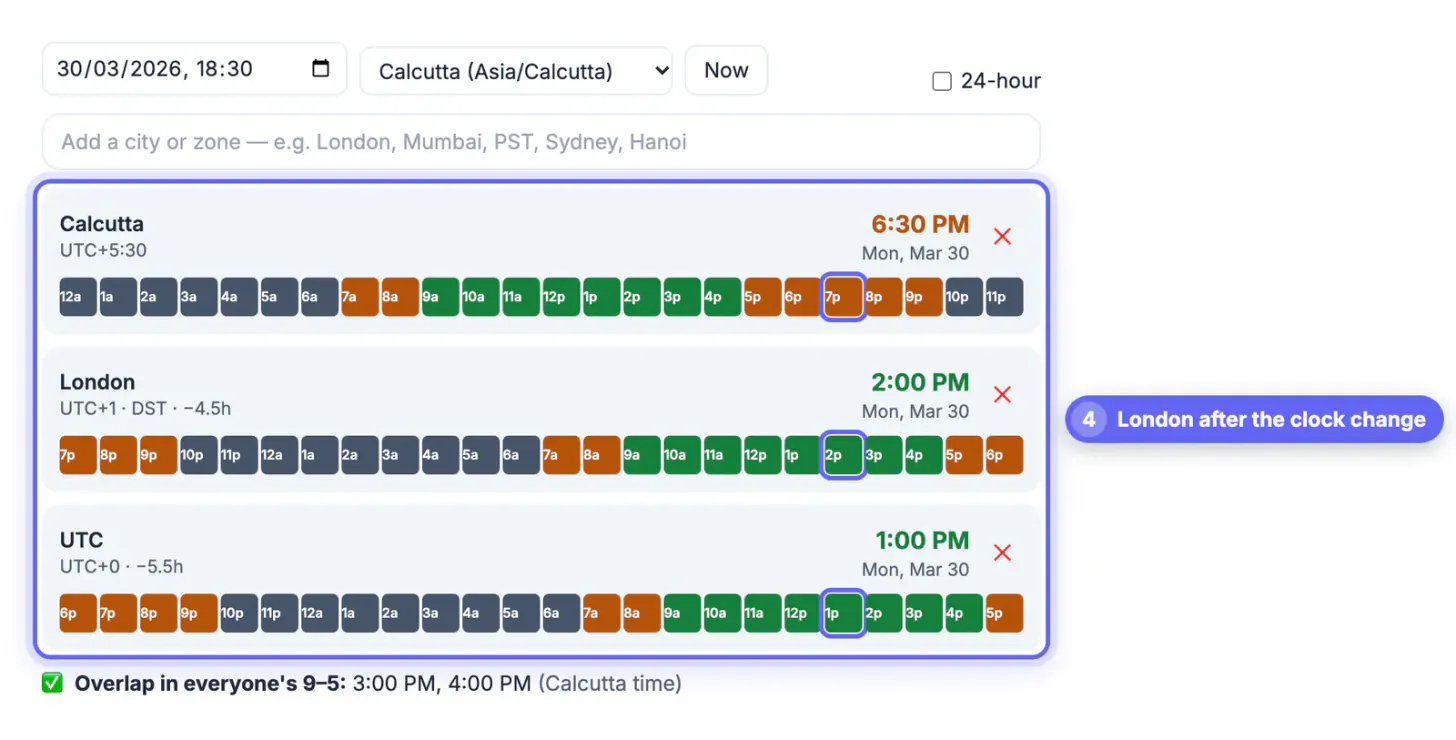
Most errors are not subtraction mistakes. They come from using a remembered offset that was true in January but not in July, forgetting that Arizona or Japan never shift their clocks, or missing that a late-evening call in California is already tomorrow in Asia. A flight connection, a filing deadline or an exam window set in another country can all slip by an hour or a whole day. Anchoring every conversion to UTC removes the guesswork, because UTC itself never changes.
The two-step UTC method, with worked examples
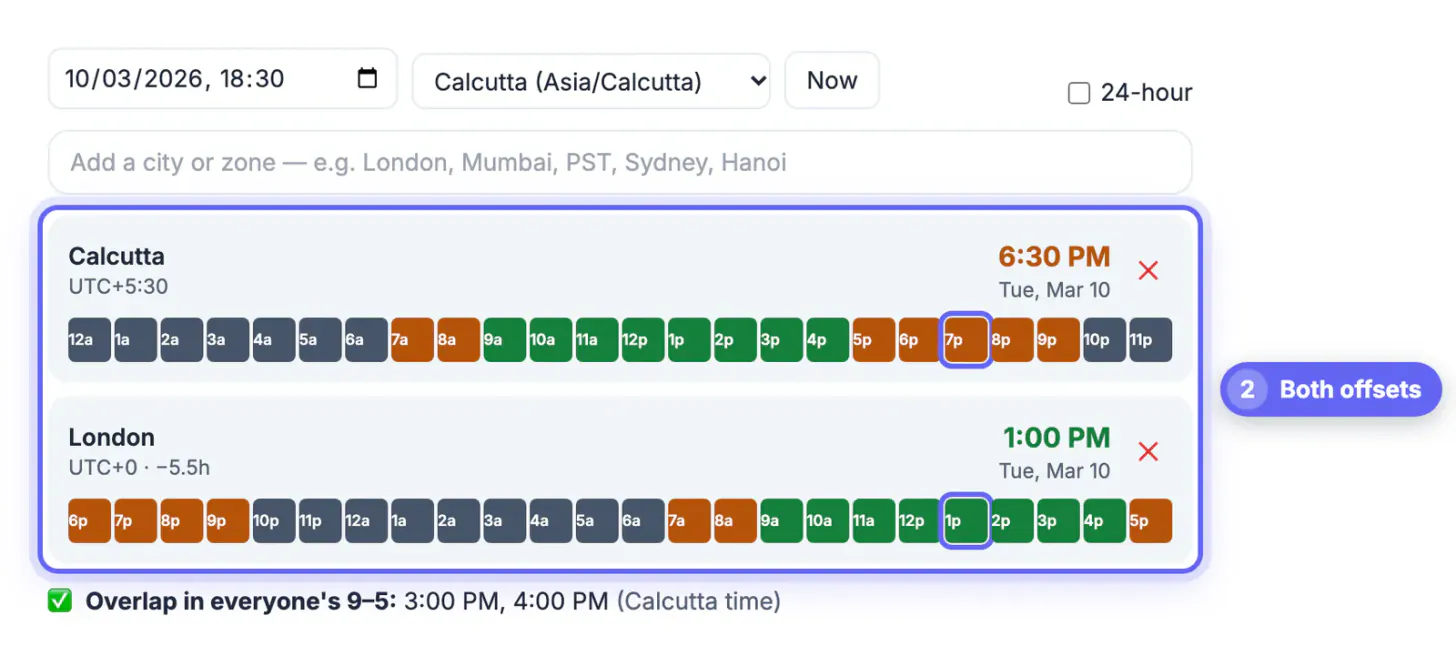
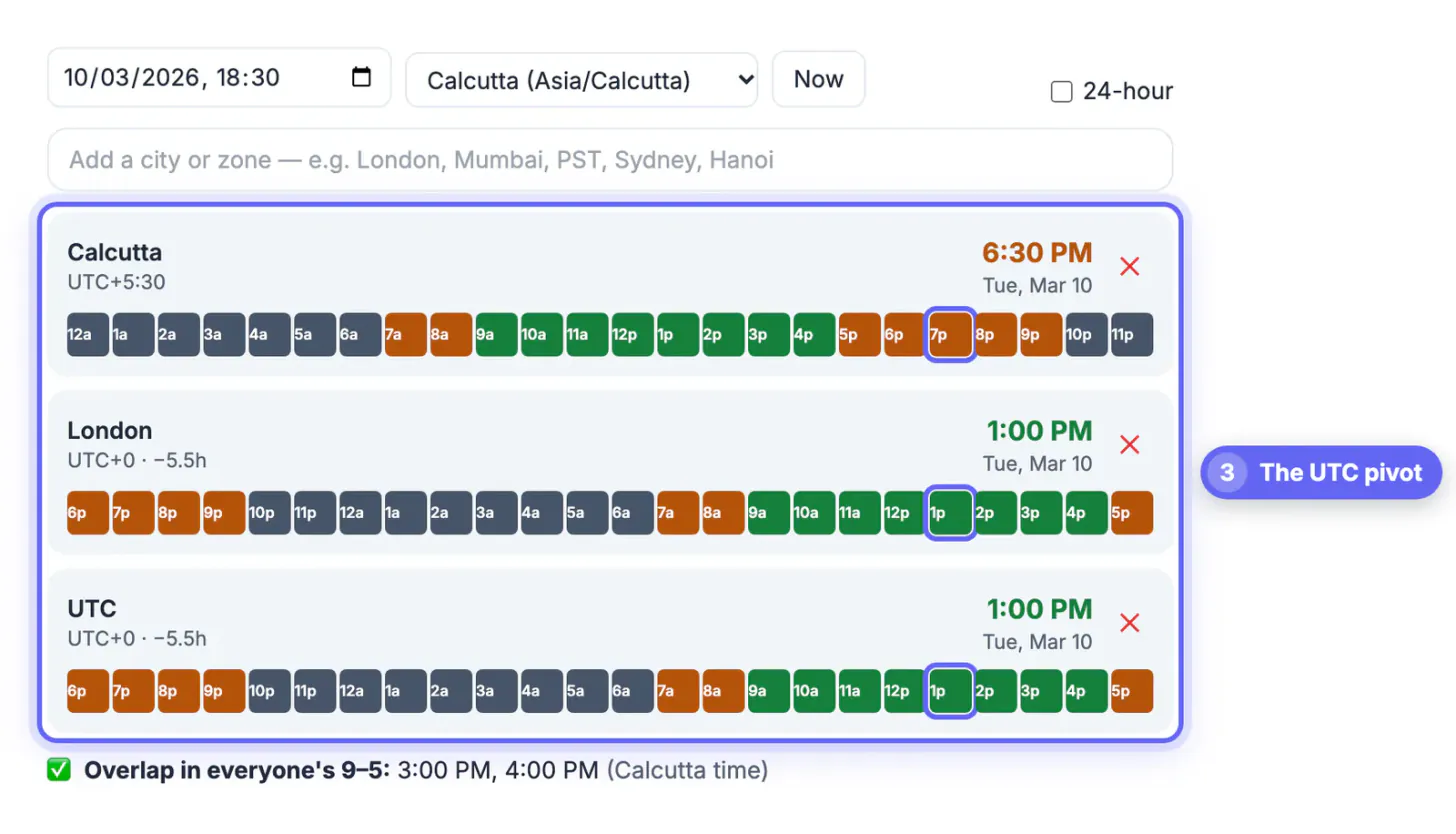
UTC (Coordinated Universal Time) is the reference clock that every regional offset is measured against. Offsets are written as UTC−5, UTC+1, UTC+5:30 and so on. The method never changes:
- Step one: subtract the source offset to reach UTC. For a place at UTC−5, add 5 hours; for UTC+9, take 9 hours away.
- Step two: add the destination offset to that UTC value.
- If the result passes midnight, move the date forward; if it drops below zero, move it back a day.
Example A: 2:00 PM in Chicago on July 14 (CDT, UTC−5) is 19:00 UTC. London is on BST, UTC+1, so it reads 8:00 PM; Tokyo, UTC+9, reads 4:00 AM on July 15.
Example B: 6:30 PM in Sydney on January 20 (AEDT, UTC+11) is 07:30 UTC. Berlin in winter is UTC+1, giving 8:30 AM the same day; New York in winter is UTC−5, giving 2:30 AM that morning.
Writing the UTC value down in the middle, even on a sticky note, catches most errors, because you can sanity-check it against any clock listed as UTC or GMT.
Daylight saving rules that shift offsets
Offsets are only fixed until a clock change. The main switches follow fixed rules, always on a Sunday:
- United States and most of Canada: forward on the second Sunday in March, back on the first Sunday in November (Eastern moves between UTC−5 and UTC−4).
- UK and European Union: forward on the last Sunday in March, back on the last Sunday in October (London between UTC+0 and UTC+1, Paris and Berlin between UTC+1 and UTC+2).
- Australia’s southeast (Sydney, Melbourne, Canberra, Hobart): back on the first Sunday in April, forward on the first Sunday in October.
- New Zealand: back on the first Sunday in April, forward on the last Sunday in September.
Between those dates the usual gaps change. For about three weeks in March and one week around the end of October, while only one side has changed, New York is four hours behind London instead of five. Sydney swings the other way, so the New York to Sydney difference is 14 hours in July but 16 hours in January.
Plenty of places never shift at all: Arizona (outside the Navajo Nation), Hawaii, Puerto Rico, most of Mexico since 2022, Japan, China, India, Singapore and the Gulf states. When one side changes and the other does not, the gap moves by an hour overnight.
Half-hour zones and date-line traps
Not every offset is a whole number of hours, and most mental-math mistakes happen here:
- India uses UTC+5:30 all year, so 9:00 AM in New York in October (UTC−4) is 6:30 PM in Mumbai, and after November 1 it is 7:30 PM.
- Nepal sits at UTC+5:45, Newfoundland at UTC−3:30 (−2:30 in summer) and Adelaide at UTC+9:30 (+10:30 in summer).
- Iran, Afghanistan, Myanmar and parts of Australia also use half-hour offsets.
- The International Date Line means Samoa and Kiribati can be a full calendar day ahead of Hawaii even though they are geographically close.
The date is the other trap. Anything from mid-afternoon in the US onward is already the next day in East Asia and Australia, so a Friday 5:00 PM deadline in San Francisco is Saturday morning in Singapore. Always write the weekday next to a converted hour; it forces you to check which day you landed on.
Checking your math with the GrabCast converter
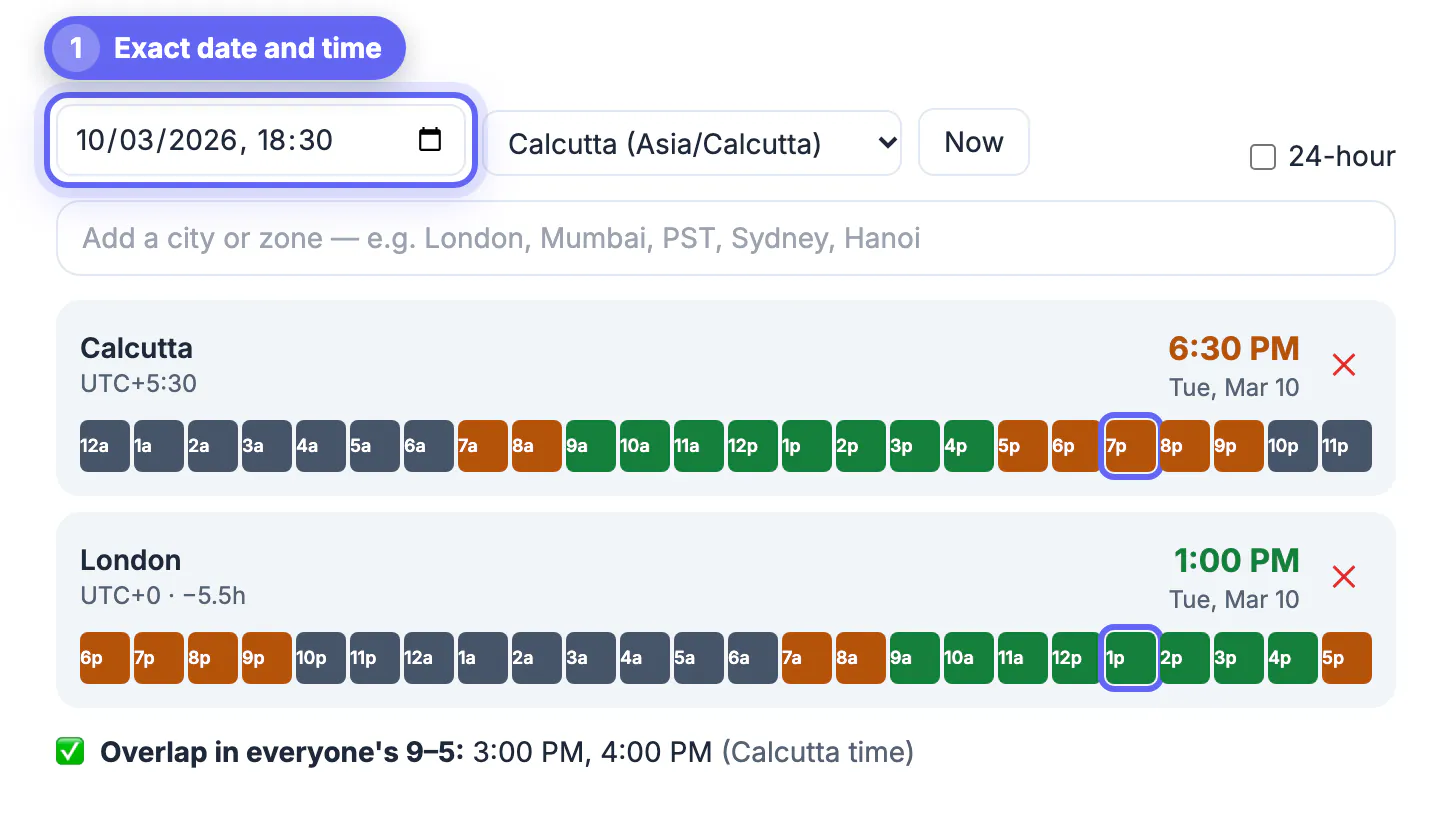
Once you know the method, a converter is the fastest way to confirm it. GrabCast’s Time Zone Converter & Meeting Planner uses the IANA zone database built into your browser and a two-pass calculation, so it applies the rules for the date you pick, including those March and October gap weeks.
- Set the date and hour in any base zone, then add places by city name (New York, Mumbai, Hanoi, SF), by abbreviation (PST, CET, IST, JST) or by IANA name such as Asia/Kathmandu.
- Each row shows the local clock, weekday and date, the UTC offset, a DST badge when summer rules apply, and the hour difference from your base.
- Toggle 12-hour or 24-hour display, or press Now to see the current moment everywhere.
- Copy the results as plain text or copy a link that reopens the same places and moment.
Two honest caveats. Abbreviations are ambiguous worldwide, so the tool maps IST to India and CST to US Central; type a city if you mean Israel or China. And it reflects the rules your browser ships with, so a country that changes its law at short notice may take a browser update to appear.
If you work with raw epoch values, the Unix Timestamp Converter handles those. Planning posts across regions? See how to find your own best posting time.
Step-by-step
Common mistakes to avoid
Pro tips
Frequently asked questions
How do I convert between time zones quickly?
Change the source hour into UTC using its offset for that date, then apply the destination offset. 2:00 PM in Chicago in July (UTC−5) is 19:00 UTC, which is 8:00 PM in London and 4:00 AM the next day in Tokyo.
Is GMT the same as UTC?
For everyday scheduling they show the same clock reading. UTC is the precise scientific standard, while GMT is also used as the name of the UK's winter zone, which becomes BST (UTC+1) in summer.
When do the clocks change?
The US and Canada move forward on the second Sunday in March and back on the first Sunday in November. The UK and EU move forward on the last Sunday in March and back on the last Sunday in October. Southeastern Australia moves back on the first Sunday in April and forward on the first Sunday in October.
Why is the US to Europe gap sometimes one hour smaller?
Because the two regions change their clocks on different Sundays. For about three weeks in March and one week in late October, New York is 4 hours behind London instead of 5.
Does the converter handle daylight saving automatically?
Yes. It uses your browser's built-in zone rules for the specific date you choose and marks rows that are on summer rules with a DST badge.
Every conversion is two steps through UTC; the only real work is choosing the right offset for that exact date. Watch the clock-change dates, the places that never change, the half-hour zones and the date line, and confirm important hours in a converter before you commit.
Related guides
Browse more: all calculator guides · Time Zone Converter