Daily vs Monthly Compounding: What It Does to APY
Daily compounding earns more than monthly compounding, but by far less than most savers expect: at a 4.5 percent APR, monthly crediting works out to an APY of 4.594 percent and daily crediting to 4.602 percent, a gap of about 85 cents a year on a $10,000 balance. The stated rate moves your earnings much more than the schedule does, which is why US banks must advertise the annual percentage yield, one number that already folds the frequency in. This guide explains APR versus APY in plain terms, lists the effective yield at every common schedule from annual to continuous with worked dollar figures, shows the few situations where frequency really matters, such as high rates and card debt, and explains the federal rules behind the percentage on a bank's rate sheet. All rates below are illustrations, not offers or financial advice.
💰 Try the Compound Interest tool now — freeOpen →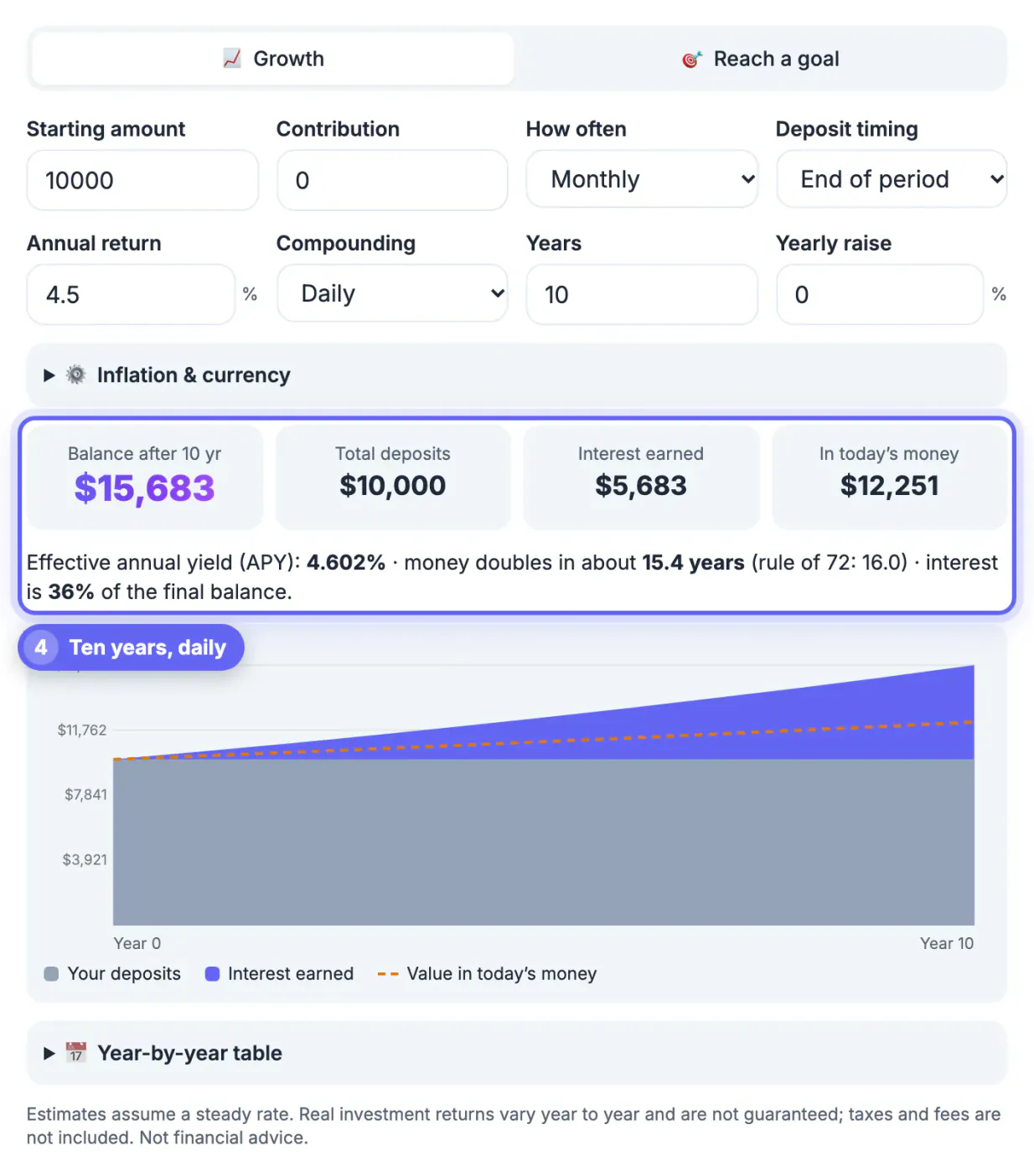
Banks like to print phrases such as compounded daily, credited monthly on their rate pages, and it sounds like a meaningful perk. Savers then try to compare a certificate of deposit that compounds monthly against a high-yield account that compounds daily, and they reasonably wonder which schedule wins. The honest answer is that the yield already settled it. Once two accounts are expressed as APY, the one with the higher percentage pays more over a year, whatever happens inside that year. Knowing this saves time and prevents a common mistake: choosing an account for its daily schedule while overlooking a quarter point of rate, a minimum balance requirement, a monthly fee or a promotional rate that expires after three months. The frequency still deserves one clear look, because it explains why the APY is higher than the headline rate and why a credit card balance grows faster than its stated APR suggests.
APR vs APY: two ways to state one rate
The nominal rate, often labeled the interest rate or APR, is the yearly percentage before any growth on growth. The annual percentage yield is what a balance actually gains in a year once each credited amount starts earning too. The link between them is APY = (1 + r ÷ n)^n − 1, where r is the nominal rate as a decimal and n is the number of periods per year.
- Nominal rate: 4.5 percent a year, the number used to set each period's slice.
- Periodic rate: 4.5 ÷ 12 = 0.375 percent per month, or 4.5 ÷ 365 = about 0.01233 percent per day.
- APY: the periodic slices stacked for a full year, 4.594 percent with twelve periods and 4.602 percent with 365.
- Loan APR is a different animal: under the Truth in Lending Act it folds certain fees into the rate but does not express the effect of growth on growth, so a loan APR is not an APY.
For deposits, read APY and ignore the rest. For borrowing, remember that the effective cost can be higher than the APR printed on the statement.
Daily vs monthly compounding at 4.5 percent
Here is one nominal rate of 4.5 percent run through every common schedule, with the balance after one year on $10,000 and after five years on $25,000, assuming no withdrawals or new deposits:
- Annually (n = 1): APY 4.500 percent, $10,450.00 after a year, $31,154.55 after five.
- Semiannually (n = 2): APY 4.551 percent, $10,455.06 and $31,230.09.
- Quarterly (n = 4): APY 4.577 percent, $10,457.65 and $31,268.76.
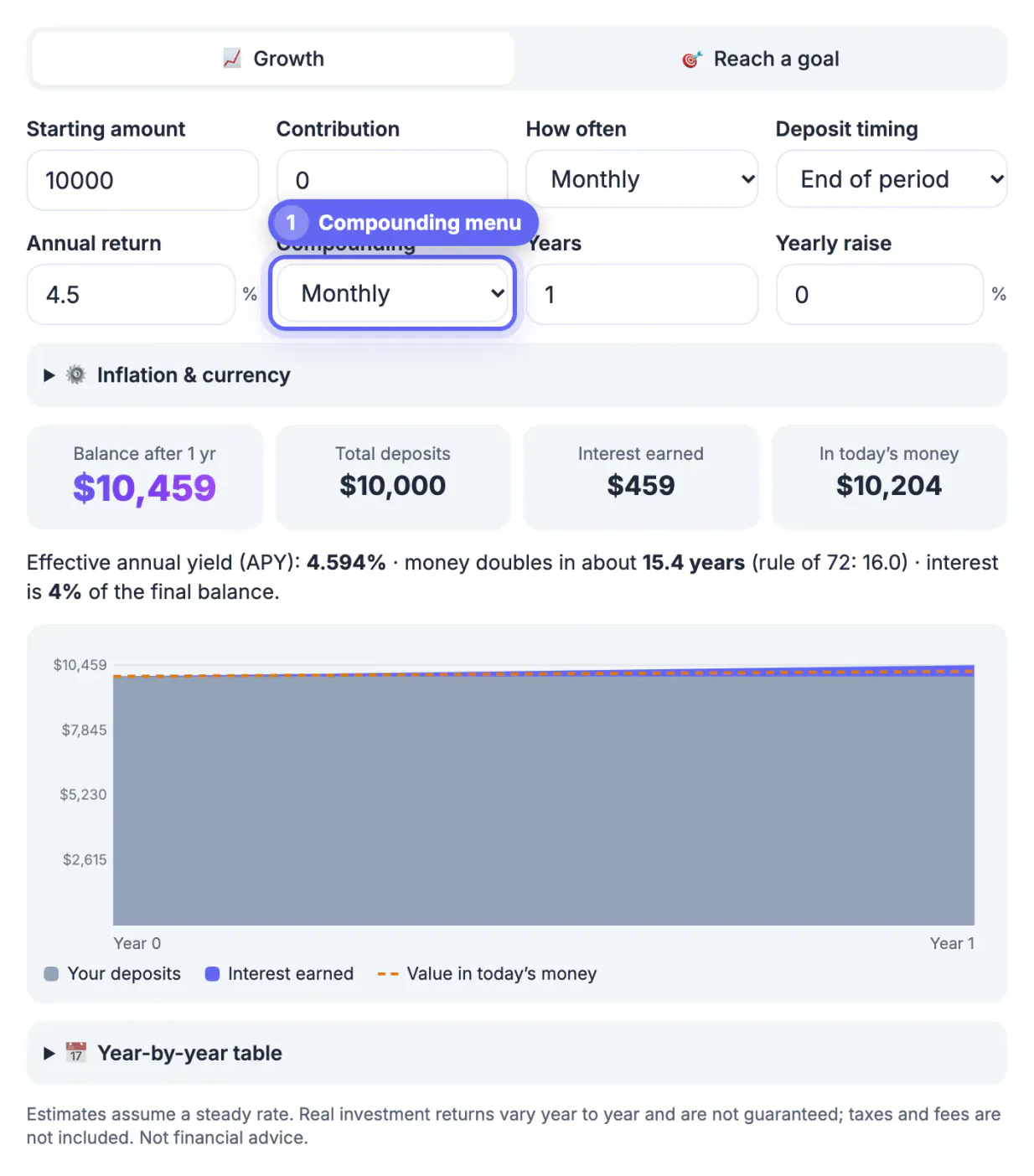
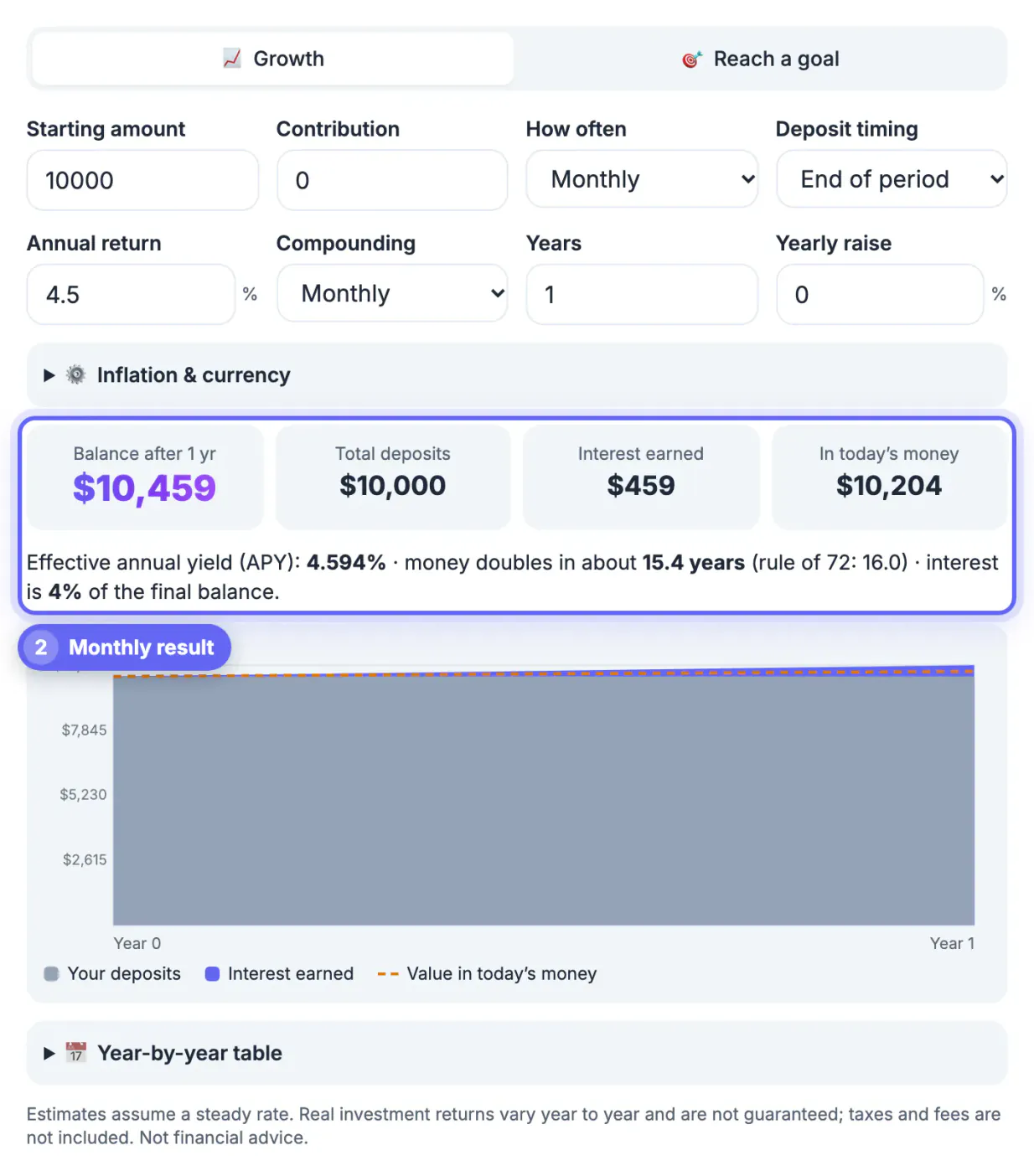
- Monthly (n = 12): APY 4.594 percent, $10,459.40 and $31,294.90.
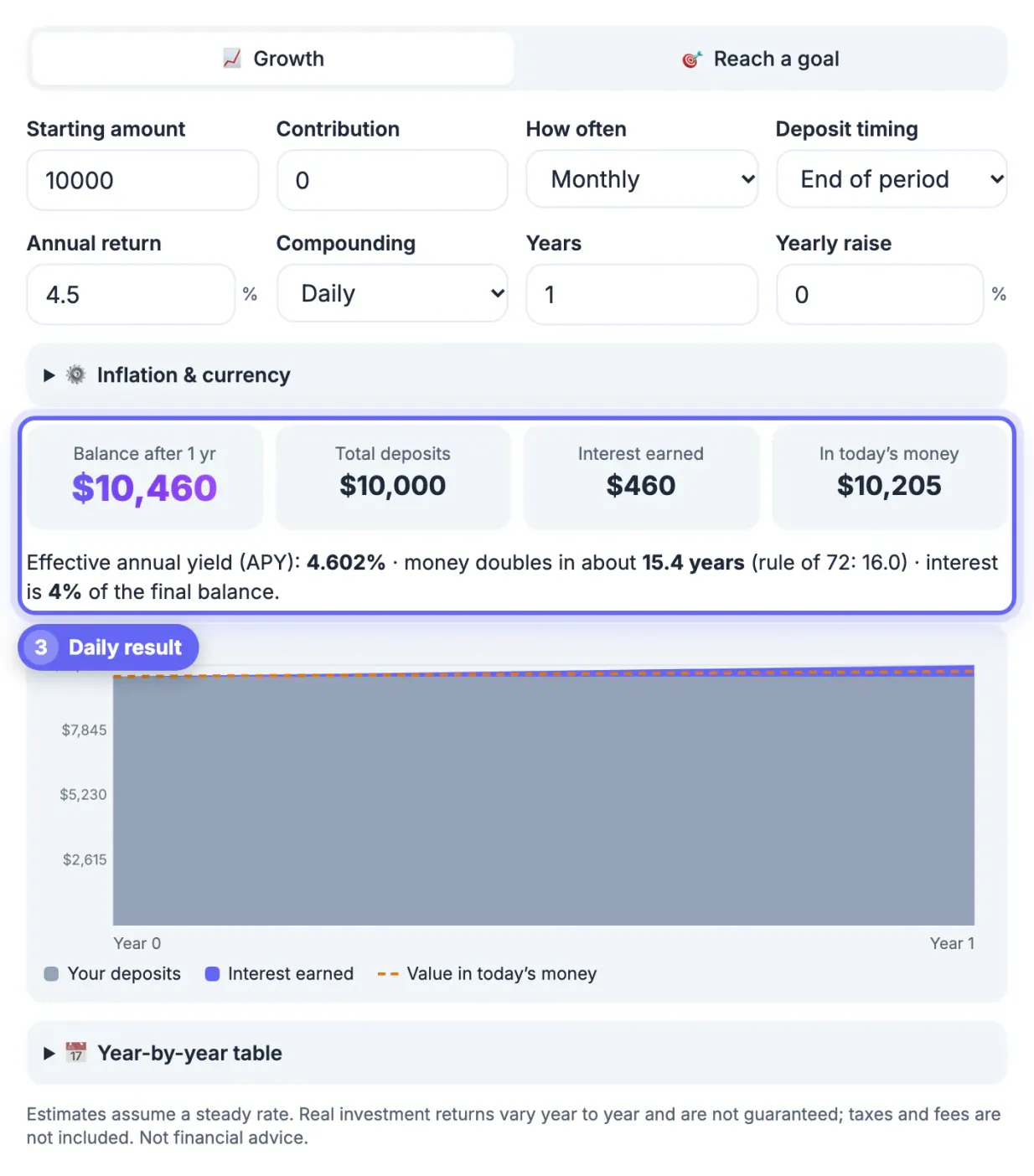
- Daily (n = 365): APY 4.602 percent, $10,460.25 and $31,307.63.
- Continuous (the mathematical limit, e^r − 1): APY 4.603 percent, $10,460.28 and $31,308.07.
Going from monthly to daily adds $12.73 over five years on $25,000, and continuous adds only 44 cents beyond daily. The largest jump sits between annual and semiannual, and every step after that is smaller. Compare that with the rate itself: moving from 4.5 to 4.75 percent on the same $25,000 adds roughly $370 over five years, almost thirty times the schedule effect.
When the schedule starts to matter
The gap between schedules grows with the rate and with the balance, so a few situations deserve a closer look.
- Low rates: at 1 percent, monthly and daily both round to an APY of 1.005 percent, so the choice is invisible.
- Higher rates: at 10 percent, monthly gives 10.471 percent and daily 10.516 percent, a gap of 0.045 points instead of 0.008.
- Card debt: a 24 percent card APR applied daily behaves like about 27.1 percent a year. A $3,000 balance left untouched for twelve months grows to about $3,813, versus $3,720 at a flat 24 percent.
- Large balances: $100,000 held ten years at 4.5 percent reaches $156,699 with monthly and $156,827 with daily crediting, a difference of $128.
- Day-count basis: some lenders, mostly on commercial loans, divide the yearly rate by 360 and then charge it on all 365 days, which lifts a 4.5 percent rate to about 4.67 percent effective.
One more detail: some accounts accrue daily but pay monthly, and the fine print may say accrued earnings are forfeited if you close the account before the crediting date. That rule, not the schedule, is what can cost you money when you switch banks mid-month.
See the effect over decades in the Retirement Calculator (401k), or on debt in the Credit Card Payoff Calculator, where compounding works against you.
How banks quote APY, and how to check the math
The Truth in Savings Act of 1991, carried out through Regulation DD for banks and a parallel NCUA rule for credit unions, makes APY the standard number for deposit accounts.
- Account disclosures must state the APY, and an ad that mentions a rate must show the APY too; if the plain rate appears, it cannot be more prominent than the APY.
- The APY is rounded to two decimal places, so a 4.5 percent rate shows up as 4.59 percent with monthly crediting and 4.60 percent with daily.
- The APY assumes the earnings stay in the account for a full year; withdrawing them each month means you earn closer to the nominal rate.
- Tiered accounts show a separate APY for each balance range, and a promotional APY usually names the date it ends.
To see the effect yourself, open GrabCast's Compound Interest Calculator, enter a balance and rate, and switch the Compounding menu between daily, monthly, quarterly, semiannually, annually and continuous. The results show the APY and the exact doubling time next to the Rule of 72 estimate, and everything runs in your browser.
Step-by-step
Common mistakes to avoid
Pro tips
Frequently asked questions
Is daily or monthly compounding better for savings
Daily is slightly better at the same nominal rate, but only slightly. At 4.5 percent the APY is 4.602 percent with daily and 4.594 percent with monthly crediting, about 85 cents a year per $10,000. A higher APY from any schedule beats a lower APY that compounds daily.
What is the difference between APR and APY
APR is the yearly rate before growth on growth, and APY is the effective yearly return once each period's earnings start earning too. APY = (1 + r ÷ n)^n − 1. On deposits, banks must show APY. On loans, APR also folds in some fees but still leaves out the effect of compounding.
What does continuous compounding mean
It is the limit you reach as the number of periods grows without end, calculated as e raised to the rate, minus 1. At 4.5 percent it gives 4.603 percent, only 0.0003 points more than daily, so it matters in finance textbooks and option pricing far more than in a savings account.
Why do banks advertise APY instead of the interest rate
Federal Regulation DD, which carries out the Truth in Savings Act, requires deposit disclosures and rate ads to show the APY so consumers can compare accounts on one scale. A bank may also show the plain rate, but not more prominently than the APY.
How can I compare two schedules myself
Use the Compound Interest Calculator: enter the balance, rate and years, then change the Compounding setting and watch the APY and ending balance update. It also shows how many years the balance takes to double, both exactly and by the Rule of 72.
Compounding more often raises the yield, but at savings-account rates the step from monthly to daily is worth cents, not dollars, on a typical balance. Compare deposit accounts by APY, which the Truth in Savings rules make every bank disclose, and save your attention for the rate, fees and how long the rate lasts. The schedule matters most on high-rate debt, where daily charging pushes a 24 percent APR toward 27 percent.
Related guides
Browse more: all calculator guides · the Compound Interest tool