Loan Payment Formula: Work Out Any Monthly Bill by Hand
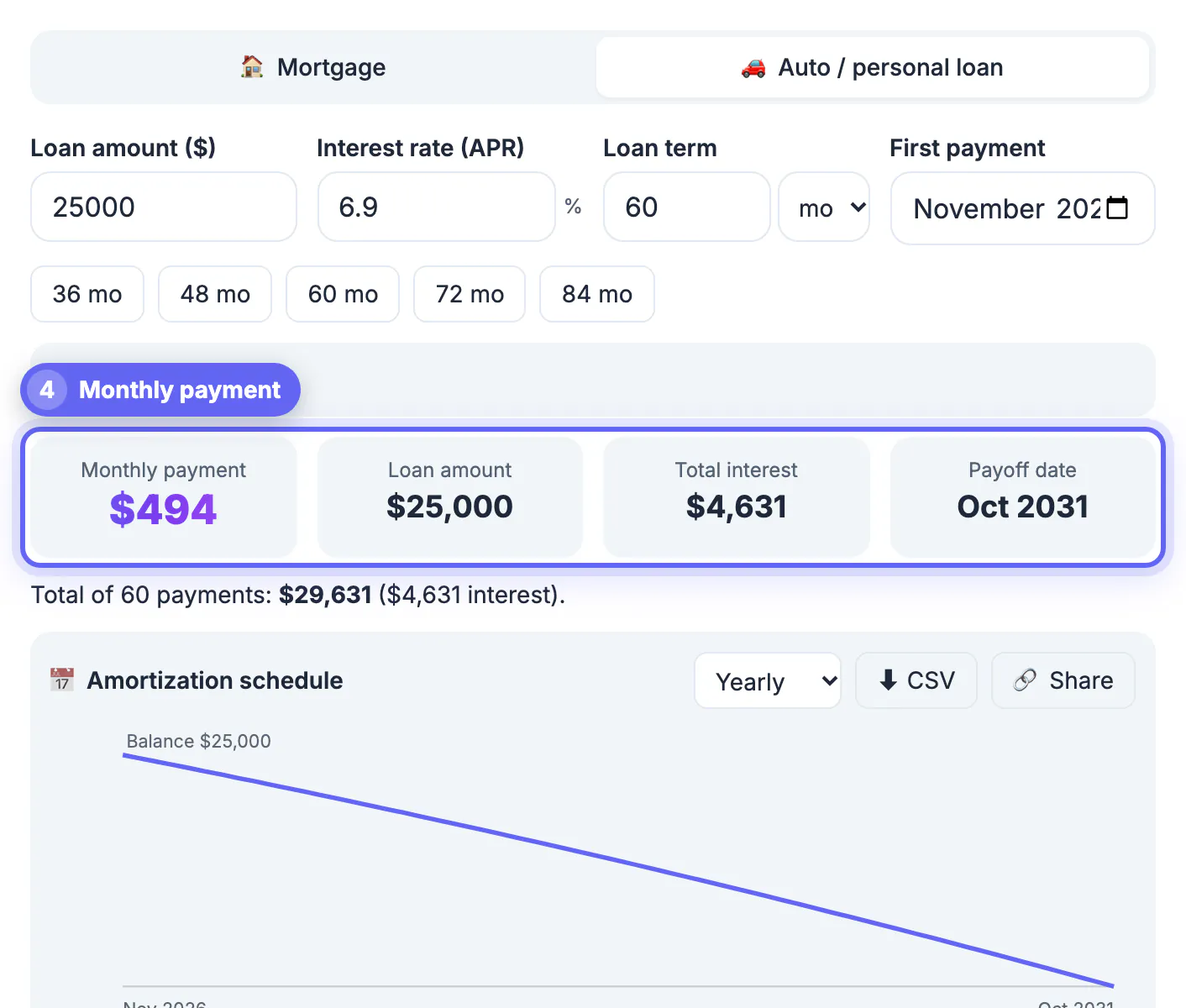
To calculate a loan payment, use the standard amortization formula: M = P × r × (1 + r)^n ÷ ((1 + r)^n − 1), where P is the amount borrowed, r is the annual rate divided by 12, and n is the number of monthly installments. For a $25,000 car loan at an example rate of 6.9 percent over 60 months, that works out to $493.85 a month and $4,631.08 of interest over the life of the note. Below, every step is shown with real numbers, including how each installment splits between interest and principal, what an extra $50 a month does, and how to check a home loan in GrabCast's free Mortgage and Loan Calculator. The rates used here are illustrations, not quotes or advice; your lender's disclosure is the number that counts.
🏠 Try the Mortgage Calculator tool now — freeOpen →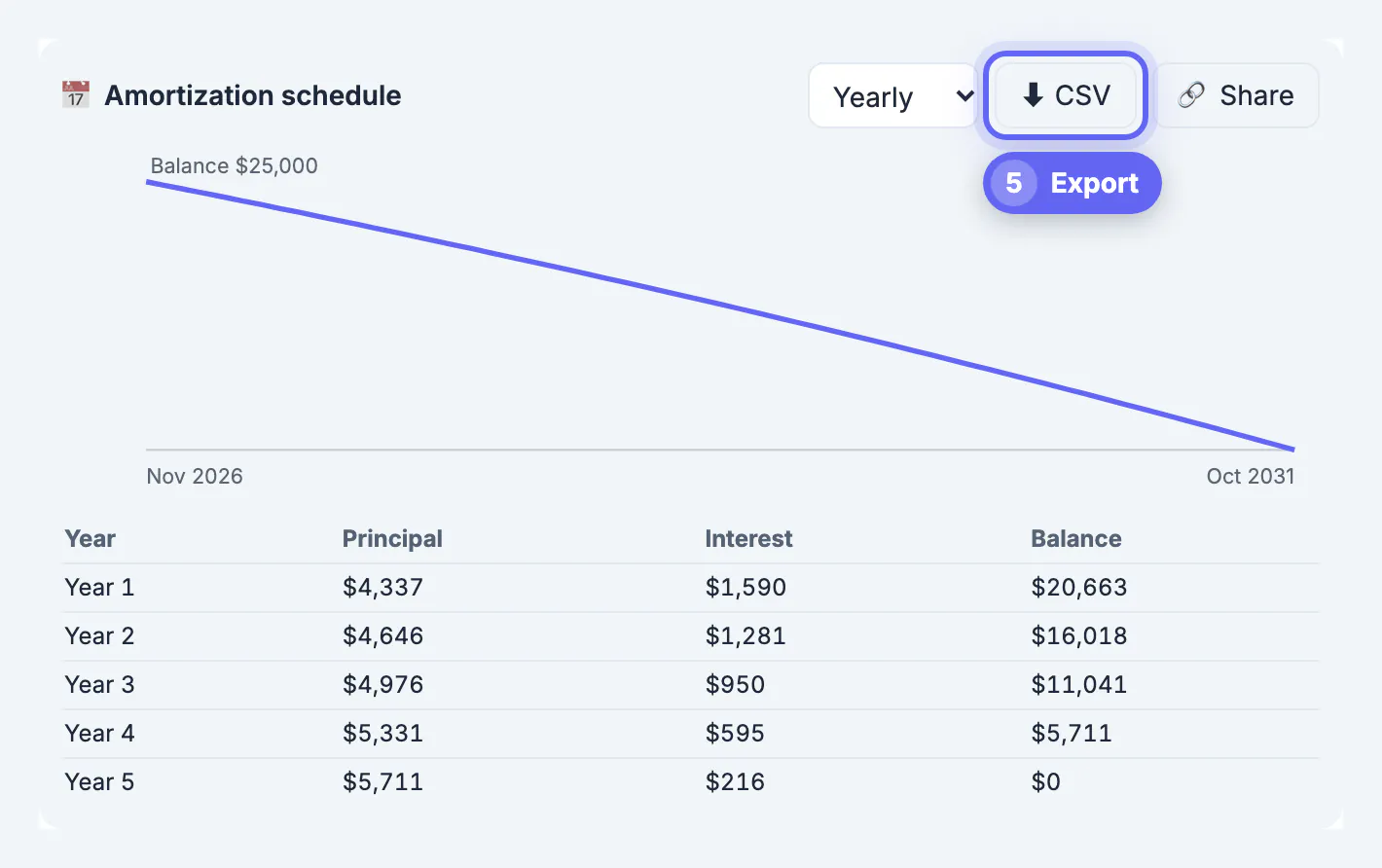
A dealer or lender quote usually leads with the monthly figure, because that is the number that feels affordable. Working it out yourself shows the other half of the picture: the same $25,000 costs $3,679.85 in interest over 48 months and $5,601.85 over 72 months at the same 6.9 percent example rate, so stretching the term lowers the monthly bill by $172.47 but adds almost $2,000 in total cost. Knowing the formula also lets you catch errors and padding. If a quoted monthly figure is higher than the formula predicts for the stated rate, term and amount, something else has been folded in, such as an add-on warranty, gap coverage or fees that were financed rather than paid up front. That is a question to ask before signing, not after the first statement arrives. The same skill helps when refinancing, since you can see exactly how much a lower rate or shorter term changes both numbers.
The amortization formula, term by term
The formula spreads a fixed rate over equal monthly installments so the balance reaches exactly zero at the end. Each symbol has one job:
- P is the principal, the amount actually borrowed after any down payment or trade-in
- r is the monthly rate: the annual percentage divided by 100 and then by 12, so 6.9 percent becomes 0.00575
- n is the count of monthly installments: 60 for five years, 360 for thirty
- (1 + r)^n is the growth factor, the only step that needs a calculator with an exponent key
If the rate is zero, the formula divides by zero; the answer is simply P divided by n. Use the note rate for this math. The APR on a disclosure can be slightly higher because it also folds in certain fees.
A $25,000 car loan worked by hand
Take P = 25,000, an example annual rate of 6.9 percent, and n = 60. First, r = 0.069 ÷ 12 = 0.00575. Next, (1.00575)^60 = 1.410595. The top of the fraction is 25,000 × 0.00575 × 1.410595 = 202.7731. The bottom is 1.410595 − 1 = 0.410595. Divide: 202.7731 ÷ 0.410595 = $493.85 a month.
Multiply by 60 to get $29,631.08 repaid in total, so the cost of borrowing is $4,631.08. Change only the term and the trade-off is clear:
- 48 months: $597.50 a month, $3,679.85 in total interest
- 60 months: $493.85 a month, $4,631.08 in total interest
- 72 months: $425.03 a month, $5,601.85 in total interest
Where each installment goes
The monthly amount stays fixed, but its split shifts every month. Interest is always the current balance times r, and whatever is left reduces the principal.
- Month 1: $143.75 interest, $350.10 principal, balance $24,649.90
- Month 2: $141.74 interest, $352.11 principal, balance $24,297.78
- Month 3: $139.71 interest, $354.14 principal, balance $23,943.65
That is why early extra principal is so effective. Adding $50 to each installment on this example pays the balance off in 54 months instead of 60 and cuts total interest to about $4,116.74, a saving of roughly $514. Check first that your lender applies extra money to principal and charges no prepayment penalty.
Checking a mortgage in the free calculator
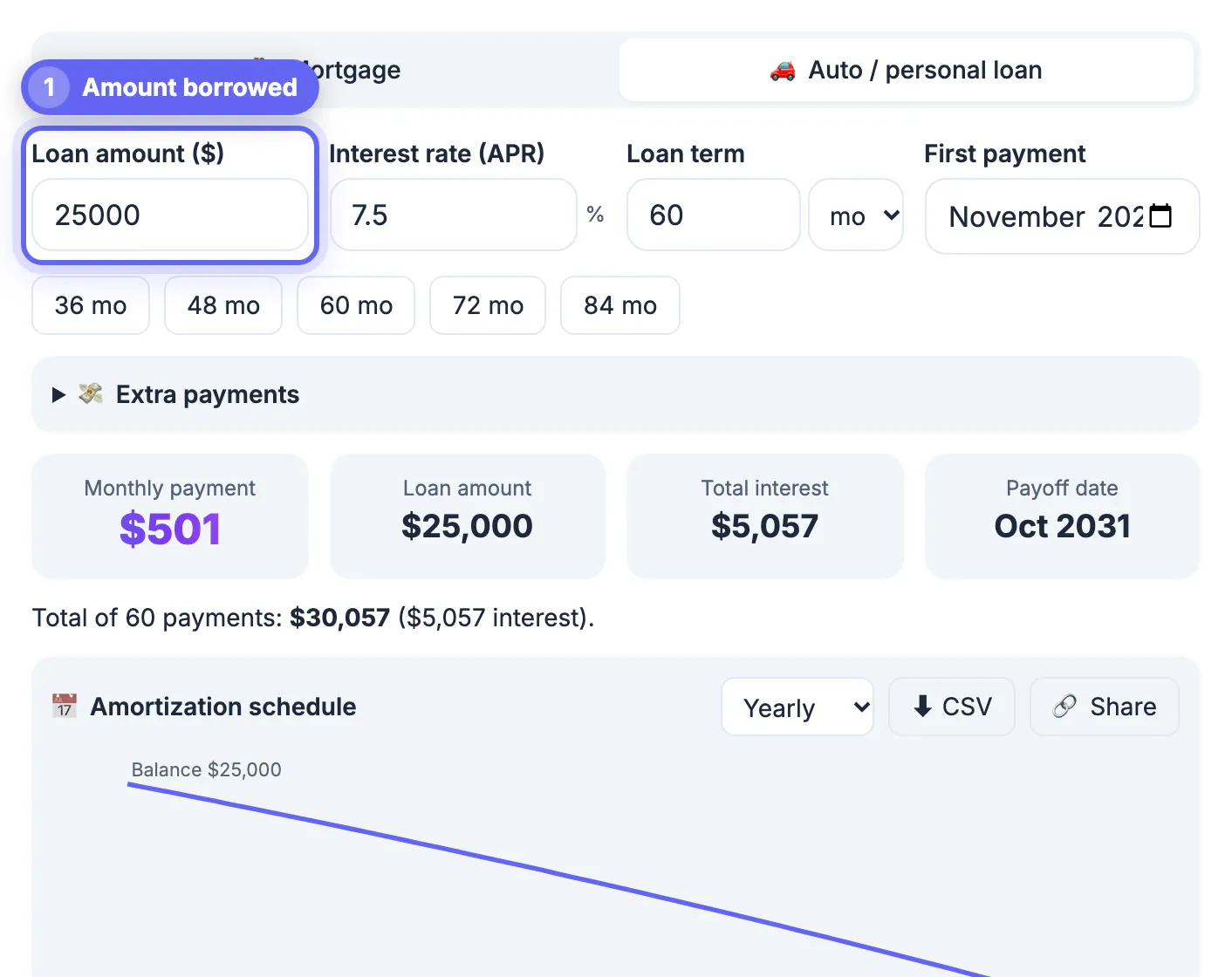
GrabCast's Mortgage and Loan Calculator uses this same formula and adds the costs a home carries. Enter the home price, down payment as a percent or dollar amount, rate and a term in years or months, and it shows the full monthly figure with property tax, insurance, PMI and HOA, plus the amount borrowed, total interest, payoff date and a yearly or monthly amortization schedule with a balance chart and CSV download.
- For principal and interest only, set property tax, insurance, PMI and HOA to 0
- PMI is added automatically when the down payment is under 20 percent, so zero it out if you do not pay it
- Example: a $250,000 price with 20 percent down leaves $200,000 borrowed; at 6.5 percent over 30 years, principal and interest come to $1,264.14
- The Extra payments panel (monthly, once a year or a one-time lump sum) shows the interest saved and how much sooner the balance is paid off
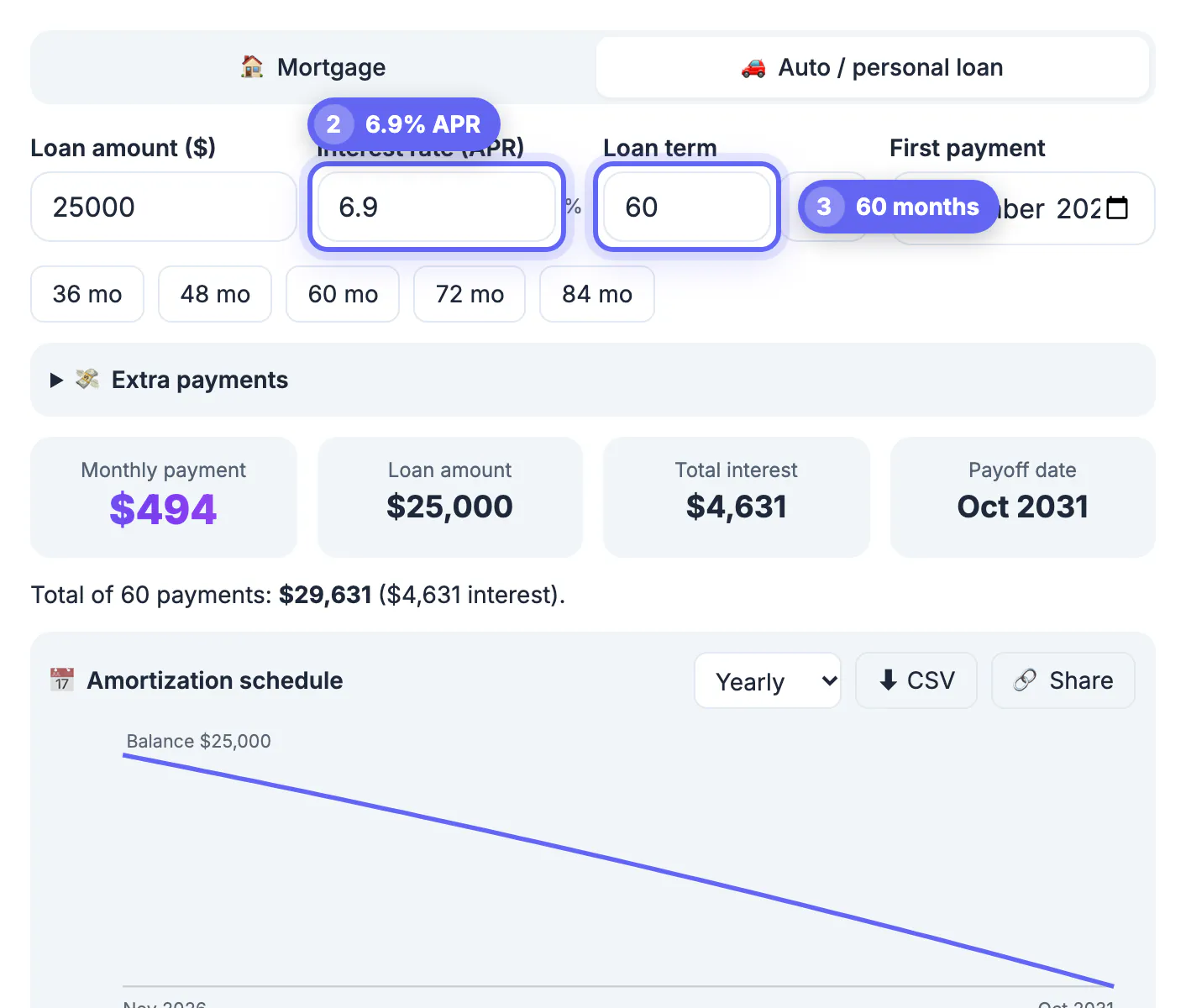
For a five-year auto or personal note, switch to the Auto / personal loan tab and pick 60 months, or check it in a spreadsheet: =PMT(0.069/12, 60, -25000) returns 493.85.
Specifically for vehicle financing, the Auto Loan Calculator applies the same math to a car payment.
Step-by-step
Common mistakes to avoid
Pro tips
Frequently asked questions
What is the formula for a monthly loan payment
M = P × r × (1 + r)^n ÷ ((1 + r)^n − 1). P is the amount borrowed, r is the annual rate divided by 12 as a decimal, and n is the number of monthly payments. For $25,000 at an example 6.9 percent over 60 months, M is $493.85.
Does the formula work for car loans, student loans and mortgages
Yes, for any fixed-rate loan with equal monthly payments. It does not cover interest-only periods, balloon payments or adjustable rates after they reset. Mortgages also carry escrow items such as property tax and insurance, which sit on top of the principal and interest amount.
How do I calculate payments in Excel or Google Sheets
Use =PMT(rate/12, months, -amount). For the car example, =PMT(0.069/12, 60, -25000) returns 493.85. The minus sign in front of the amount makes the result positive. The spreadsheet uses the same amortization formula shown in this guide.
Why is my lender's number different from mine
Small differences usually come from rounding or the first payment date. Larger gaps often mean fees, add-on products or taxes were financed into the balance, or the quote includes escrow for tax and insurance. Ask for an itemized breakdown and compare it with your own calculation.
Is this guide financial advice
No. It explains standard loan math with example rates so you can check quotes yourself. The right loan, term or rate depends on your full situation, so rely on official disclosures and consider talking with a licensed professional before a big borrowing decision.
Any fixed-rate monthly installment follows one formula: M = P × r × (1 + r)^n ÷ ((1 + r)^n − 1), with r as the monthly rate and n as the number of payments. Work one example by hand, compare terms by total interest, and use the calculator to see a full home payment with tax, insurance and PMI.
Related guides
Browse more: all calculator guides · the Mortgage Calculator tool