Read and Write Roman Numerals: Rules, Chart, Examples
Roman numerals use seven letters: I = 1, V = 5, X = 10, L = 50, C = 100, D = 500 and M = 1,000. To read them, add the letters from left to right, but subtract any letter that stands before a larger one. To write them, split the number into thousands, hundreds, tens and ones, and write each part separately: 1994 is 1,000 + 900 + 90 + 4, which becomes M + CM + XC + IV = MCMXCIV. This guide covers both directions, the six subtraction pairs, common traps such as IIII, and how to write a date.
🏛️ Try Roman Numeral Converter now — freeOpen →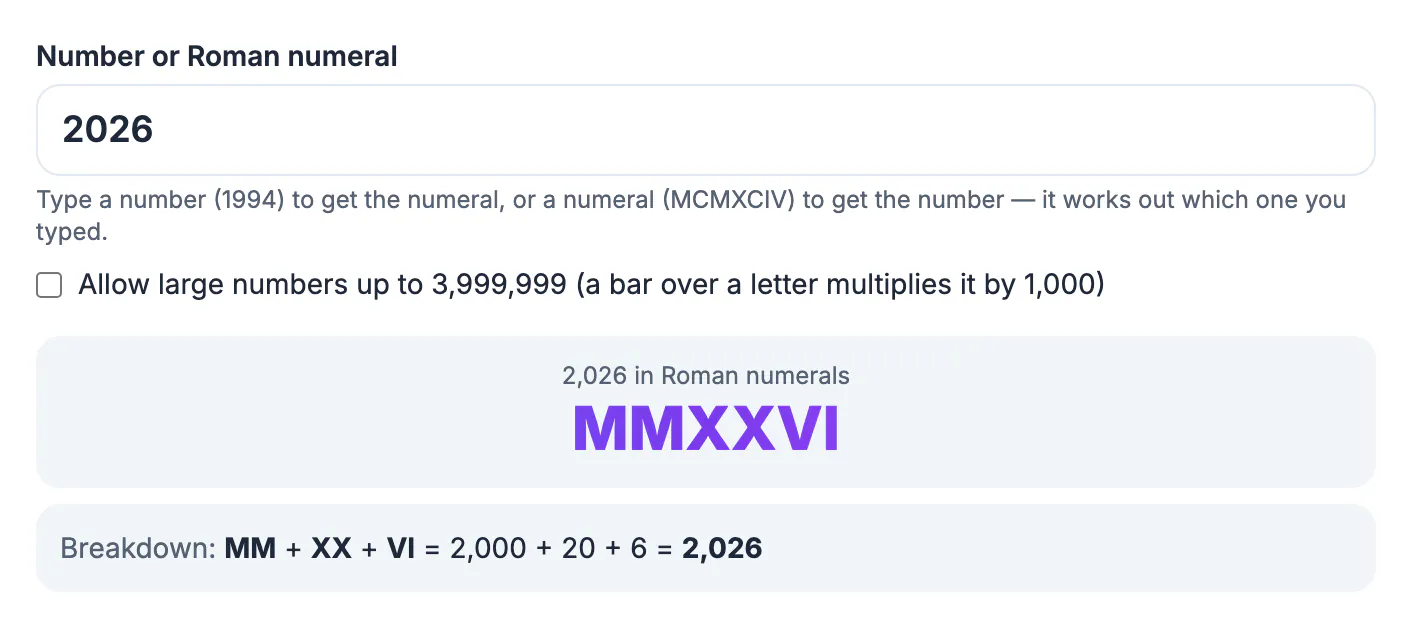
Roman numerals are not just for history class. They appear on clock faces, movie copyright lines, book chapters and the front matter of theses, Super Bowl numbers, building cornerstones, monarchs and popes, outline headings, and a lot of tattoos. Reading one correctly takes seconds once you know the subtraction rule, and writing one correctly matters when the result ends up engraved, printed or inked, where a wrong letter is expensive to fix.
The seven letters and the one rule
Every numeral is built from I, V, X, L, C, D and M. Letters are normally written from largest to smallest and added: XVI = 10 + 5 + 1 = 16, and MDCLXVI = 1,666 uses each letter once.
The exception is subtraction. When a smaller letter comes directly before a larger one, it is subtracted. Only six pairs are allowed:
- IV = 4 and IX = 9
- XL = 40 and XC = 90
- CD = 400 and CM = 900
Two more limits keep the system tidy. I, X, C and M may repeat at most three times in a row, so 3 is III but 4 is IV. V, L and D never repeat, because VV would just be X. There is no zero; the Romans used the word nulla.
How to write a number in Roman numerals
Break the number into place values and convert each one on its own. Never try to subtract across places, such as writing 99 as IC or 1990 as MXM; those are not standard.
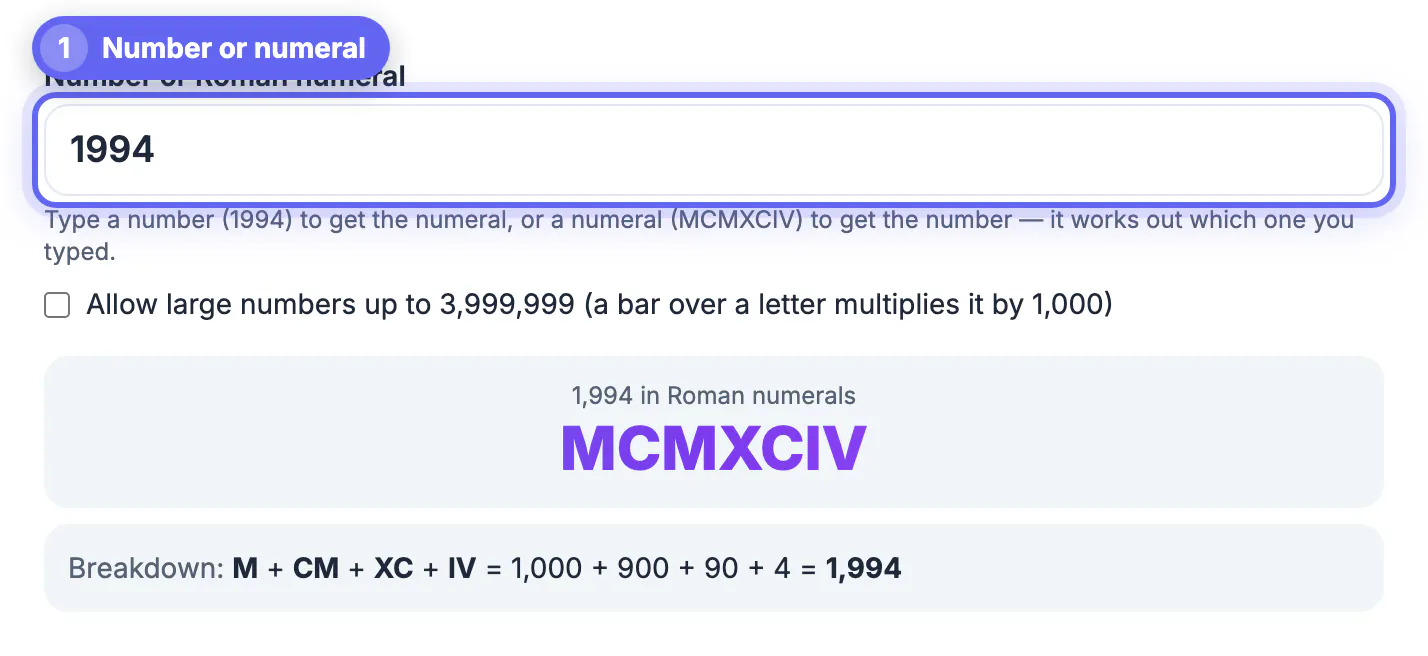
- 1994 = 1,000 + 900 + 90 + 4 = M + CM + XC + IV = MCMXCIV.
- 2026 = 2,000 + 20 + 6 = MM + XX + VI = MMXXVI.
- 49 = 40 + 9 = XL + IX = XLIX, not IL.
- 3,999 = MMM + CM + XC + IX = MMMCMXCIX, the largest standard numeral.
For each digit, the pattern is the same at every place: 1, 2 and 3 repeat the unit letter; 4 is unit + five; 5 is the five letter; 6 to 8 add units after it; and 9 is unit + ten. For ones that gives I, II, III, IV, V, VI, VII, VIII, IX; for tens X, XX, XXX, XL, L, LX, LXX, LXXX, XC.
How to read a Roman numeral
Go through the letters left to right. Add each value unless the next letter is larger, in which case subtract it. It is often easier to spot the subtraction pairs first and group them.
Take MCMLXXXIV. Group it as M, CM, LXXX and IV, then add: 1,000 + 900 + 80 + 4 = 1,984. The same method reads MMXXVI as 2,000 + 20 + 6 = 2,026. With practice, you learn to see CM, XC and IV as single chunks, which makes long numerals as easy as short ones.
A few to practise on: XLII is 42, XCIX is 99, CDXLIV is 444, and the year in an old film credit, MCMXCIX, is 1999. For numbers of 4,000 and above you may see a bar drawn over letters, which multiplies them by 1,000, so V with a bar is 5,000. These large forms are rare outside puzzles and inscriptions, but the converter reads and writes them once you tick the large-numbers option.
Standard form, clocks and the IIII question
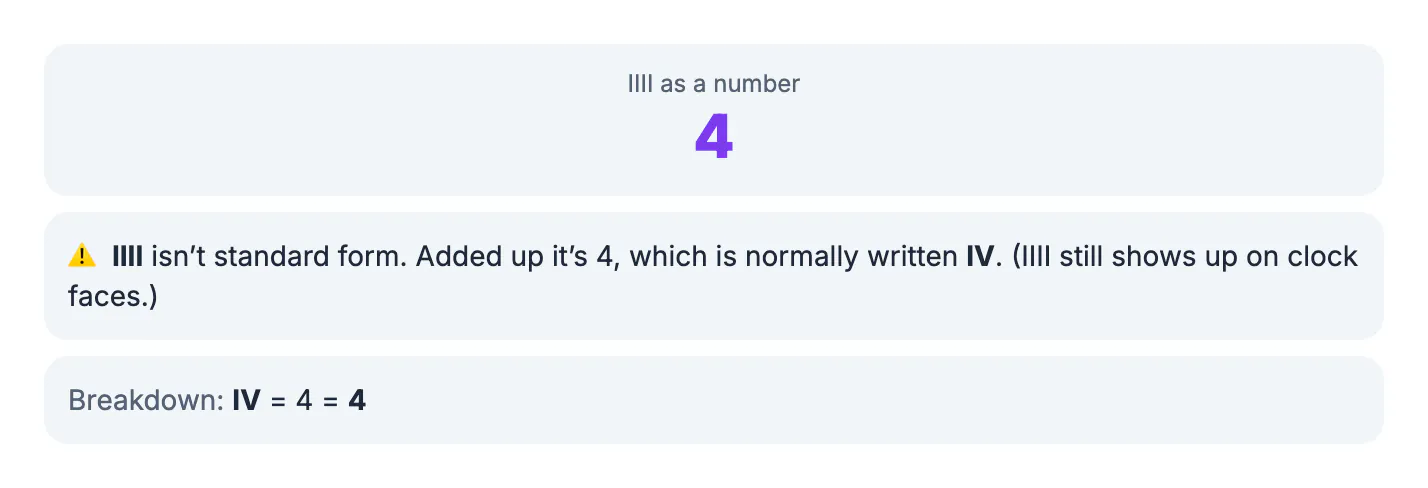
Many clock faces show 4 as IIII instead of IV. It is an old design tradition, balancing the IIII against the VIII on the other side, but it is not standard form. If you type IIII into the converter, it still reads it as 4 and adds a note that the standard way to write it is IV.
The same check catches other non-standard spellings, such as VV, IC or XXXX. That matters for anything permanent: a plaque, a certificate, an engraved watch or a tattoo should use the standard form unless you deliberately want the clock-face style.
Writing dates in Roman numerals
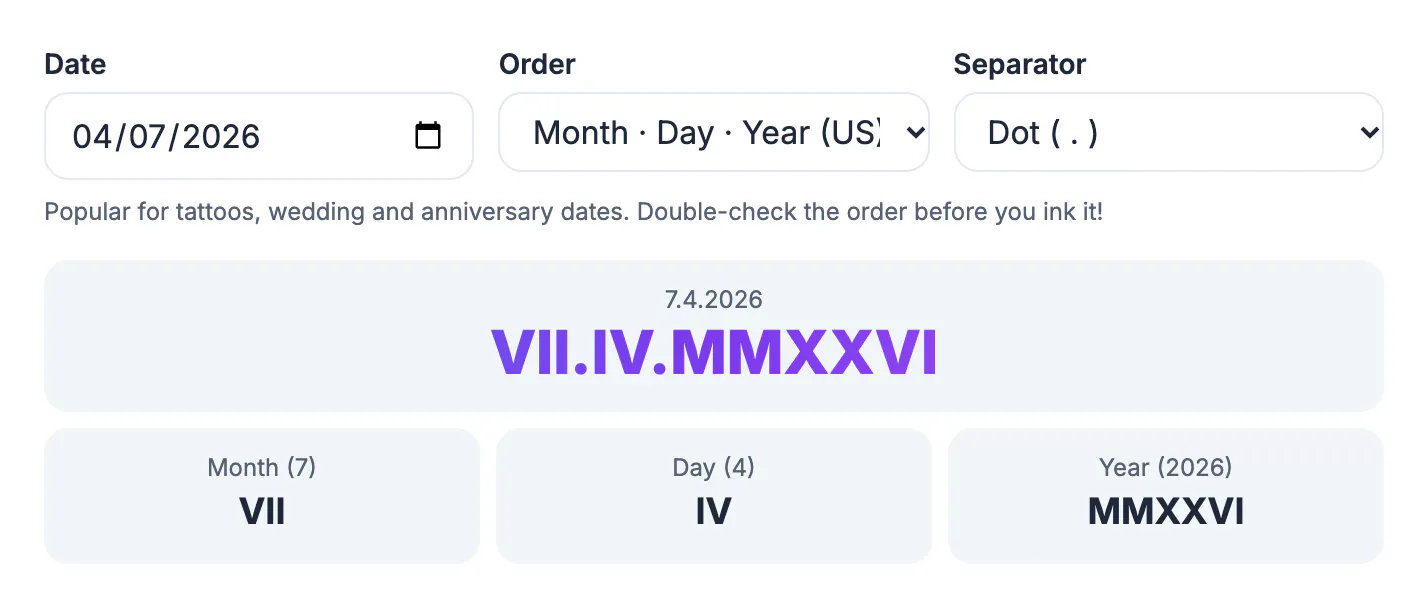
A date is just three numbers converted separately and joined with a separator. The only real decision is the order. July 4, 2026 in US month-day-year order with dots is VII.IV.MMXXVI; in day-month-year order it becomes IV.VII.MMXXVI, which reads as 7 April to most Americans.
The converter's Date tab has an Order menu with Month · Day · Year (US), Day · Month · Year and Year · Month · Day, and a Separator menu with a dot, middle dot, dash, slash or space. It shows the digits above the result, such as 7.4.2026, and separate Month, Day and Year cards so you can check each part before you commit it to anything permanent.
Using the Roman Numeral Converter
On the Number ⇄ Roman tab, type into the Number or Roman numeral box. It detects which way you are going: digits give a numeral, and letters (upper or lower case) give a number. Every result includes a Breakdown line, such as M + CM + XC + IV = 1,000 + 900 + 90 + 4 = 1,994, so you can see how it was built.
Tick Allow large numbers up to 3,999,999 to write bigger values, where a bar over a letter multiplies it by 1,000. Zero, negatives and decimals get a clear message, since Roman numerals have none of them. Copy result copies the numeral, Copy share link saves the input in a link, and the Roman numerals chart & rules panel holds the seven letters, the rules and a chart of 1 to 10, 20 to 100 and 200 to 1,000.
Other number systems are covered by the Binary, Hex & Decimal Converter.
Step-by-step

Common mistakes to avoid
Pro tips
Frequently asked questions
How do you write 1994 in Roman numerals?
MCMXCIV: M (1,000) + CM (900) + XC (90) + IV (4).
What year is MCMLXXXIV?
1984. Group it as M, CM, LXXX and IV: 1,000 + 900 + 80 + 4.
Is IIII a correct Roman numeral for 4?
It adds up to 4 and appears on many clock faces, but the standard form is IV. The converter reads IIII and notes that IV is standard.
How do you write 2026 in Roman numerals?
MMXXVI: MM (2,000) + XX (20) + VI (6).
What is the largest Roman numeral?
In standard form, 3,999 (MMMCMXCIX). With a bar over letters to multiply by 1,000, the converter goes up to 3,999,999.
Learn the seven letters and the six subtraction pairs, convert one place value at a time, and read by grouping pairs such as CM and IV. For anything permanent, check the standard form and the date order before it is printed or inked.
Related guides
Browse more: all calculator guides · Roman Numeral Converter