Flesch Reading Ease Score: What It Means, How to Raise It
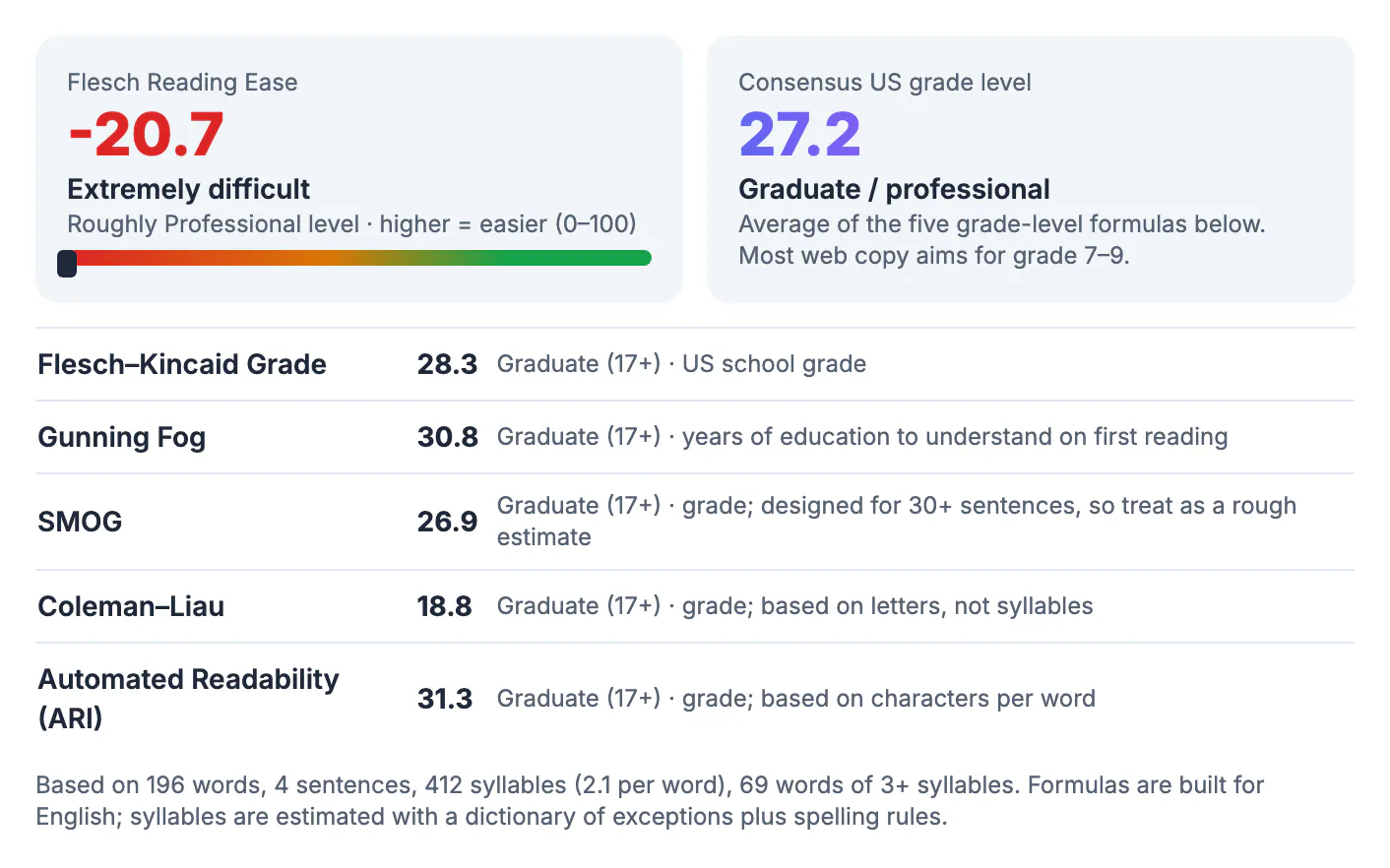
The Flesch Reading Ease score rates English text from roughly 0 to 100 using only two measurements: how long your sentences are and how many syllables your words have. Higher means easier; 60 to 70 is plain English that most adults read comfortably, and anything under 30 reads like a legal contract. GrabCast's free Readability Checker, part of its Word Counter, calculates this score together with five grade-level formulas as you type, in your browser. This guide explains what the number measures, why two short sentences beat one long one, and how a dense homeowners association parking notice went from minus 20.7 to 89.8 by rewriting sentences, without losing a single rule.
🔢 Try the Word Counter tool now — freeOpen →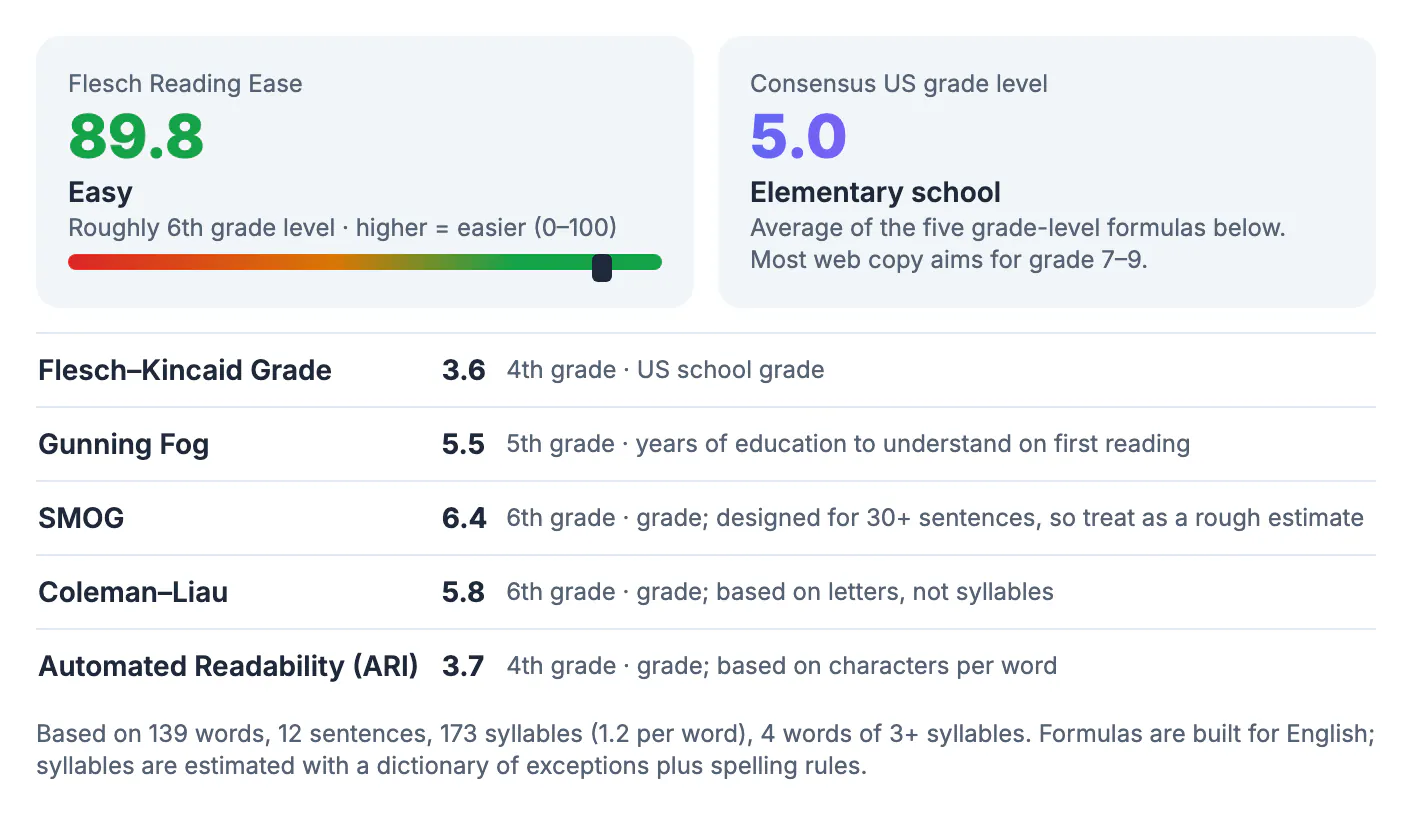
People skim. A notice about towing, a return policy or a medication reminder is read quickly, often on a phone, by someone who did not ask to read it. When sentences run past 40 words and every second word has three syllables, readers miss the one detail that matters, then call the office or ignore the rule. A readability score will not tell you whether a text is accurate, kind or complete, but it flags the mechanical habits that make text hard: stacked clauses, nominalizations such as utilization instead of use, and passive constructions that hide who does what. Because the formulas are simple arithmetic, the score moves the moment you split a sentence or swap a long word, which makes it a practical editing gauge rather than a verdict.
How the Flesch Reading Ease score is calculated
Rudolf Flesch published the formula in 1948, and it is still the standard: 206.835 minus 1.015 times the average sentence length in words, minus 84.6 times the average syllables per word. Only those two ratios matter. Vocabulary difficulty, grammar and meaning are invisible to it.
- Average sentence length: words divided by sentences; each extra word per sentence costs about one point
- Average syllables per word: each extra tenth of a syllable per word costs about 8.5 points
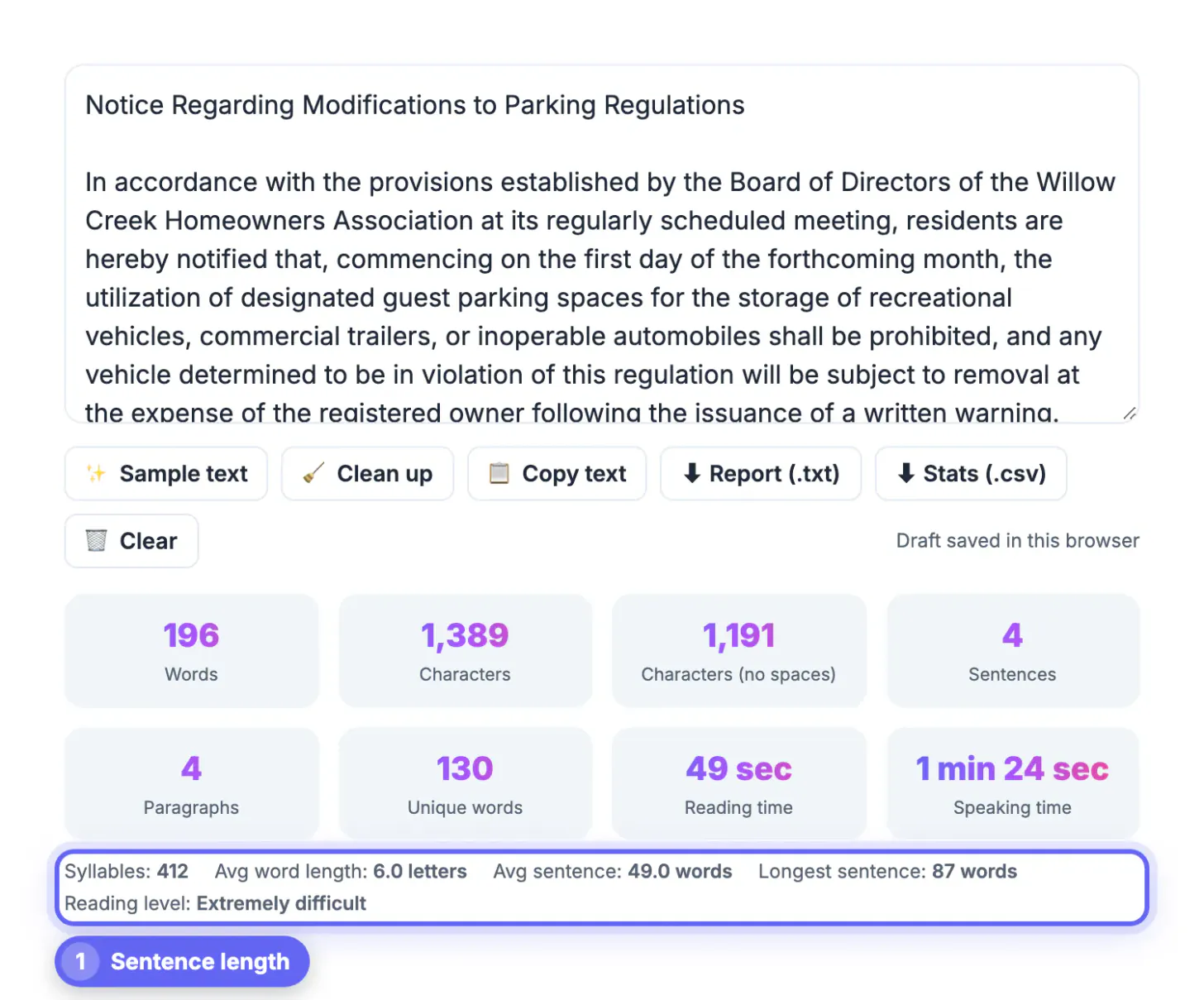
- The HOA notice averaged 49.0 words per sentence and 2.1 syllables per word, which drives the score below zero
- The rewrite averaged about 11.6 words per sentence and 1.2 syllables per word, which lands near 90
The checker estimates syllables with a dictionary of exceptions plus spelling rules. Its FAQ notes the formulas are built for English and are most reliable above about 100 words, so score a whole section rather than one line.
What a good score looks like for your audience
There is no universal target, but there are sensible ranges. The Readability tab labels each band and also shows a consensus US grade level, the average of Flesch–Kincaid, Gunning Fog, SMOG, Coleman–Liau and the Automated Readability Index.
- 90 to 100, very easy: short instructions, signs, children's text
- 60 to 70, plain English: most web pages, emails, notices and marketing copy aim here, about 8th to 9th grade
- 30 to 50, difficult: technical reports and specialist articles, acceptable when readers expect it
- Below 30, very difficult: academic and legal prose; the original notice scored -20.7 with a consensus grade of 27.2
- For a general audience, a consensus grade of about 7 to 9 is a practical target
SMOG is designed for texts with 30 or more sentences, so on a short notice the tool reminds you to treat it as a rough estimate. When the five grade formulas disagree by several grades, trust the average rather than any single one.
Raising the score without dumbing the text down
The goal is not to remove information but to carry it in shorter, more concrete units. The rewrite kept every rule from the original notice: the start date, the banned vehicle types, the warning before towing, the five-business-day request window and the board's right to fine.
- Split at every and, whereupon and which that starts a new idea; one idea per sentence
- Replace nominalizations: utilization of became use, issuance of a written warning became you will get a written warning
- Name the actor: an application will be evaluated became the parking committee will look at
- Swap long words for common ones when the meaning is identical: commencing became start, prior to became before
- Turn a heading into a plain statement: Notice Regarding Modifications to Parking Regulations became New Parking Rules Start Next Month
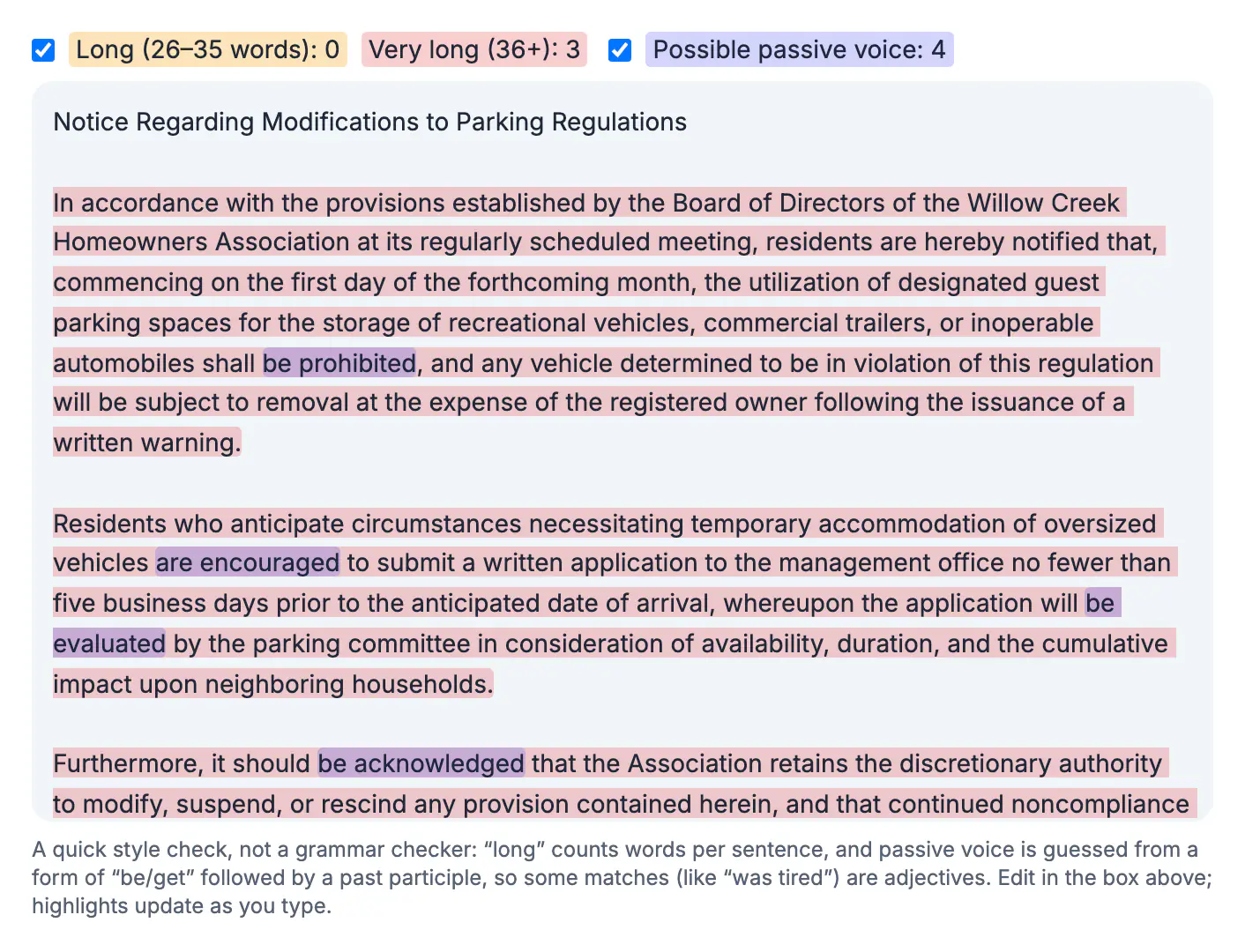
The Style check tab helps find targets. On the original it flagged 3 very long sentences of 36 words or more and 4 possible passive voice phrases, such as be prohibited and be evaluated. It is a heuristic, so phrases like was tired can be flagged too; read each highlight rather than rewriting blindly.
Shorten dense passages with this summarizing guide, and use the Text Diff Checker to compare drafts before and after.
Where readability formulas mislead
Because the formulas count rather than read, they can reward bad writing and punish good writing. Knowing the blind spots keeps you from chasing a number.
- Short words are not always clear words; jargon such as HOA or APR scores as easy but may confuse newcomers
- Bullet lists without end punctuation can count as one giant sentence or many tiny ones depending on line breaks
- Technical terms that must stay, such as a drug name, lower the score without making the text worse
- Choppy text with 5-word sentences scores very high but can read as curt; the plain notice at 89.8 is at the easy end on purpose, for a notice people skim
- The formulas are built for English; scores for other languages are not meaningful
Use the score to compare drafts of the same text, not to rank unrelated documents. A drop from grade 27 to grade 5 on the same notice is real progress; a grade 9 manual is not automatically worse than a grade 6 flyer.
Step-by-step
Common mistakes to avoid
Pro tips
Frequently asked questions
What is a good Flesch Reading Ease score?
For general readers, 60 to 70 or higher. That range is plain English, roughly 8th to 9th grade. Scores below 30 read like academic or legal text.
Can the score be negative?
Yes. The formula has no floor, so very long sentences full of long words push it below zero. The original parking notice in this guide scored -20.7.
What is the consensus grade level?
The average of five grade-level formulas: Flesch–Kincaid Grade, Gunning Fog, SMOG, Coleman–Liau and the Automated Readability Index. It smooths out the disagreements between them.
Is my text uploaded when I check readability?
No. The Word Counter's FAQ states all counting and scoring happen in your browser. The draft is saved only in this browser's local storage so a refresh does not lose it, and Clear deletes it.
Does the tool work for languages other than English?
The counts do, but the readability formulas and syllable rules are designed for English, so their scores are not meaningful for other languages.
The Flesch Reading Ease score measures sentence length and word length, nothing more, and that is exactly why it is useful while editing. Aim for 60 or higher for general readers, split long sentences, name the actor, prefer common words, and check the Style check highlights. Keep every fact, compare drafts of the same text, and stop when the text reads clearly rather than when the number peaks.
Related guides
Browse more: all text and developer guides · the Word Counter tool