Hourly Overtime Paycheck: What Extra Hours Really Net
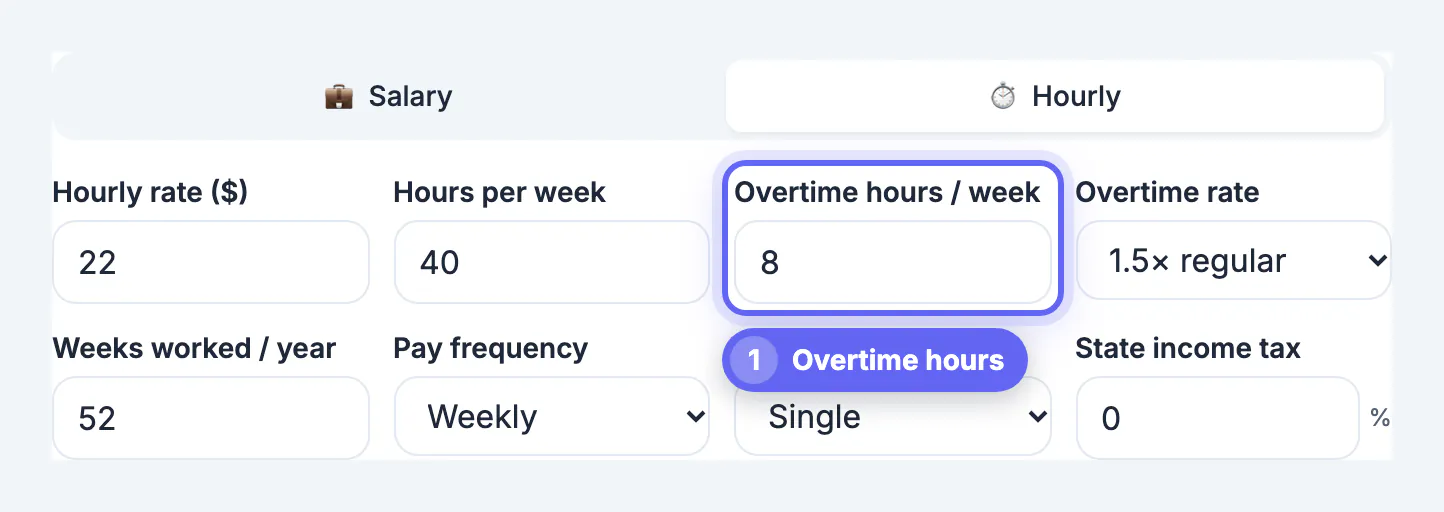
Overtime adds less to an hourly paycheck than the time-and-a-half rate suggests, because every extra dollar is taxed at your top bracket plus Social Security and Medicare. Take a warehouse lead earning $22 an hour, working 40 regular hours plus 8 overtime hours at 1.5 times, paid weekly, filing single, in a state with no wage income tax. The GrabCast Paycheck & Salary Calculator shows $1,144.00 gross and $961.13 take-home per week. Turn overtime off and the same week nets $749.00, so those 8 hours add $212.13, about $26.52 per overtime hour instead of $33. This page shows how to model your own overtime, what the 2026 federal overtime deduction option changes in the estimate, and why it tends to arrive as a refund rather than a bigger check. Treat all figures as estimates for tax year 2026, not tax advice.
💰 Try the Paycheck & Salary Calculator now — freeOpen →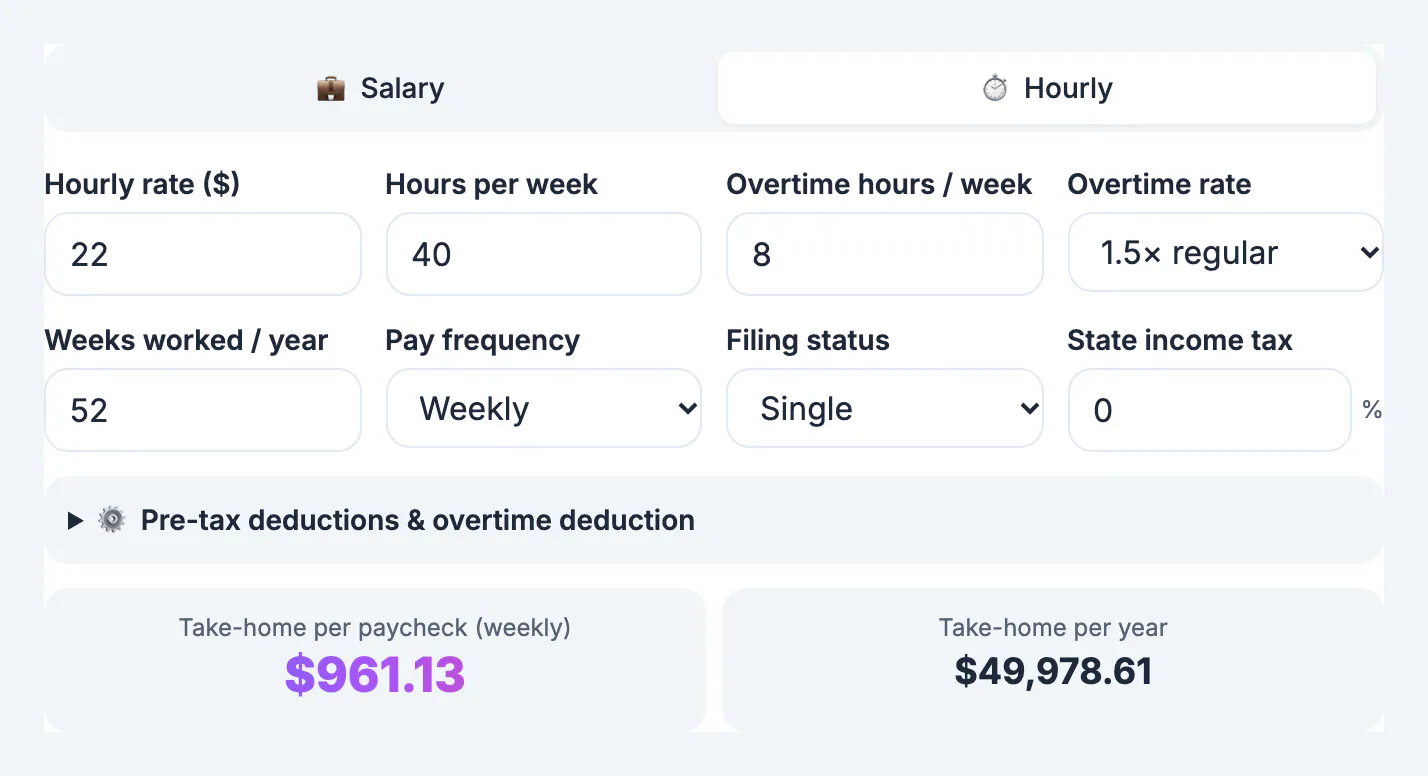
Extra shifts are a trade: evenings, weekends and fatigue in exchange for money. Deciding whether a Saturday shift is worth it is easier when you know what actually lands in your account. Hourly pay also varies week to week, so the net figure on a heavy overtime week can make a normal week look like a pay cut. Running both versions, with and without overtime, gives you a floor to budget on and a realistic ceiling for the weeks you pick up more hours.
The hourly overtime paycheck in numbers
With Hourly selected, the calculator multiplies the rate by regular hours and adds overtime at the chosen multiplier. For this worker the weekly result is:
- Regular pay: $22 times 40 hours, or $880.
- Overtime pay: $22 times 1.5 times 8 hours, or $264.
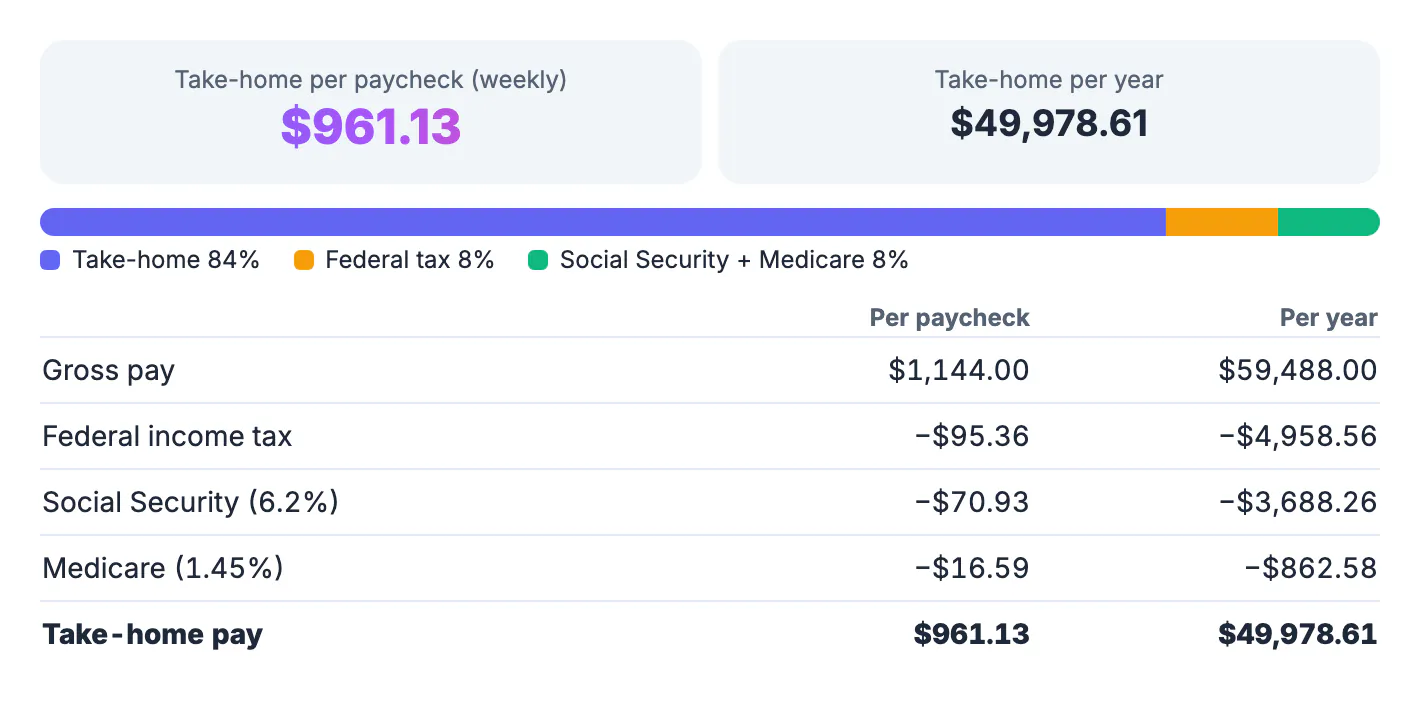
- Gross pay: $1,144.00 per week, $59,488.00 per year over 52 weeks.
- Federal income tax: minus $95.36 per week, $4,958.56 per year.
- Social Security: minus $70.93 per week; Medicare: minus $16.59 per week.
- No state income tax line, because the state field is 0.
- Take-home pay: $961.13 per week, $49,978.61 per year.
The bar chart reads 84% take-home, 8% federal tax and 8% Social Security plus Medicare. The summary line shows the worker sits in the 12% bracket, and the hourly equivalent under the results is an average that blends regular and overtime hours.
What each overtime hour is worth after tax
To isolate overtime, run the calculator twice: once with 8 overtime hours and once with 0. The difference is the real value of the extra time.
- Without overtime: $880 gross and $749.00 take-home per week.
- With 8 overtime hours: $1,144 gross and $961.13 take-home.
- Difference: $264 more gross and $212.13 more take-home, so about 80% of overtime pay reaches the account.
- Per hour: $33 gross overtime becomes roughly $26.52 net.
- The missing 20% is the 12% federal bracket plus 7.65% for Social Security and Medicare.
If your state taxes wages, add its rate to that marginal cost. Someone in the 22% bracket with a 5% state estimate would keep noticeably less of each overtime dollar, which is why the same shift can be worth different amounts to two coworkers.
The 2026 overtime deduction option and your paycheck
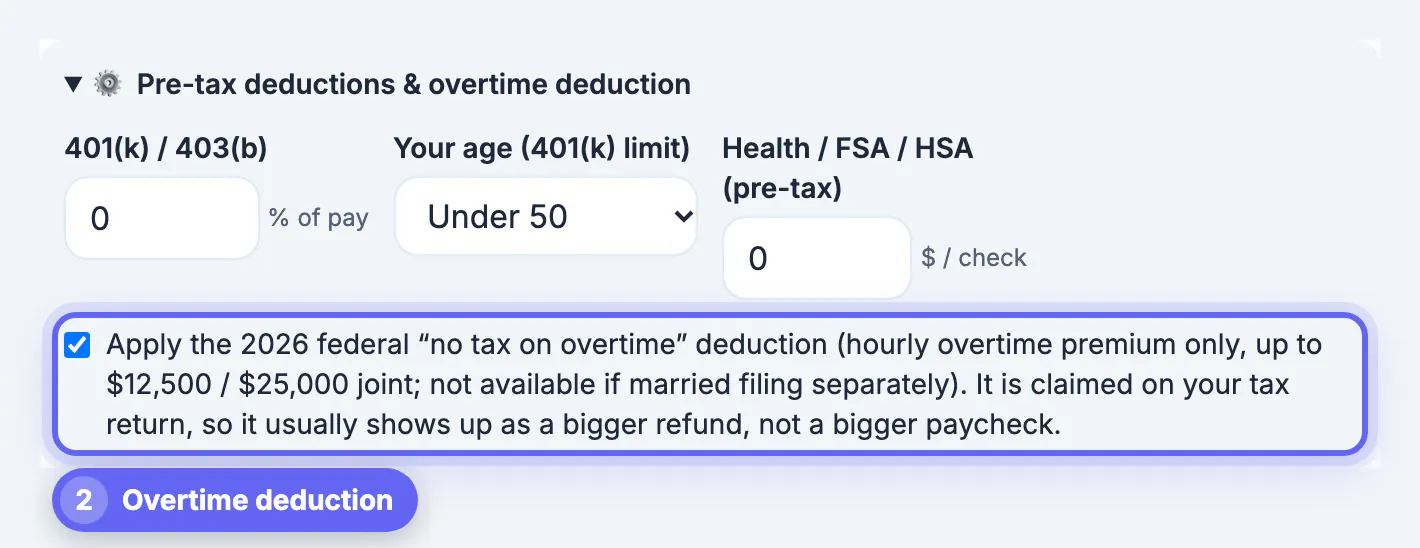
The calculator includes a checkbox for the federal deduction on overtime pay that applies for 2025 through 2028. Per the tool's notes, it covers only the premium half of time-and-a-half FLSA overtime, is capped at $12,500 or $25,000 for joint filers, phases out above $150,000 or $300,000 of income and is not available to married filing separately.
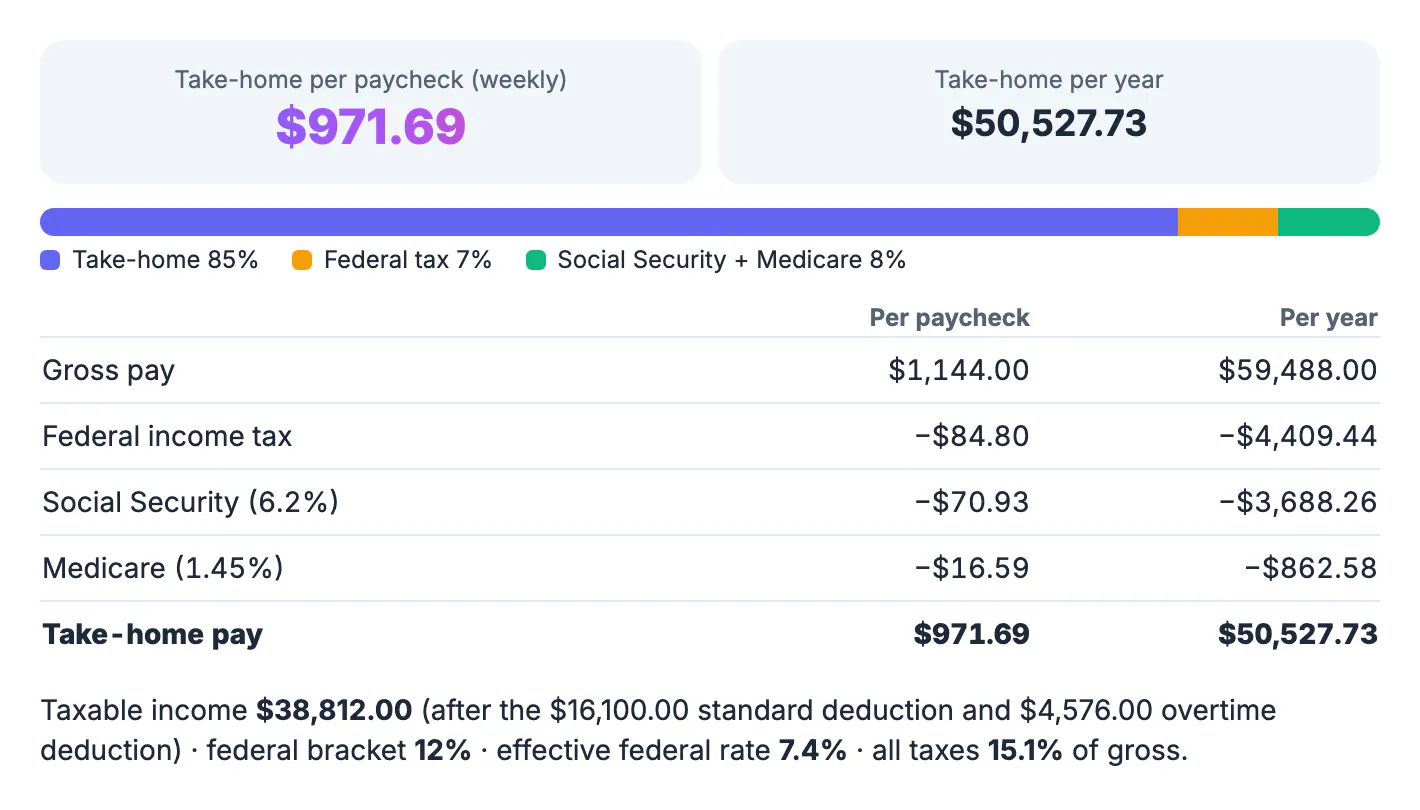
- For this worker, the premium portion is $11 per overtime hour, times 8 hours, times 52 weeks: $4,576 a year.
- With the box ticked, taxable income drops from $43,388 to $38,812 and federal tax falls from $4,958.56 to $4,409.44 a year.
- The estimate shows $971.69 per week instead of $961.13, a $10.56 weekly difference, or $549.12 for the year.
- Payroll taxes do not change; Social Security and Medicare still apply to all overtime pay.
The important caveat: you claim this deduction on your tax return. Your employer's withholding may not reflect it during the year, so the $549 usually shows up as a larger refund in spring rather than a larger weekly deposit. Leave the box unchecked when you want to predict the actual check.
Overtime scenarios the calculator does not cover
Keep these limits in mind before you rely on the numbers:
- Double-time or holiday rates: switch the overtime rate to 2 times, but the overtime deduction option only counts a premium of up to half the regular rate.
- Irregular weeks: the tool assumes the same overtime every week of the year, so average your hours over a typical month.
- Shift differentials, tips, bonuses and commissions are not modeled, and employers sometimes withhold supplemental pay at a flat rate.
- Daily overtime rules in some states, and exempt salaried roles, change who gets overtime at all; check your state labor department.
- Tax credits, dependents and other household income can change the federal line.
For timesheet math such as breaks and daily totals, add up your hours first, then bring the weekly overtime number into the paycheck estimate.
Tracking hours first? The Time Card Calculator totals them, and the Retirement Calculator (401k) shows long-term effects of saving more.
Step-by-step
Common mistakes to avoid
Pro tips
Frequently asked questions
How much of my overtime pay will I keep?
Roughly your pay minus your top federal bracket, 7.65% for Social Security and Medicare and any state rate. For a single filer in the 12% bracket with no state income tax, about 80% of overtime pay reaches the paycheck in this estimate.
Does the overtime deduction make my weekly paycheck bigger?
Usually not. It is claimed on your tax return, so it tends to show up as a larger refund. The calculator applies it to the annual estimate so you can see its size.
Which part of overtime counts for the deduction?
Only the premium portion of FLSA overtime, the extra half in time-and-a-half, up to $12,500 or $25,000 for joint filers, with a phase-out above $150,000 or $300,000 of income.
Can I model double time?
Yes. Set the overtime rate to 2 times regular. The gross pay reflects double time, but the deduction option still only counts a premium of up to half the regular rate.
Does the tool know my state's income tax rules?
No. The state field is one flat percentage. States without a wage income tax can leave it at 0; everyone else should enter an estimated effective rate.
Eight overtime hours at $33 add $264 to this worker's gross pay but $212.13 to take-home, about $26.52 an hour after federal and payroll taxes. The 2026 overtime deduction trims the annual federal bill by about $549 in this example, mostly as a refund. Model a no-overtime baseline and an overtime week side by side, budget on the first, and let the second fund your goals.
Related guides
Browse more: all calculator guides · the Paycheck & Salary Calculator