BOGO vs Percent Off: Which Deal Actually Saves More
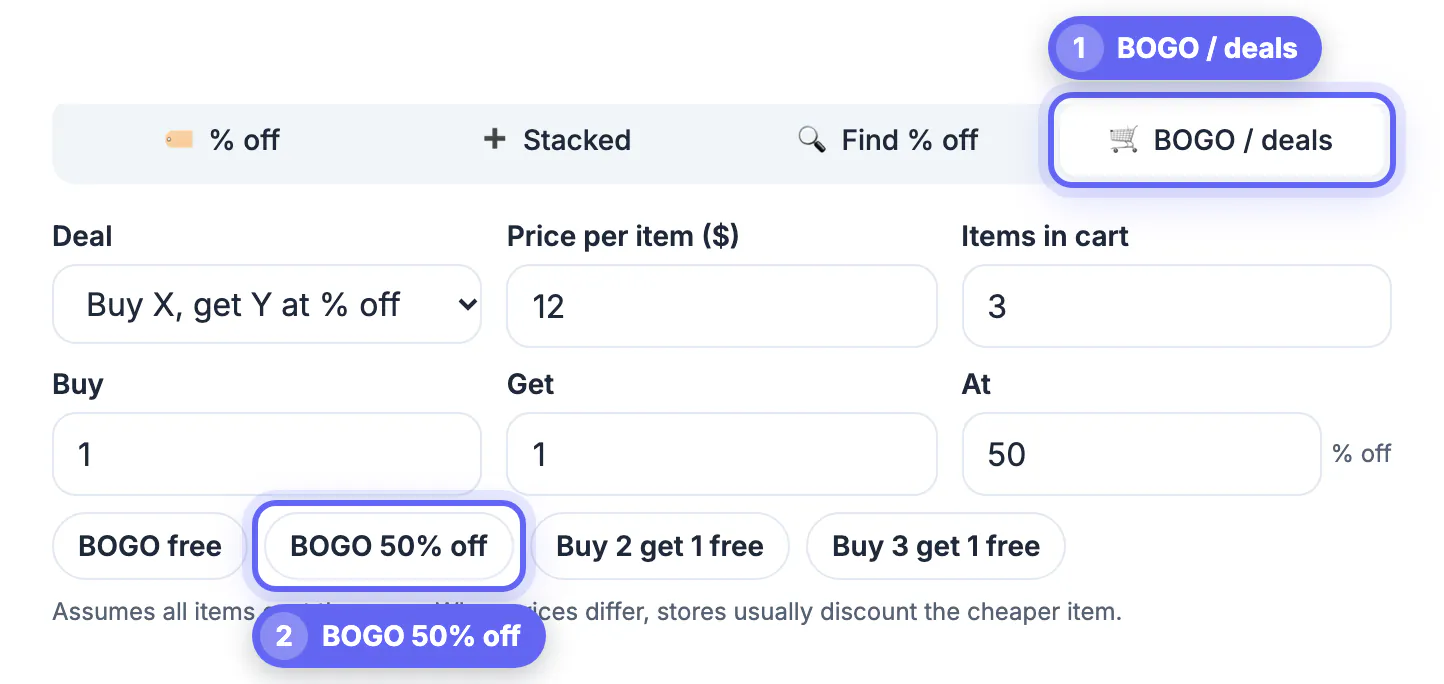
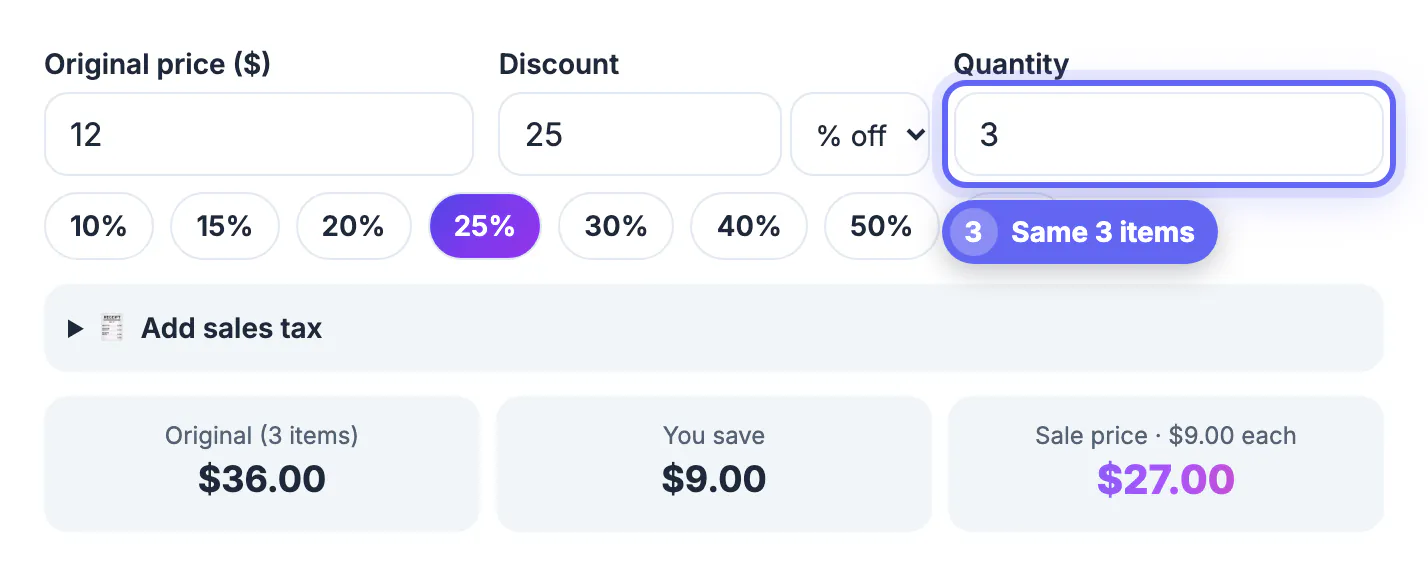
Buy one, get one 50% off is the same as 25% off only when you buy items in pairs; with an odd number in the cart it saves less, and a simple percent-off sale can win. Say three bottles of a store-brand shampoo cost $12 each. The BOGO / deals tab of the GrabCast Discount Calculator shows BOGO 50% off charges $30 for three, a 16.67% saving, and suggests adding one more item because it would be half price. A plain 25% off on the same three bottles comes to $27. This comparison guide shows how to line up BOGO, percent-off and multi-buy offers such as 3 for $10 on the same cart, when adding an item really saves money, and where the calculator's same-price assumption stops matching the register.
🏷️ Try the Discount Calculator now — freeOpen →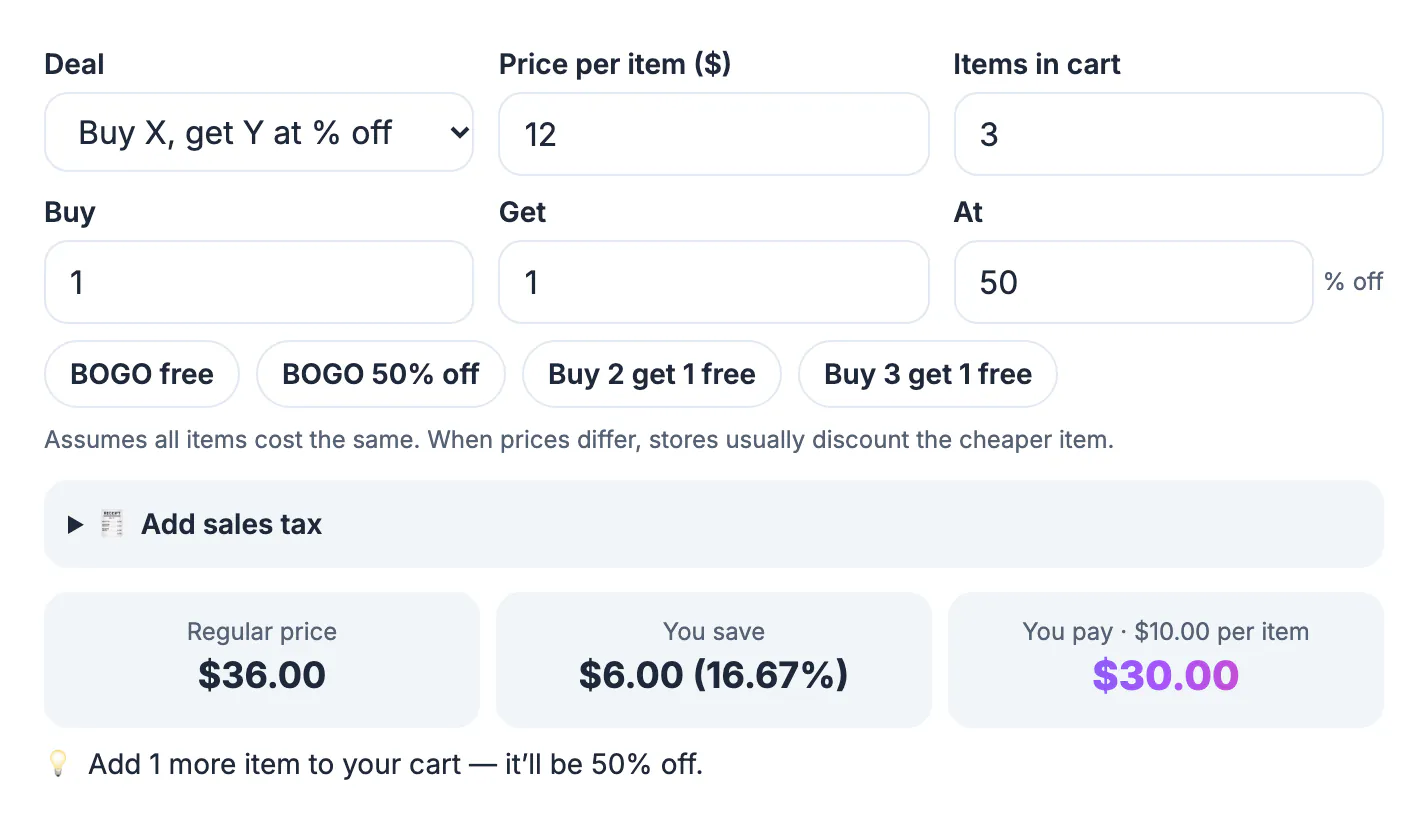
Stores mix formats on purpose: one aisle has buy one, get one free, the next has 30% off, and the endcap says 3 for $10. Each sounds generous, but they reward different cart sizes. A deal that is great for a family stocking up can be mediocre for one person buying a single item. Comparing them as a final price for the quantity you actually need, instead of as a headline, keeps you from buying extra things just to trigger a promotion. It also helps to think about storage space, expiry dates and whether the item is one you would buy anyway at the regular price, because a deal on something you never use has a real cost and no benefit at all.
BOGO vs percent off on the same cart
The fairest comparison is the total you pay for the same items under each offer. For three $12 items:
- BOGO 50% off: one pair gets its second item at half price and the third is full price, so you pay $30 and save $6, or 16.67%.
- Straight 25% off: every item drops to $9, so you pay $27 and save $9.
- With four items, BOGO 50% off becomes two full pairs: $36 instead of $48, exactly 25% off.
- BOGO free on three items gives one free item, $24 for three, or 33.33% off; on four items it reaches 50%.
- Buy 2 get 1 free works out to 33.33% off only when the cart is a multiple of three.
The pattern: BOGO-style deals equal their headline percentage only for complete sets. Every leftover item is paid at full price and pulls the average saving down.
When adding one more item is worth it
The calculator watches for incomplete sets. With three items on a BOGO 50% offer it shows a tip: add 1 more item to your cart and it will be 50% off.
- The fourth item costs $6, and the total becomes $36 for four, or $9 each.
- That matches the 25% off price per item, so the extra purchase only makes sense if you will use it.
- Buying something you do not need to complete a set is spending, not saving.
- For household staples with a long shelf life, completing the set is often reasonable.
- For perishables, check the use-by date before you add another.
Look at the per-item price the calculator shows under You pay. It is the clearest way to compare formats that use different quantities.
Checking X for $Y multi-buy offers
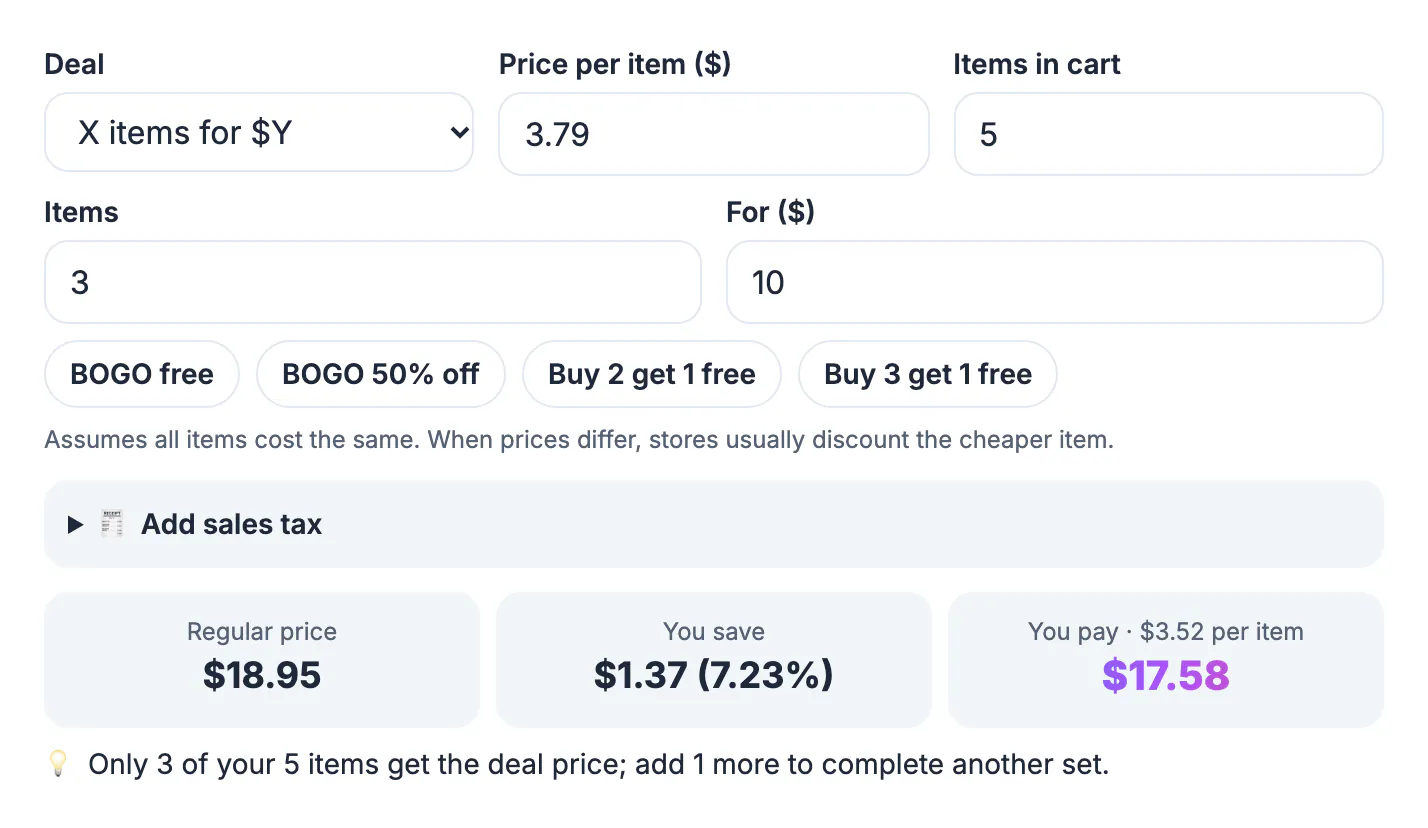
Switch the Deal menu to X items for $Y to test offers like 3 for $10. With a regular price of $3.79 and five items in the cart:
- One set of three costs $10 instead of $11.37.
- The two leftover items are charged at $3.79 each, the regular price.
- Total: $17.58 instead of $18.95, a saving of $1.37, or 7.23%, about $3.52 per item.
- The tool notes that only 3 of the 5 items get the deal price and that adding 1 more completes another set.
- If the set price is higher than buying the items separately, the calculator warns you instead of showing a saving.
Some stores give the multi-buy price per item even for a single unit, while others require the full set. The calculator assumes leftovers pay full price, so check the shelf tag.
To see the effective discount on a multi-buy, this percent-of-a-number guide gives the quick math.
Assumptions to check at the register
The BOGO / deals tab keeps the math simple, which means a few real-world details need your attention:
- It assumes every item costs the same. When prices differ, stores usually discount the cheaper item, so your saving is smaller.
- Loyalty-card requirements, limits per customer and online-only offers are not modeled.
- Mail-in rebates and app rewards arrive later and may never arrive if you miss a step.
- Sales tax can be added with the Add sales tax option, applied to the discounted total.
- Unit prices on shelf tags, per ounce or per count, are still the best way to compare different package sizes.
Use the calculator to compare offers on identical items, and the shelf's unit price to compare different sizes or brands.
Step-by-step

Common mistakes to avoid
Pro tips
Frequently asked questions
Is buy one, get one 50% off the same as 25% off?
Only for complete pairs of same-priced items. With three $12 items BOGO 50% off saves 16.67%, while 25% off saves the full 25%.
Is buy one, get one free the same as 50% off?
For complete pairs of same-priced items, yes. With an odd number of items, or different prices, the saving is lower.
How does the calculator handle leftover items?
In BOGO deals it groups items into sets and charges extra items at full price. In X for $Y deals it charges leftovers at the regular price and tells you how many more complete another set.
Which item does a BOGO discount apply to when prices differ?
Stores usually discount the cheaper item. The calculator assumes equal prices, so enter the lower price for the discounted item to get a realistic total. For example, with a $12 item and an $8 item on buy one, get one 50% off, the discount usually applies to the $8 item, saving $4 rather than $6.
Is my shopping data stored?
No. The calculator runs in your browser and nothing you enter is uploaded. Share links keep your inputs after the # sign only when you copy one.
BOGO deals only reach their headline value on complete sets: three $12 items on BOGO 50% off cost $30, while 25% off costs $27. Compare offers as a final price for the quantity you need, use the per-item figure to cross-check, and add an extra item only when you will actually use it. The BOGO / deals and % off tabs make that comparison take seconds.
Related guides
Browse more: all calculator guides · the Discount Calculator