Stacked Discounts: Why 40% Plus 15% Off Isn't 55%
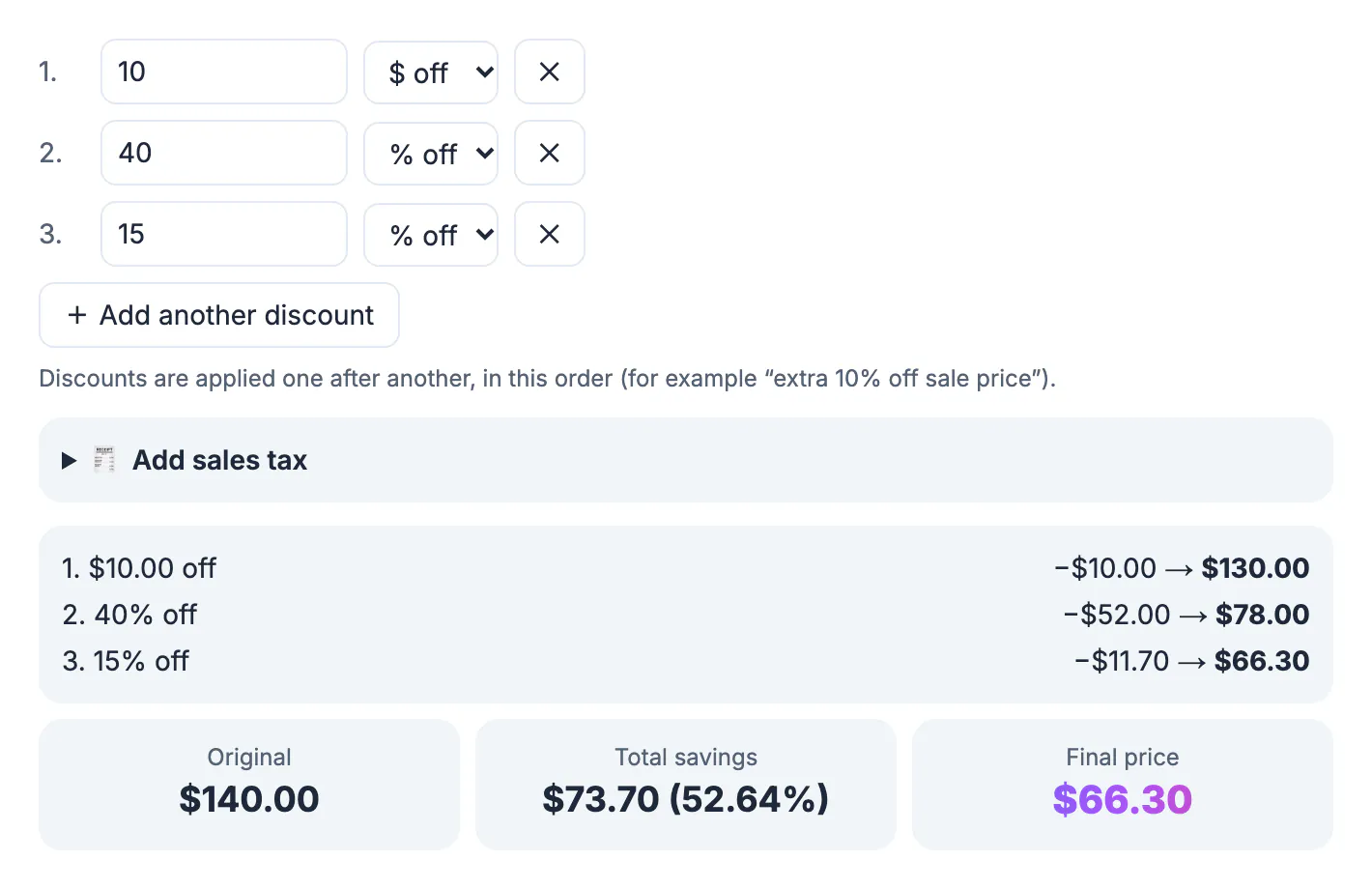
Stacked discounts are applied one after another, so each new percentage comes off an already reduced price: 40% off plus an extra 15% off is 49% off in total, not 55%. Picture a $140 winter jacket marked 40% off, with an extra 15% off at checkout and a $10 loyalty coupon on top. The Stacked tab of the GrabCast Discount Calculator walks the price down step by step to $61.40, a total saving of $78.60, or 56.14%. Apply the same $10 coupon first instead of last and you pay $66.30. This guide explains the math behind extra-percent-off sales, why the position of a dollar coupon changes your price while the order of percentages does not, and what store rules to check before you count on a stack. It focuses on combining offers; for a single percent-off price, a basic discount formula is enough.
🏷️ Try the Discount Calculator now — freeOpen →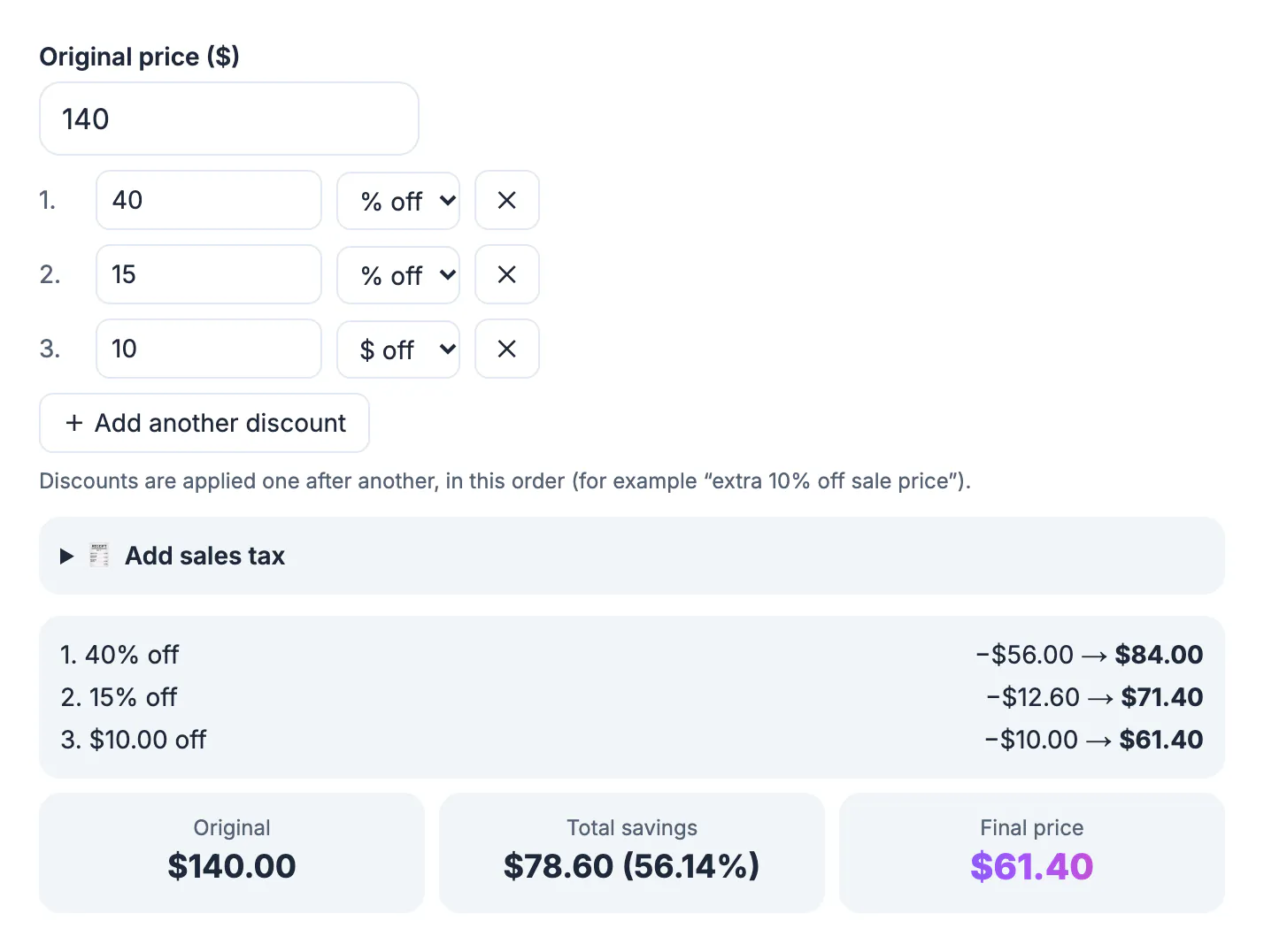
Retail signs are built for speed: a big red 40% and a smaller extra 15% invite shoppers to add the two and think of the deal as roughly half off. The real total is lower, and when a fixed-dollar coupon joins the stack the result depends on the order the register applies it. A few dollars on one jacket is small, but the same mistake on furniture, electronics or a full holiday list adds up. Checking the real final price also helps you compare a stacked sale with a competitor's single, simpler discount. Knowing the real figure also makes it easier to decide whether to wait: if a stack gets you to 49% off today and the store's biggest seasonal sales usually reach 50%, buying now costs you almost nothing extra.
How stacked discounts are calculated
Each percentage applies to the running price left by the step before it. For two percentage discounts the combined effect is one minus the product of what you pay at each step.
- 40% off means you pay 0.60 of the price; an extra 15% off means you pay 0.85 of what is left.
- Together you pay 0.60 times 0.85, or 0.51, of the original, which is 49% off.
- Adding the percentages would claim 55% off, overstating the saving by 6 points.
- On the $140 jacket, the two percentages alone give $71.40, not $63.00.
- When every row is a percentage, the calculator prints this comparison for you, such as 40% + 15% off equals 49% off, not 55%.
The order of two percentage discounts does not matter, because multiplication gives the same product either way: 15% first and then 40% also lands on $71.40.
The $140 jacket, step by step
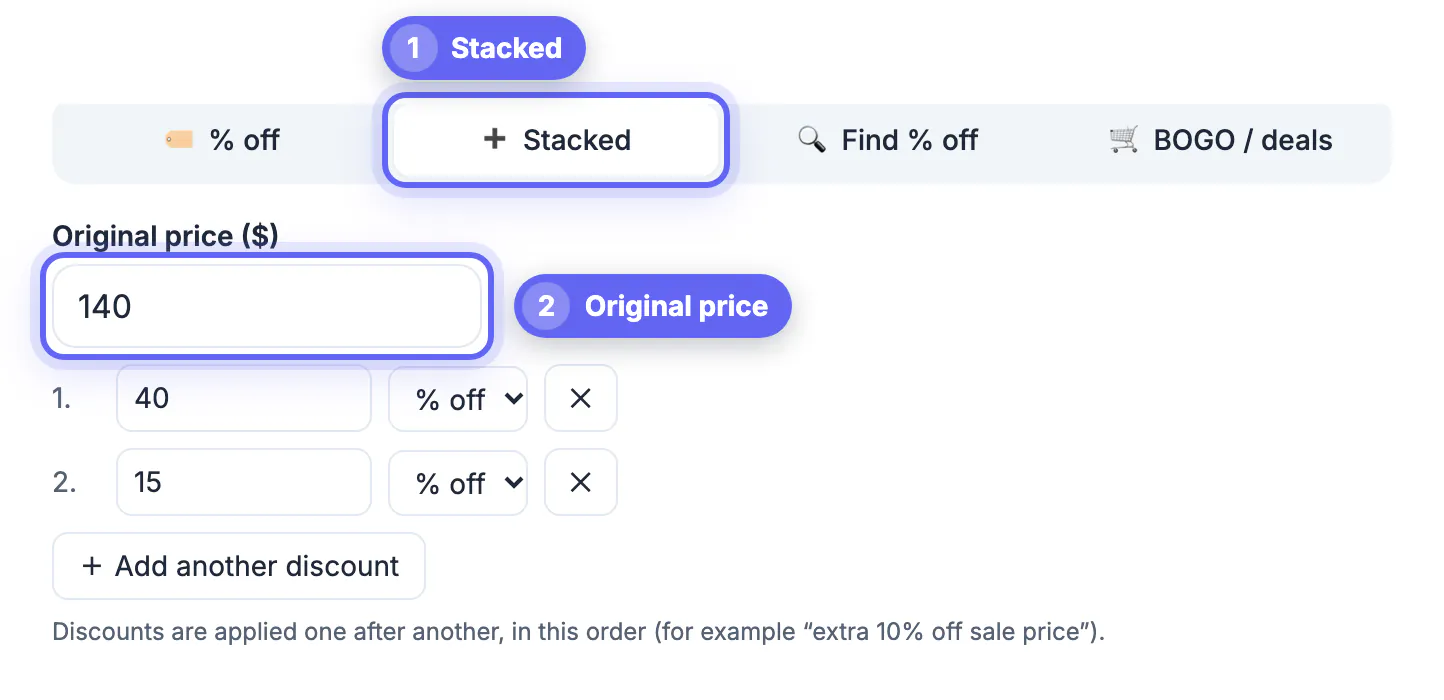
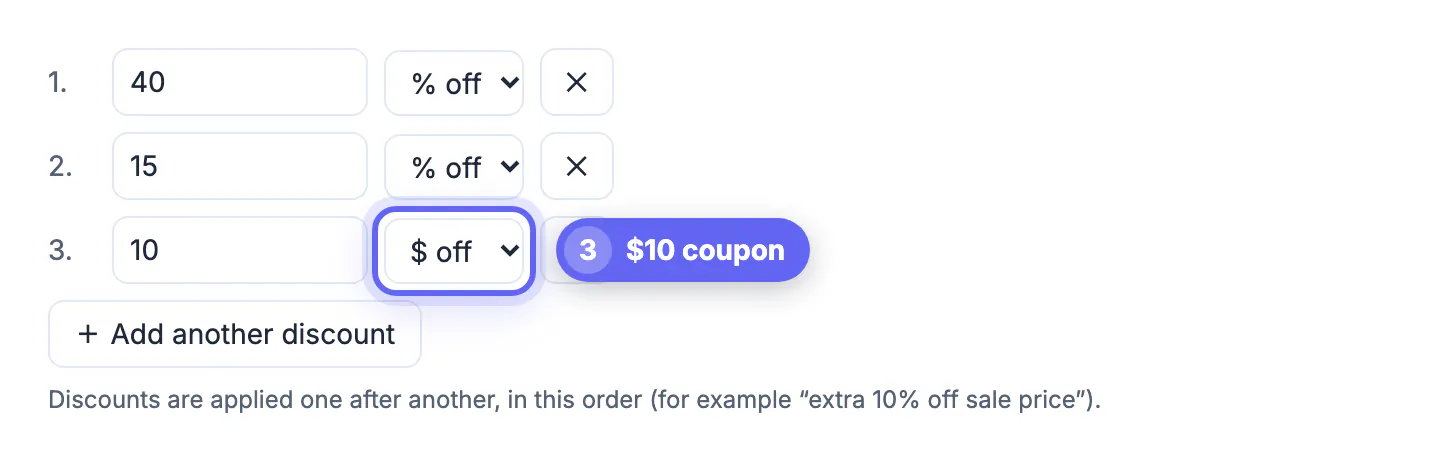
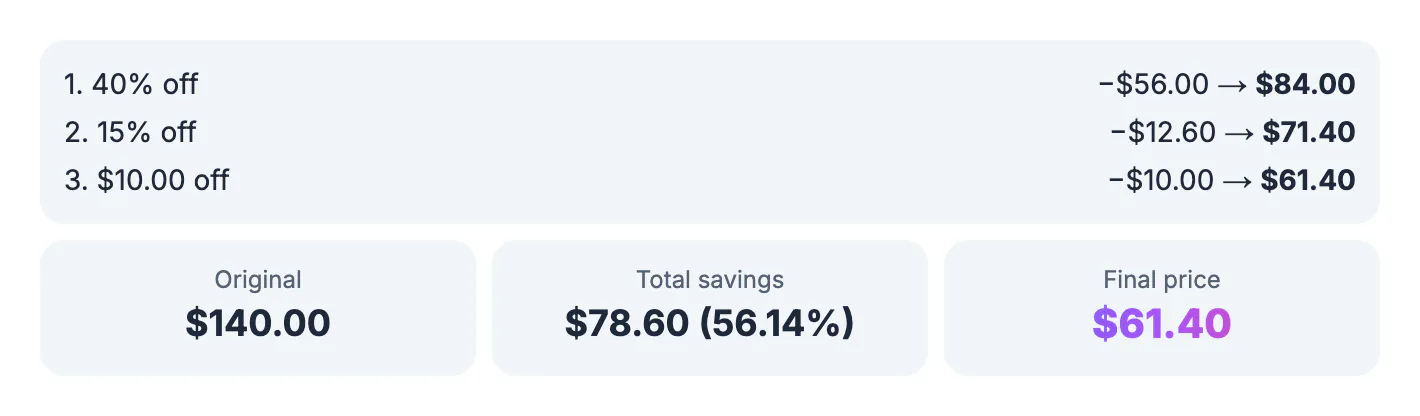
With the Stacked tab open, the jacket's discounts are entered as three rows in checkout order. The calculator shows each cut and the running price:
- Row 1, 40% off: minus $56.00, leaving $84.00.
- Row 2, 15% off: minus $12.60, leaving $71.40.
- Row 3, $10.00 off: minus $10.00, leaving $61.40.
- Total savings: $78.60, or 56.14% of the $140 original.
- Final price: $61.40 before any sales tax.
Each row can be switched between % off and $ off, and rows can be added or removed, so the same screen handles a store coupon, a loyalty reward, a student discount or an employee discount in whatever combination you actually have.
Why coupon order changes the final price
A fixed-dollar coupon behaves differently from a percentage. If it is applied last, you get its full face value. If it comes first, the later percentages shrink it too.
- Coupon last: 40% off, then 15% off, then $10 off gives $61.40.
- Coupon first: $10 off leaves $130, 40% off leaves $78.00, 15% off leaves $66.30.
- Difference: $4.90, because the $10 coupon was itself discounted by 49% when applied first.
- Rule of thumb: dollar-off coupons are worth the most at the end of the stack, and percentages do not care about their own order.
- The Stacked tab keeps rows in the order you enter them, so reorder them to match your receipt.
You rarely choose the order yourself; the store's point-of-sale system does. The calculator helps you predict which order your receipt will use and check it afterward.
Price rises work the same way in reverse; this percentage increase guide shows why up and down changes are not symmetrical.
Store rules that decide whether a stack works
The math is only half the story. Before you plan around a stack, check the fine print:
- Many coupons say they cannot be combined with other offers or exclude items already on sale.
- Extra percent-off events sometimes apply only to clearance or only to full-price items.
- Dollar-off coupons often need a minimum purchase measured before or after other discounts.
- Manufacturer coupons and store coupons can be treated differently, including for sales tax in some states.
- Returns of stacked purchases may refund only the net amount you paid for each item.
If you need a total with tax, open Add sales tax in the calculator; it applies the rate to the discounted price, which is how most store discounts are taxed.
Step-by-step
Common mistakes to avoid
Pro tips
Frequently asked questions
Is 40% off plus an extra 15% off the same as 55% off?
No. The extra 15% applies to the already reduced price, so you pay 0.60 times 0.85, or 51% of the original. That is 49% off in total.
Does the order of percentage discounts matter?
No. Two or more percentages give the same final price in any order. Order only matters when a fixed-dollar coupon is part of the stack. That is why the calculator's comparison line only appears when every row is a percentage.
Should a dollar-off coupon go first or last?
Last is better for you. Applied last, a $10 coupon saves $10. Applied first, later percentages shrink its value, which cost $4.90 in the jacket example. Some registers let the cashier choose, so it is worth asking politely when the difference is large.
Is sales tax charged before or after discounts?
The calculator adds tax to the discounted price, which is how most store discounts work. In many states a manufacturer's coupon does not lower the taxable price, so check your receipt.
Is anything I enter saved or uploaded?
No. Everything runs in your browser. A share link only exists if you copy one, and it keeps your inputs in the part of the address after the # sign.
Stacked discounts multiply rather than add, so 40% plus 15% off is 49% off, and a $10 coupon is worth its full value only when it comes last. The $140 jacket ends at $61.40 with the coupon last and $66.30 with it first. Enter your own stack in the order your receipt uses, check the store's rules, and let the calculator show the true final price. A minute of checking at home can save a frustrating surprise at the register.
Related guides
Browse more: all calculator guides · the Discount Calculator