Hourly to Annual Salary: The 2,080-Hour Rule and Table
To convert hourly to annual salary, multiply the hourly rate by 2,080, the hours in a full-time year of 40 hours times 52 weeks: $25 an hour is $52,000 a year. To go back, divide the salary by 2,080. That gives gross pay before taxes; unpaid time off, part-time hours and overtime change the number, and take-home pay is lower again.
💰 Try Paycheck & Salary Calculator now — freeOpen →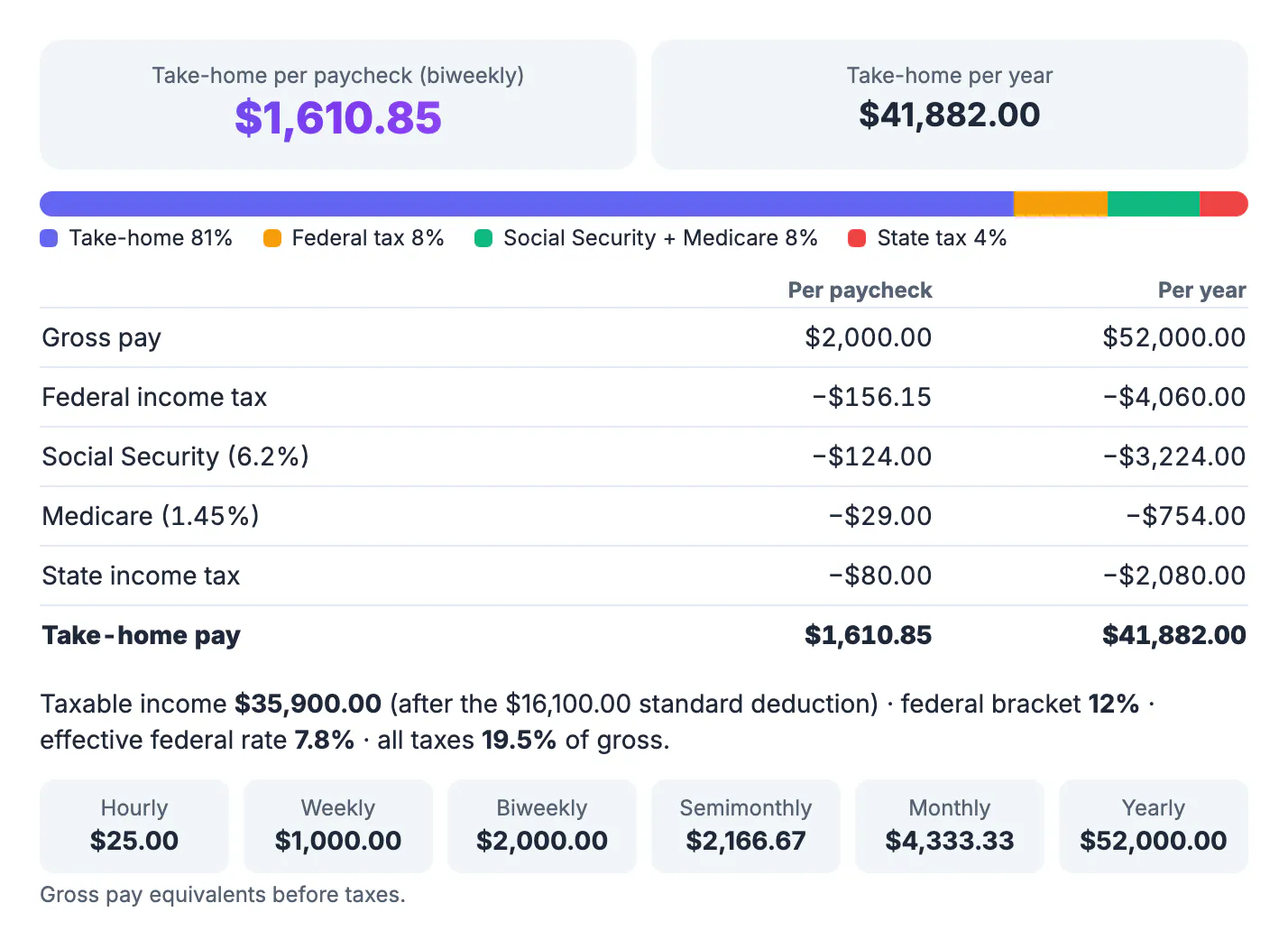
Job ads mix formats: $24 an hour, $48,000 a year, $4,000 a month. You cannot compare them until they share a unit. The same question comes up when you move from hourly to salaried, negotiate a raise, or fill in a rental application that asks for annual income. The math is simple; the judgment is in the hours you use and remembering the result is gross pay.
The hourly to annual salary formula
Annual salary = hourly rate × hours per week × weeks paid per year. For a standard full-time job that is 40 × 52 = 2,080 hours.
- $22 × 2,080 = $45,760 a year.
- Monthly: divide by 12, or multiply the hourly rate by 173.33 hours. $22 an hour is about $3,813 a month.
- Biweekly: 80 hours per paycheck, so $22 an hour is $1,760 gross every two weeks.
- Salary to hourly: $60,000 ÷ 2,080 = $28.85 an hour.
- Shortcut: double the rate and add three zeros. $25 becomes $50,000, about 4% under the exact figure.
Some calendar years have 261 or 262 weekdays (2,088 or 2,096 hours), but most payroll departments still use 2,080.
Quick table: $15 to $50 an hour
Full time, 40 hours a week, 52 paid weeks, before taxes:
- $15 an hour = $31,200 a year, $2,600 a month.
- $20 an hour = $41,600 a year, about $3,467 a month.
- $25 an hour = $52,000 a year, about $4,333 a month.
- $30 an hour = $62,400 a year, $5,200 a month.
- $35 an hour = $72,800 a year, about $6,067 a month.
- $40 an hour = $83,200 a year, about $6,933 a month.
- $50 an hour = $104,000 a year, about $8,667 a month.
Each extra dollar an hour adds $2,080 a year.
Unpaid time off, part-time hours and overtime
2,080 assumes you are paid for every week, including holidays and vacation. Adjust when that is not true:
- Unpaid time off: two unpaid weeks means 2,000 hours, so $25 an hour is $50,000.
- Part time: 25 hours a week × 52 = 1,300 hours. At $20 that is $26,000 a year.
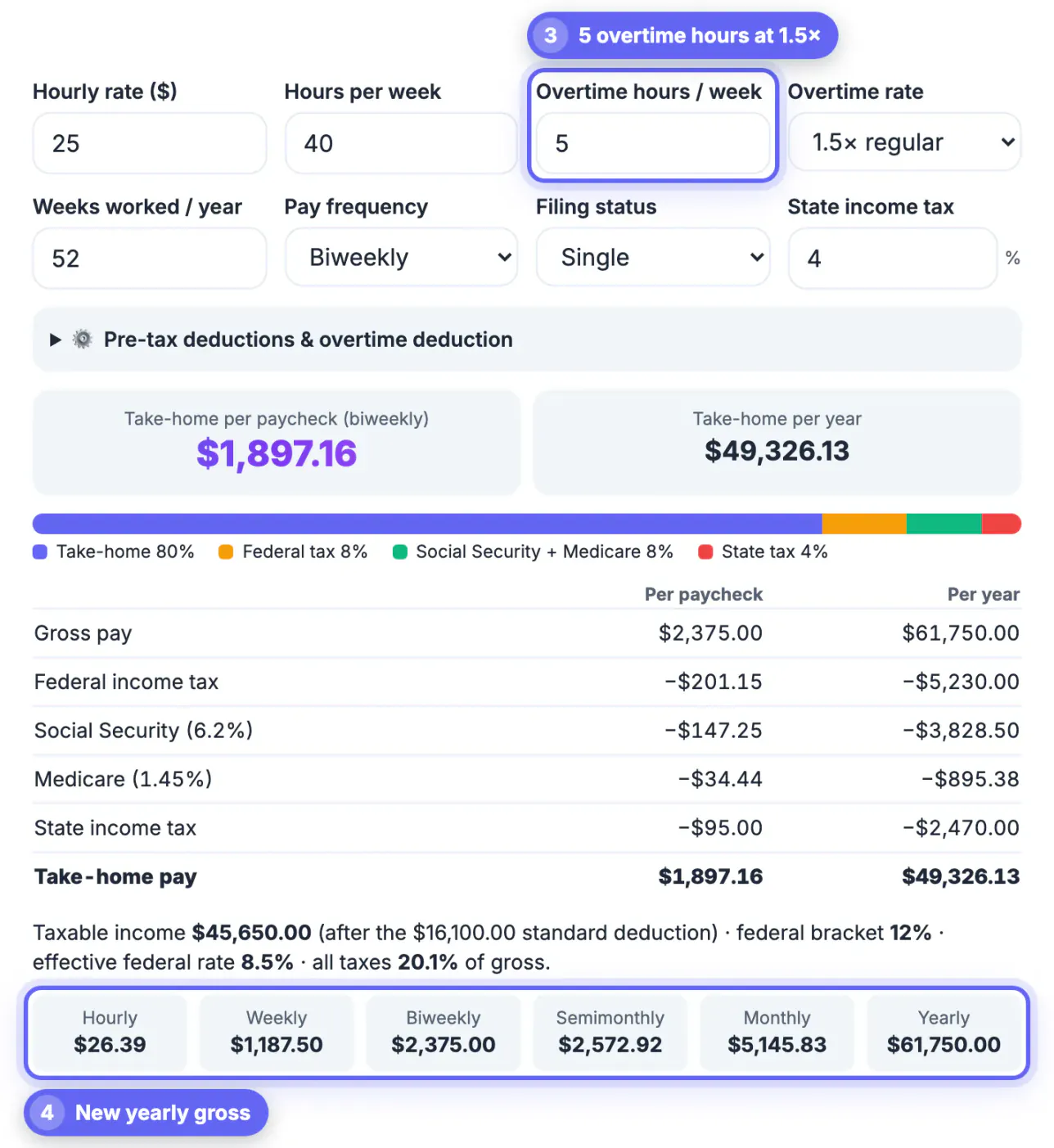
- Overtime: under federal law, non-exempt employees earn at least 1.5× their regular rate for hours over 40 in a workweek. Five overtime hours a week at $25 adds $187.50 a week, or $9,750 over 52 weeks. Some states, such as California, also have daily overtime rules.
Also weigh paid holidays, health insurance and retirement matching; they can be worth more than a dollar or two an hour.
From gross salary to take-home pay in the calculator
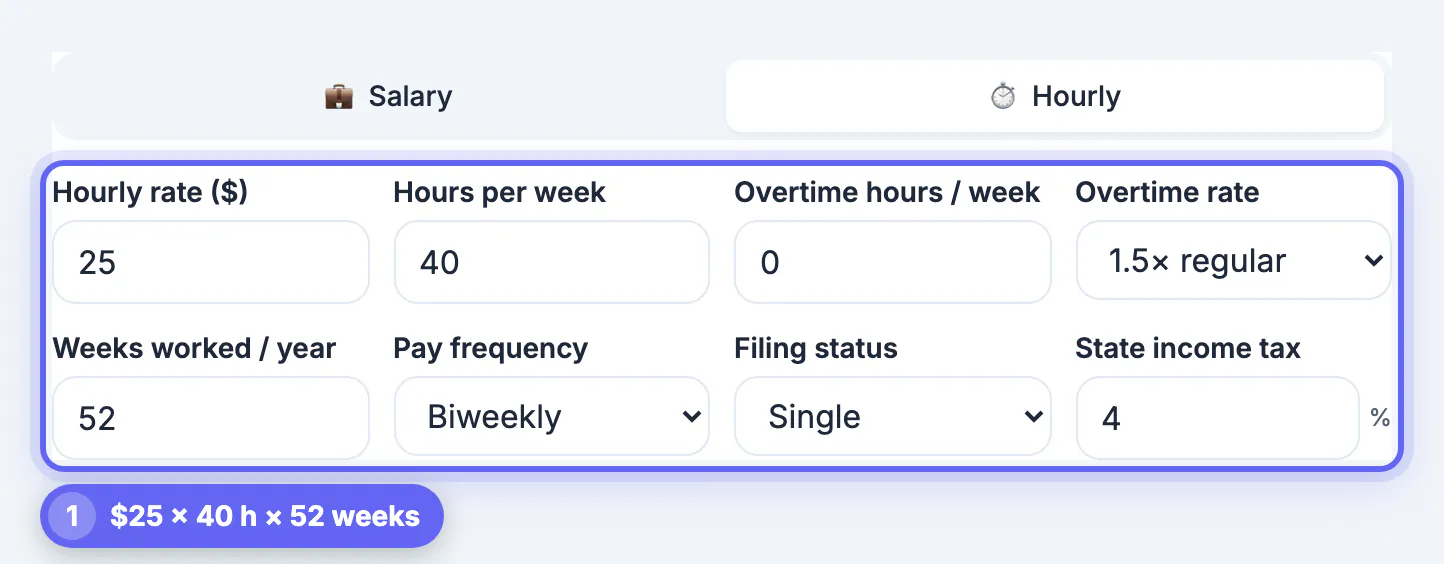
GrabCast's Paycheck & Salary Calculator does both directions and then estimates what you keep. Choose Hourly to enter a rate, hours per week, weeks worked per year and any overtime hours (at 1.5× or 2×), or Salary to enter an annual figure.
- A row of gross equivalents shows hourly, weekly, biweekly, semimonthly, monthly and yearly pay. The hourly figure is gross divided by your hours and weeks; weekly and the other periods divide the yearly total evenly by 52, 26, 24 and 12.
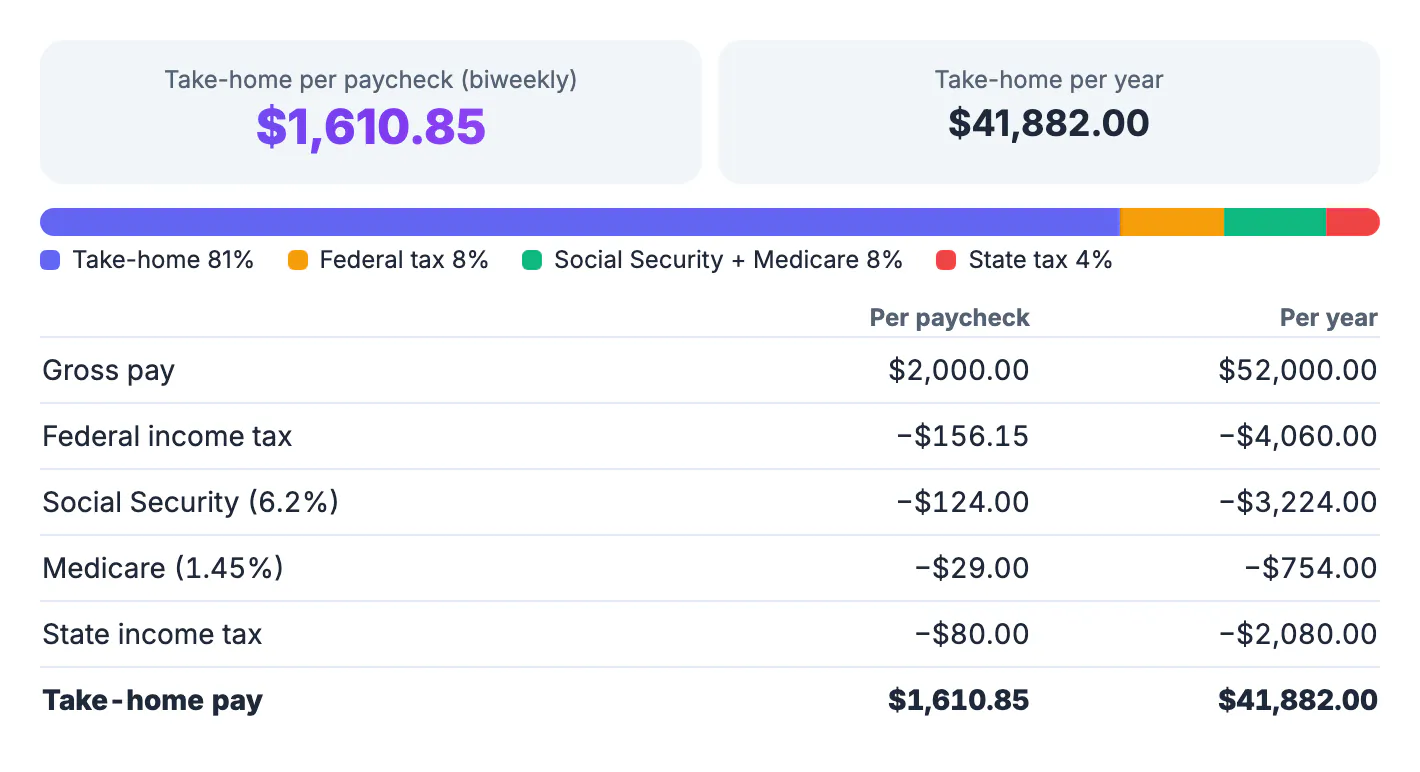
- Below it, take-home per paycheck and per year subtracts federal income tax (standard deduction only), Social Security, Medicare, pre-tax 401(k) and health deductions, and a flat state percentage you enter.
- Brackets, the standard deduction and the Social Security wage base follow the tax year the tool is set to, so take-home reflects current-year rules.
- It runs in your browser; results can be copied, exported as CSV or shared as a link.
It is an estimate, not tax advice: credits, dependents, local taxes and your W-4 can make actual withholding differ.
Comparing job offers fairly
Hourly pay and salary are not equal until you include benefits, hours and paid leave. Convert both offers to the same basis, then compare the total package.
- Salary job: divide by 2,080 for an effective hourly rate, and use actual expected hours if you regularly work more than 40.
- Hourly job: add overtime and subtract unpaid holidays.
- Benefits: add the value of health insurance, retirement match and paid time off.
- Commute and costs: remote work can save hundreds per month.
To see what you keep, the Paycheck & Salary Calculator estimates take-home pay, and calculating a percentage helps with raises and bonuses. If you are paid in another currency, converting currency and what you actually pay explains reference rates.
Common assumptions that change the answer
The 2,080-hour rule assumes 40 hours a week for 52 weeks. Some employers pay for 2,087 hours, a few round to 2,000, and contract work often excludes holidays and sick leave. Always check how your employer defines the working year and whether the stated rate is before or after taxes.
Step-by-step

Common mistakes to avoid
Pro tips
Frequently asked questions
How do I convert hourly to annual salary?
Multiply the hourly rate by 2,080 for full-time work: $30 × 2,080 = $62,400. Use fewer hours for part-time or unpaid weeks.
Why 2,080 hours?
It is 40 hours a week times 52 weeks. It assumes paid holidays and vacation are included.
How much is $20 an hour a year?
$41,600 gross at 40 hours a week for 52 weeks, or about $3,467 a month before taxes.
How do I convert annual salary to hourly?
Divide by 2,080. $75,000 ÷ 2,080 = $36.06 an hour. The calculator shows this in its gross equivalents row.
Does the calculator show pay after taxes?
Yes. It estimates federal income tax, Social Security, Medicare and a flat state rate for the tax year it is set to. It is an estimate, not tax advice.
Hourly × 2,080 gives a full-time annual salary; divide by 2,080 to go back. Adjust the hours for unpaid time off or part-time work, add overtime separately, and use the calculator to see what the gross figure means after taxes.
Related guides
Browse more: all calculator guides · Paycheck & Salary Calculator