Words in a 2-Minute Speech: Time a Toast by Word Count
A 2-minute speech is about 280 words when delivered at a relaxed 140 per minute, the pace GrabCast's free Word Counter uses for its speaking time estimate. That makes the count the quickest way to size a wedding toast, a retirement tribute, a class presentation or a video script before you rehearse. Paste the draft and the Speaking time card shows the estimate instantly, in your browser. This guide times a real draft, a 319-word retirement toast for a librarian that ran 2 minutes 17 seconds, and trims it to 216 words and 1 minute 33 seconds while keeping every story that mattered. You will also get a word budget for common speaking slots and the reasons your delivery may run faster or slower than the estimate.
🔢 Try the Word Counter tool now — freeOpen →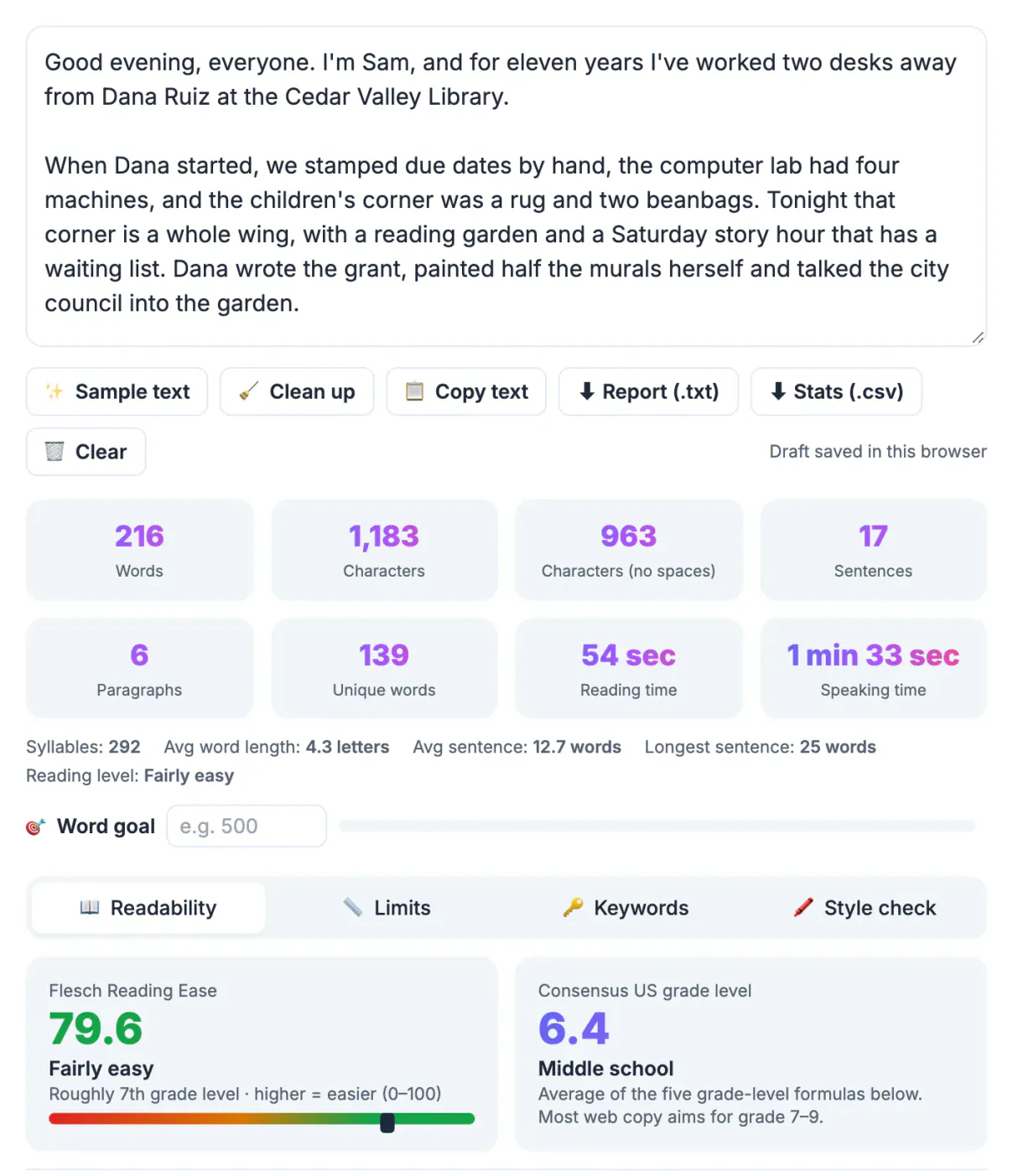
Organizers rarely say keep it to 280 words; they say you have two minutes. Most speakers underestimate how long their draft runs, because silent reading is much faster than speaking and pauses for laughter or applause add time. Converting the slot into a count before you write gives you a budget, the same way a column has a length. It also tells you early whether a story fits: a 90-second anecdote inside a two-minute toast leaves 30 seconds for everything else. Counting is not a substitute for rehearsal, but it prevents the most common failure, arriving at the microphone with twice as much as the room has patience for, and it gives you an objective way to decide what to cut when every line feels important.
How many words fit a 2-minute speech and other slots
The Word Counter estimates speaking time at 140 per minute, a comfortable pace for a toast or presentation. Reading time uses 238 per minute, which is why a speech looks short when you skim it. Multiply the minutes you have by 140 for a first budget.
- 30-second video intro or elevator pitch: about 70
- 1-minute toast or award thank-you: about 140
- 2-minute wedding or retirement toast: about 280
- 3-minute class presentation: about 420
- 5-minute talk or eulogy: about 700
- 10-minute conference talk: about 1,400
Leave headroom. A toast that fits exactly 280 on paper often runs over once you pause for a laugh or look up at the room, so aim for 10 to 20 percent under the slot, around 230 to 250 for two minutes.
Timing the retirement toast, before and after
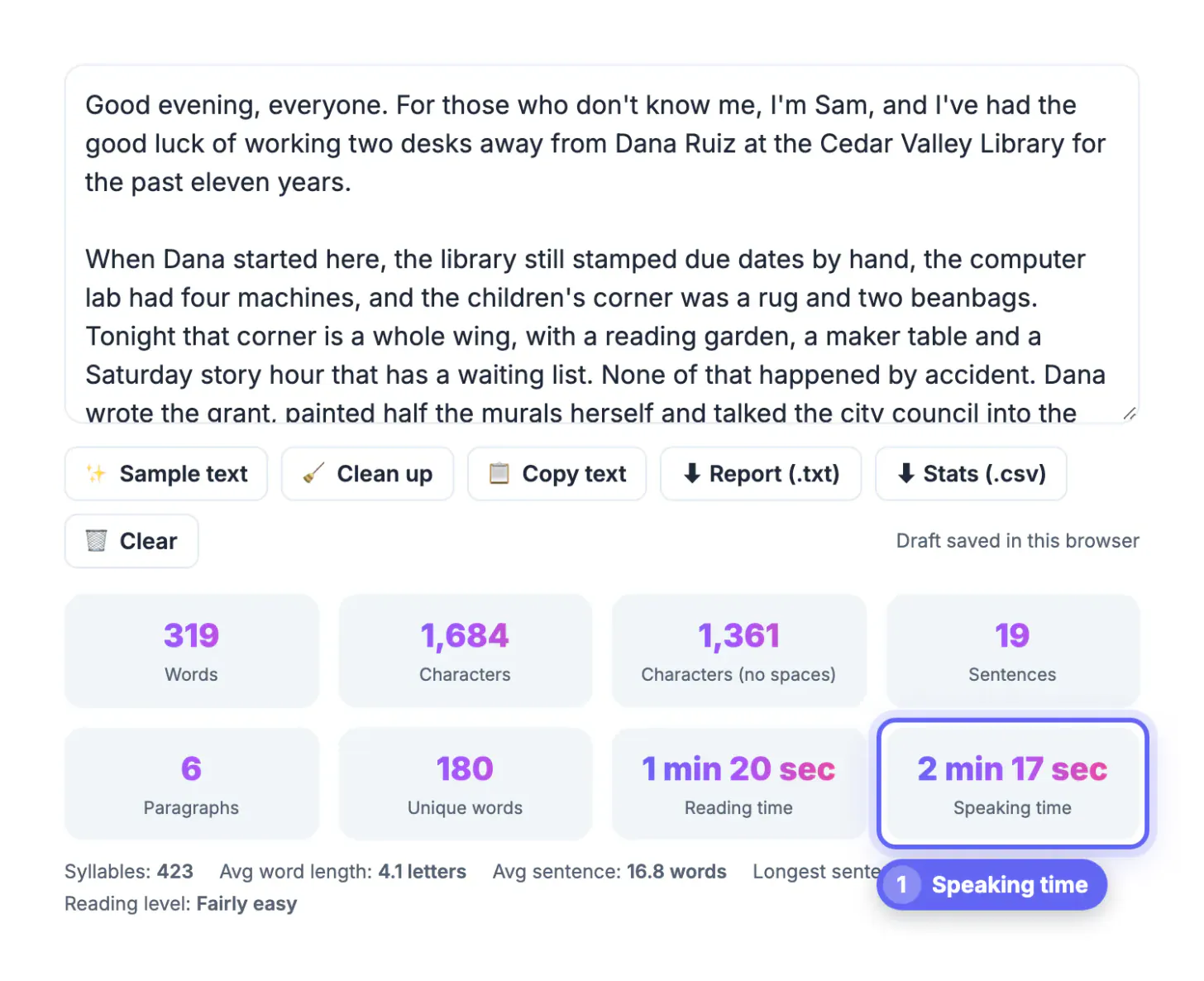
The first draft of the toast for Dana Ruiz, a fictional librarian leaving after many years, had 319 words, 19 sentences and 6 paragraphs. The Speaking time card read 2 min 17 sec, and silent reading time only 1 min 20 sec, which is why it felt short to the writer.
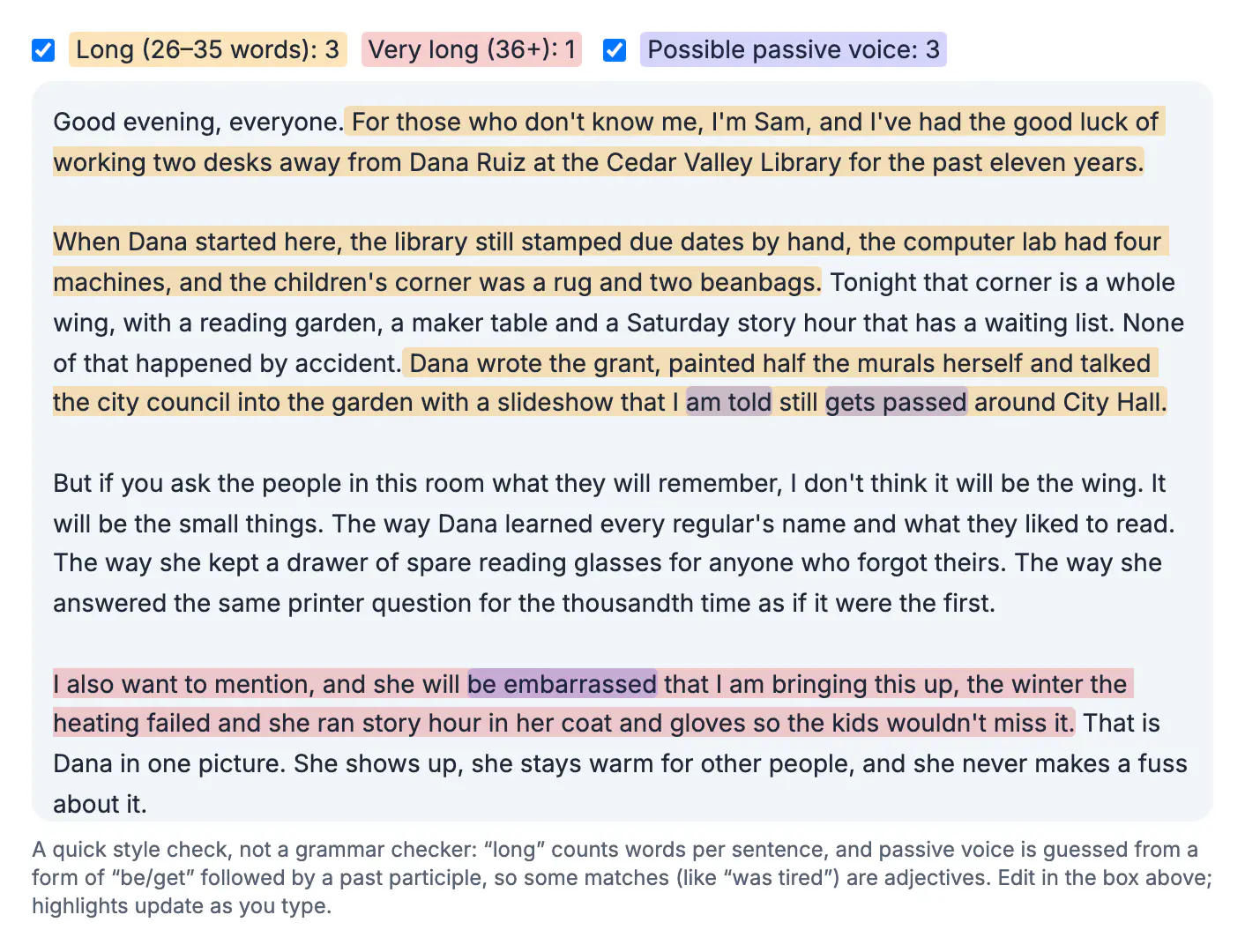
- Style check found 3 long sentences of 26 to 35 and 1 very long one of 36 or more; long sentences are hard to say in one breath
- The opening spent a full sentence on for those who don't know me, which the host's introduction already covered
- Two stories made the same point about kindness; the heating story was stronger, so the printer story went
- Hedges such as I also want to mention, and she will be embarrassed that I am bringing this up became plain statements
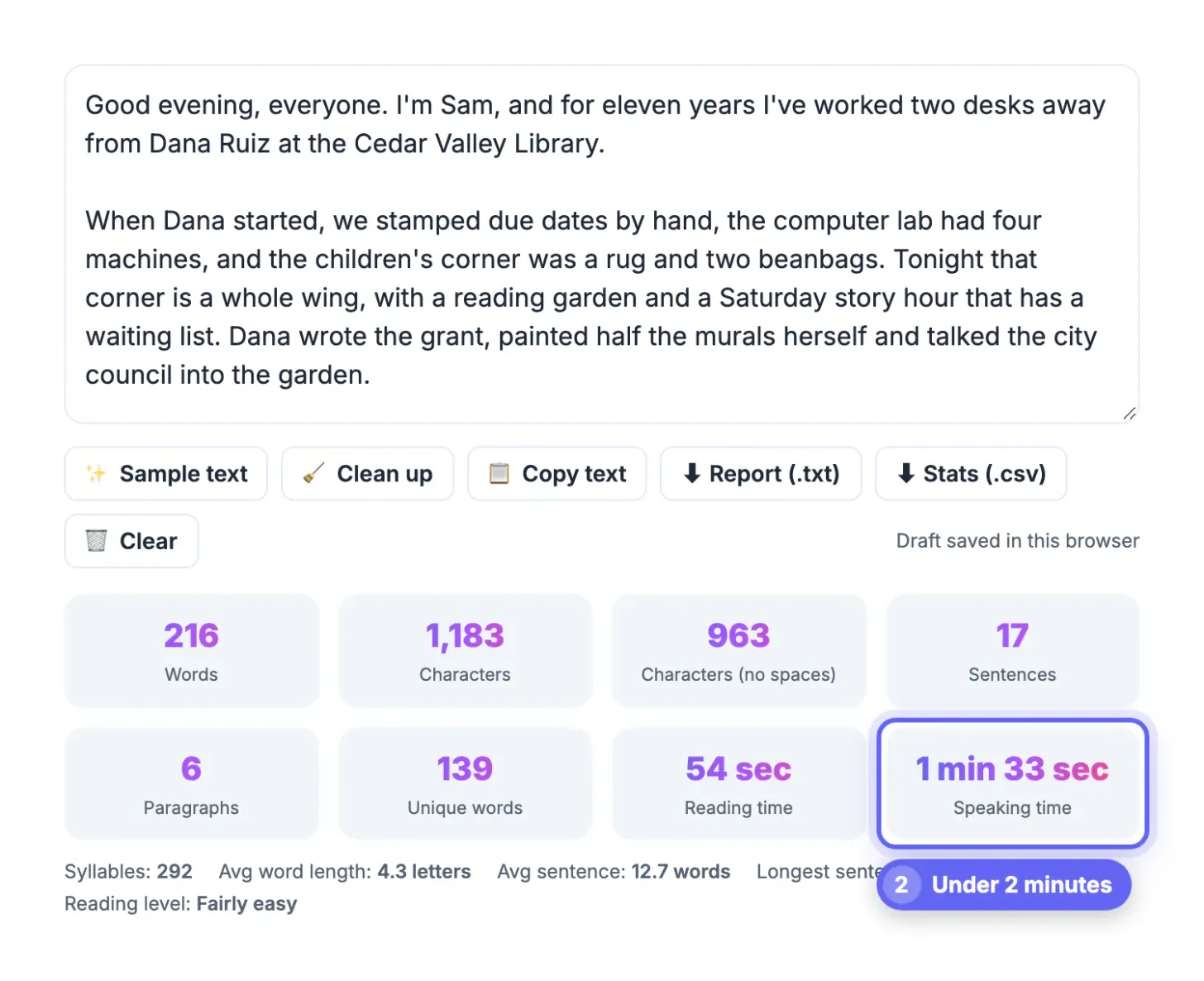
The trimmed version had 216 words, 17 sentences and a longest sentence of 25. Speaking time dropped to 1 min 33 sec, leaving room for pauses, and the Readability tab showed a Flesch Reading Ease of 79.6, fairly easy, which suits a room listening rather than reading.
Why your real time differs from the estimate
An estimate based on a fixed pace is a starting point. Delivery speed varies by person, occasion and material, and the count cannot see any of that.
- Nervous speakers often rush; a practiced, calm delivery with pauses runs slower than 140
- Laughter, applause and a raised glass add seconds the text does not contain
- Names, numbers and technical terms slow you down; dates like 1998 take longer to say than to read
- Scripts for video voiceover are often read faster and more evenly than a live toast
- Speaking in a second language usually takes longer than the estimate
Rehearse once with a phone timer after trimming. If your natural pace is 120 per minute, a two-minute slot fits about 240; if you speak at 160, it fits about 320. Once you know your own pace, the count predicts your timing far better.
Trimming a speech without losing its heart
Cutting is easier with a plan than line by line. Decide what the audience must remember, usually one story and one wish, and protect those first.
- Cut the throat-clearing: thank-yous the host already made and introductions of yourself beyond one line
- Keep one story per point; a second example of the same trait rarely adds as much as it costs
- Replace a list of achievements with the single one that says the most, such as a grant, a mural or a garden
- Break sentences longer than about 25 words; they are the ones you stumble on
- End on the action: Please raise your glasses is a clear signal and takes three seconds
Set a Word goal if you want a progress bar while writing; it counts up to your target and shows how many are left to go. For trimming, watch the Speaking time card instead, since the goal bar is built for reaching a minimum rather than staying under a cap.
Time a rehearsal with the Voice Recorder, and compare cut versions in the Text Diff Checker.
Step-by-step
Common mistakes to avoid
Pro tips
Frequently asked questions
How many words is a 2-minute speech?
About 280 at 140 per minute, the pace the Word Counter uses. For a relaxed delivery with pauses, aim for 230 to 250.
How many words is a 5-minute speech?
About 700 at 140 per minute. Slower speakers may need closer to 600 to finish on time.
What pace does the speaking time estimate use?
140 words per minute. Reading time uses 238 per minute, which is why a script looks shorter when you read it silently.
Does the tool store my speech?
The draft is saved only in this browser's local storage so a refresh does not lose it, and the Clear button deletes it. The counting runs in your browser.
Can I use this for a YouTube or podcast script?
Yes. Paste the script and read the speaking time. Voiceover reads are often a little faster than live toasts, so time one take and adjust.
A 2-minute speech holds about 280 at 140 per minute, and a relaxed delivery needs closer to 240. Paste the draft, read the speaking time, cut repeated stories and long sentences, and leave room for pauses. Then rehearse once with a timer and learn your own pace, because the count predicts the clock only as well as it matches your voice.
Related guides
Browse more: all text and developer guides · the Word Counter tool