Cumulative GPA After a New Semester or Transfer
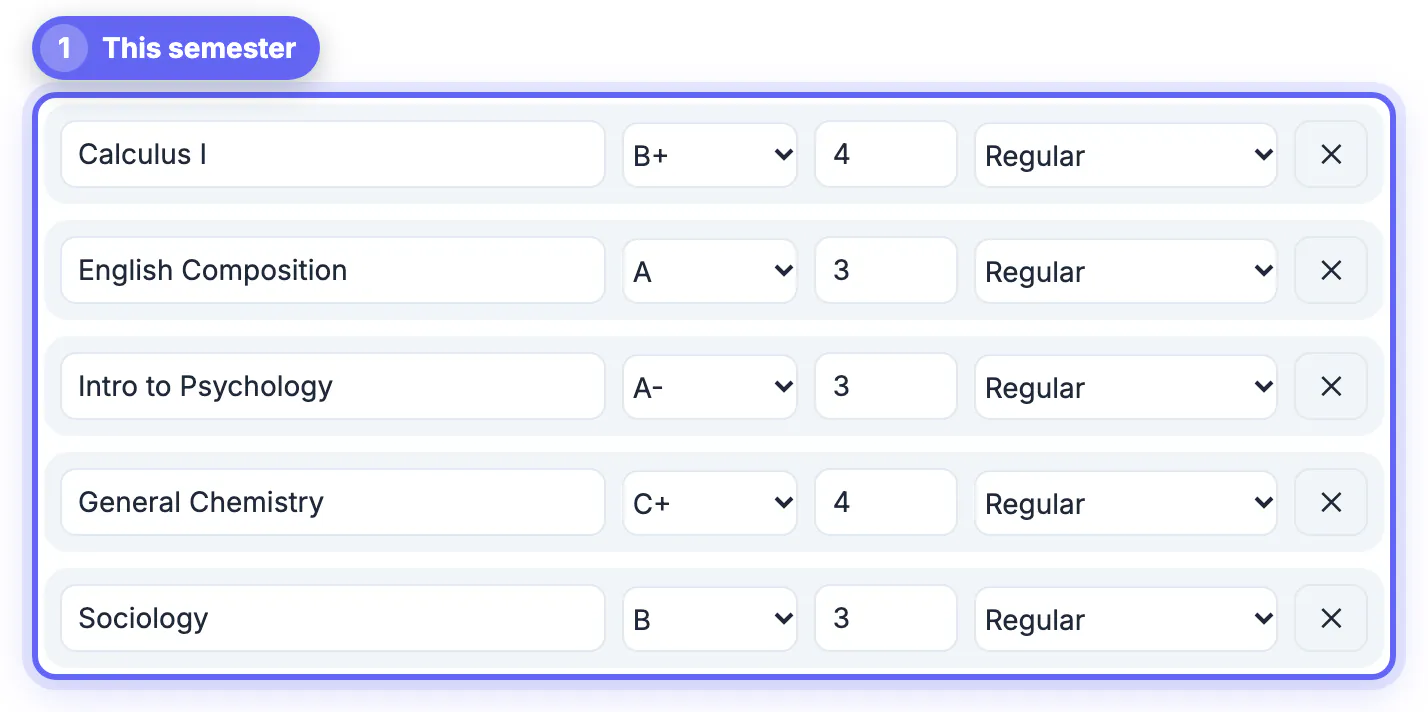
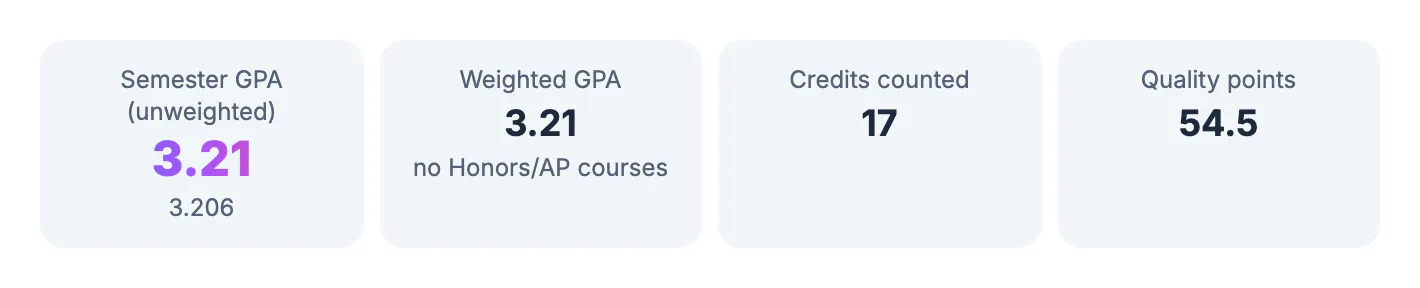
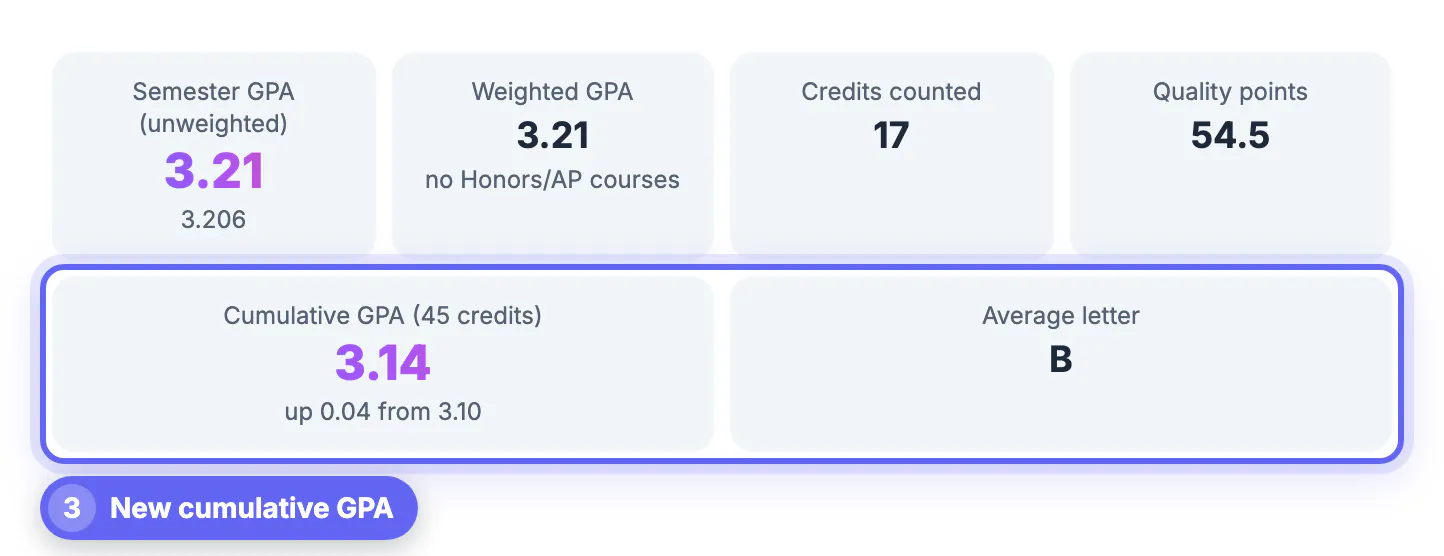
Your new cumulative GPA is the total quality points from every graded credit divided by the total graded credits, so a new semester moves it in proportion to how many credits it adds. A college sophomore, Jordan, entered the spring term with a 3.10 over 28 credits and just finished a 17-credit semester: Calculus I (B+, 4 credits), English Composition (A, 3), Intro to Psychology (A-, 3), General Chemistry (C+, 4) and Sociology (B, 3). The GrabCast GPA Calculator shows a 3.21 semester and a 3.14 cumulative average over 45 credits, up 0.04. This guide explains why a strong term raises the overall figure so slowly, how to enter credits you already have, and what to do when transfer credits come from another school that may not count their grades. Rules vary by institution, so treat the result as an estimate and confirm with your registrar.
🎓 Try the GPA Calculator now — freeOpen →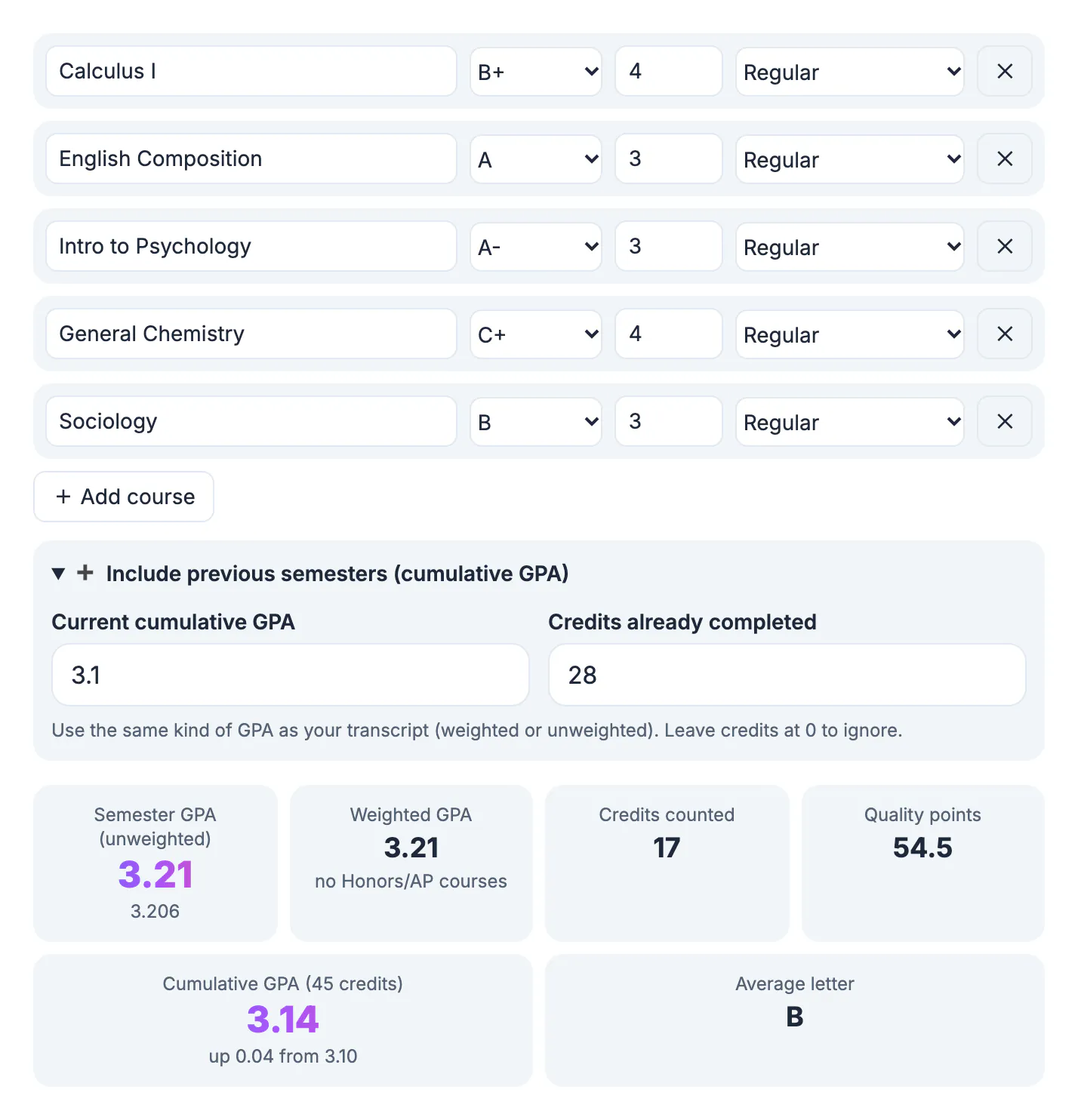
Scholarships with renewal requirements, academic probation, eligibility for athletics, applications to a major and many internship filters look at the cumulative average rather than one semester. Because older credits keep their weight, a good term after a rough start can feel invisible on the transcript. Knowing exactly how much each term moves the overall number helps you set realistic goals, spot when you are close to a cutoff and decide how many credits to take next.
The cumulative GPA formula with real numbers
The calculator combines the old average and this term's courses using quality points, the grade points times credits for each course.
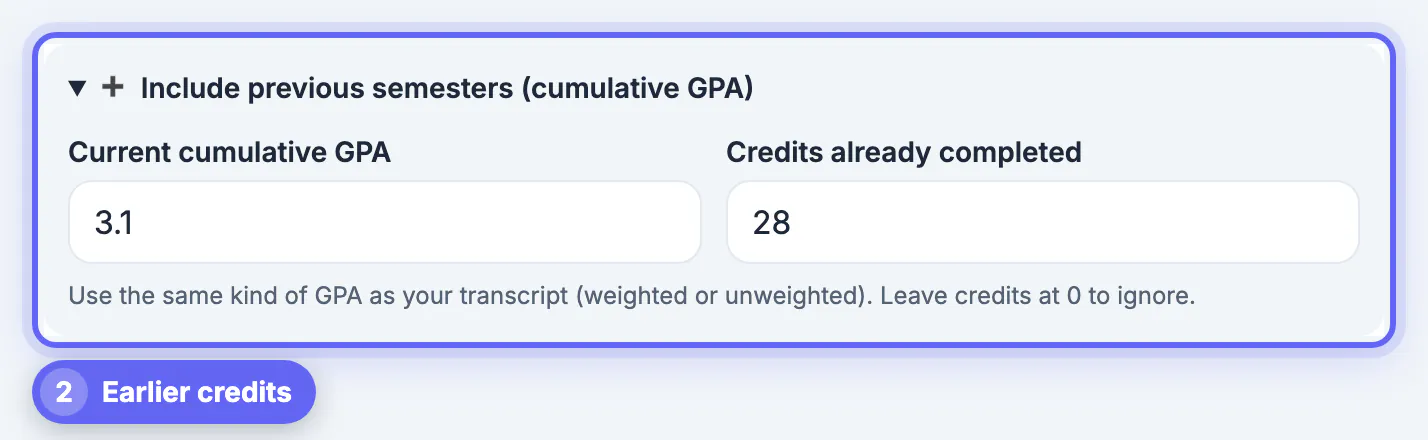
- Earlier record: 3.10 times 28 credits equals 86.8 quality points.
- This semester: Calculus I 3.3 times 4, Composition 4.0 times 3, Psychology 3.7 times 3, Chemistry 2.3 times 4 and Sociology 3.0 times 3, for 54.5 quality points.
- Semester result: 54.5 divided by 17 credits, or 3.206, shown as 3.21.
- Combined: 86.8 plus 54.5 equals 141.3 quality points over 45 credits.
- Cumulative result: 141.3 divided by 45, or 3.14, up 0.04 from 3.10.
You can never average the two numbers directly. Averaging 3.10 and 3.21 would give about 3.16, which ignores that the older record has more credits behind it.
Why a good term moves the average slowly
Each new term is diluted by everything before it. Jordan's 17 credits are 38% of the 45-credit total, so the new term only pulls the average about 38% of the way from 3.10 toward 3.21.
- Early in college, one semester is a large share of the record and can move the average a lot.
- By the senior year, the same semester might be a fifth of the credits or less, so gains shrink.
- Heavy-credit courses matter more: the 4-credit C+ in chemistry cost more quality points than a 3-credit C+ would.
- Repeating a course can help only if your school replaces the old grade; the calculator cannot know that rule.
- Withdrawals (W) and pass (P) grades do not count, so they neither help nor hurt the average.
To see how many terms it takes to reach a goal, the Grade I need tab solves that directly from your current average and credits.
Transfer credits and a new school's record
Transfer is where cumulative math most often goes wrong, because institutions differ in how they record outside coursework.
- Many colleges accept transfer credits toward graduation but start a new institutional average from zero; in that case, leave earlier credits at 0 and enter only courses taken at the new school.
- Some schools do include transfer grades; then enter the transfer average and credits in the previous-semesters fields.
- Graduate programs and some employers recalculate a combined average across every school you attended, so keep both records.
- Quarter-system credits are not the same size as semester credits; check how your new school converts them before combining.
- Use the same kind of average as your transcript, weighted or unweighted, as the calculator's note reminds you.
When in doubt, ask the registrar which courses count toward the institutional average, then run the calculator once for each version you might need.
Getting the inputs right from a transcript
The result is only as good as the numbers you type. A few habits prevent most errors:
- Copy the cumulative average and graded credits from the most recent official transcript, not from memory.
- Use graded credits, not total earned credits; pass/fail and withdrawn credits usually are not in the average.
- Enter each current course's actual credit hours, including labs that carry their own credit.
- Switch the grade scale to 4.33 only if your school gives an A+ more than 4.0.
- Open Include previous semesters before reading the result; with the panel closed, only the semester is shown.
The Copy result button produces a plain-text summary with each course and the cumulative line, which is handy for an advising appointment.
If your transcript is a PDF, copying the text from it makes entering grades easier, and the Grade Calculator handles single-class math.
Step-by-step
Common mistakes to avoid
Pro tips
Frequently asked questions
How do I calculate a cumulative average by hand?
Multiply your current average by your graded credits, add the quality points from the new courses, and divide by the total credits. In the example, 86.8 plus 54.5 equals 141.3 over 45 credits, or 3.14.
Why did my average only go up a little after a good semester?
Because older credits keep their weight. The more credits you already have, the smaller the share a new term represents, so its effect is diluted.
Do transfer credits count toward my new school's average?
It depends on the school. Many count the credits toward graduation but not the grades; others include them. Ask the registrar, and enter earlier credits only if they count.
Should I use weighted or unweighted numbers?
Use the same kind your transcript uses. The calculator's previous-semesters note asks for the same type as the courses you enter.
Is my information stored anywhere?
No. The calculator runs in your browser and nothing you type is uploaded. Share links store your inputs in the part of the address after the # sign only when you copy one.
Jordan's 3.21 semester lifts a 3.10 record over 28 credits to a 3.14 cumulative average over 45 credits, because older credits keep their weight. Enter this term's courses, add your earlier average and graded credits from the transcript, and let the calculator weight them correctly. For transfer credits or repeated courses, confirm your school's rules first; the registrar's figure is the official one.
Related guides
Browse more: all calculator guides · the GPA Calculator