Weighted GPA With Honors and AP Classes: How It Works
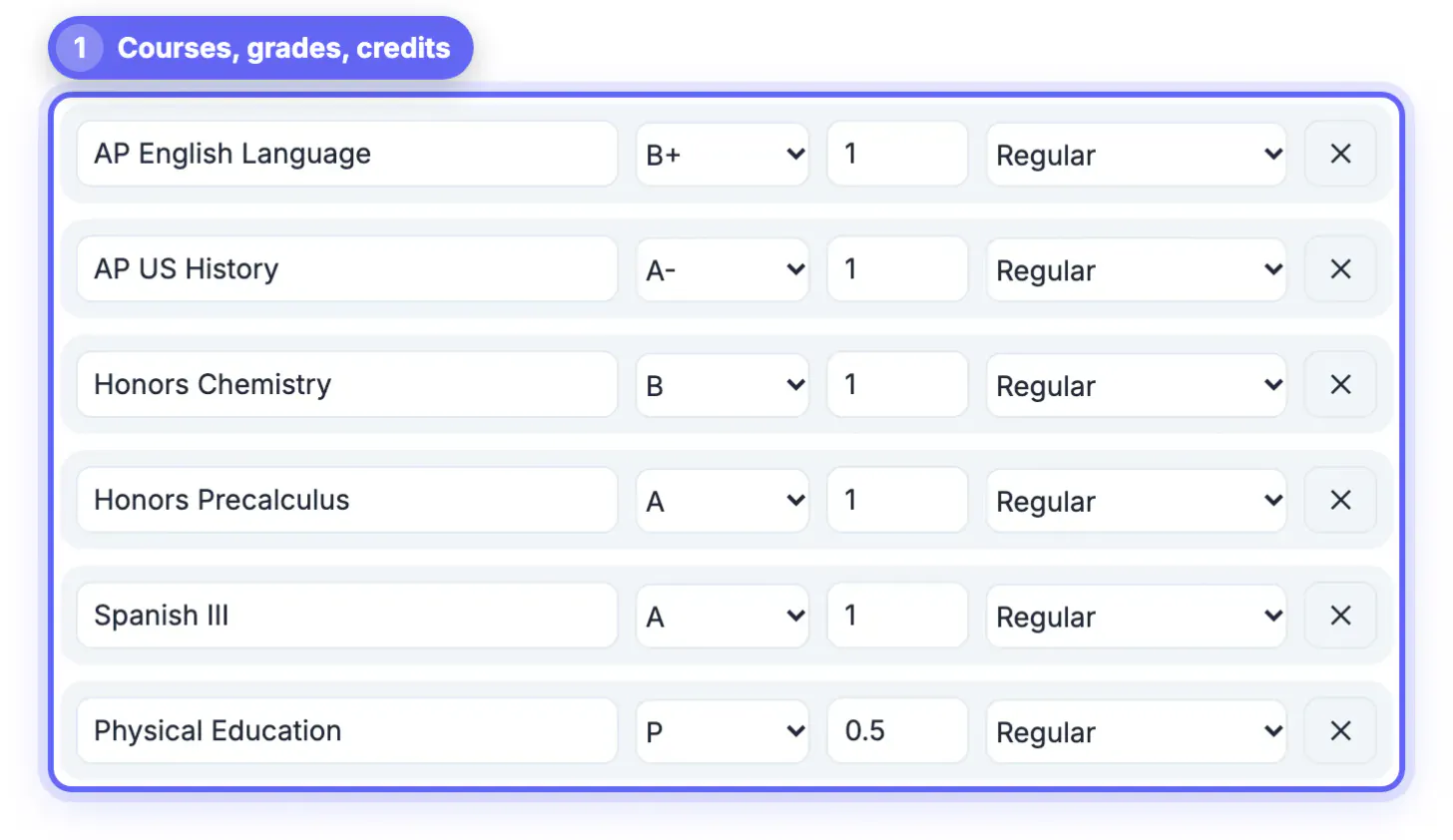
A weighted GPA adds bonus points for harder classes: on the common US scale, Honors courses earn an extra 0.5 and AP, IB or dual-enrollment college courses an extra 1.0 on top of the letter grade, so a weighted average can go above 4.0. Take a fictional high school junior, Maya, with AP English Language (B+), AP US History (A-), Honors Chemistry (B), Honors Precalculus (A), Spanish III (A) and a pass/fail PE class. The GrabCast GPA Calculator puts her semester at 3.60 unweighted and 4.20 weighted. This guide shows how that gap is built, one class at a time, why the pass/fail course does not count, what changes if one grade moves, and why colleges and scholarship forms may still ask for the unweighted number. Schools set their own weighting rules, so treat the result as an estimate and check your handbook.
🎓 Try the GPA Calculator now — freeOpen →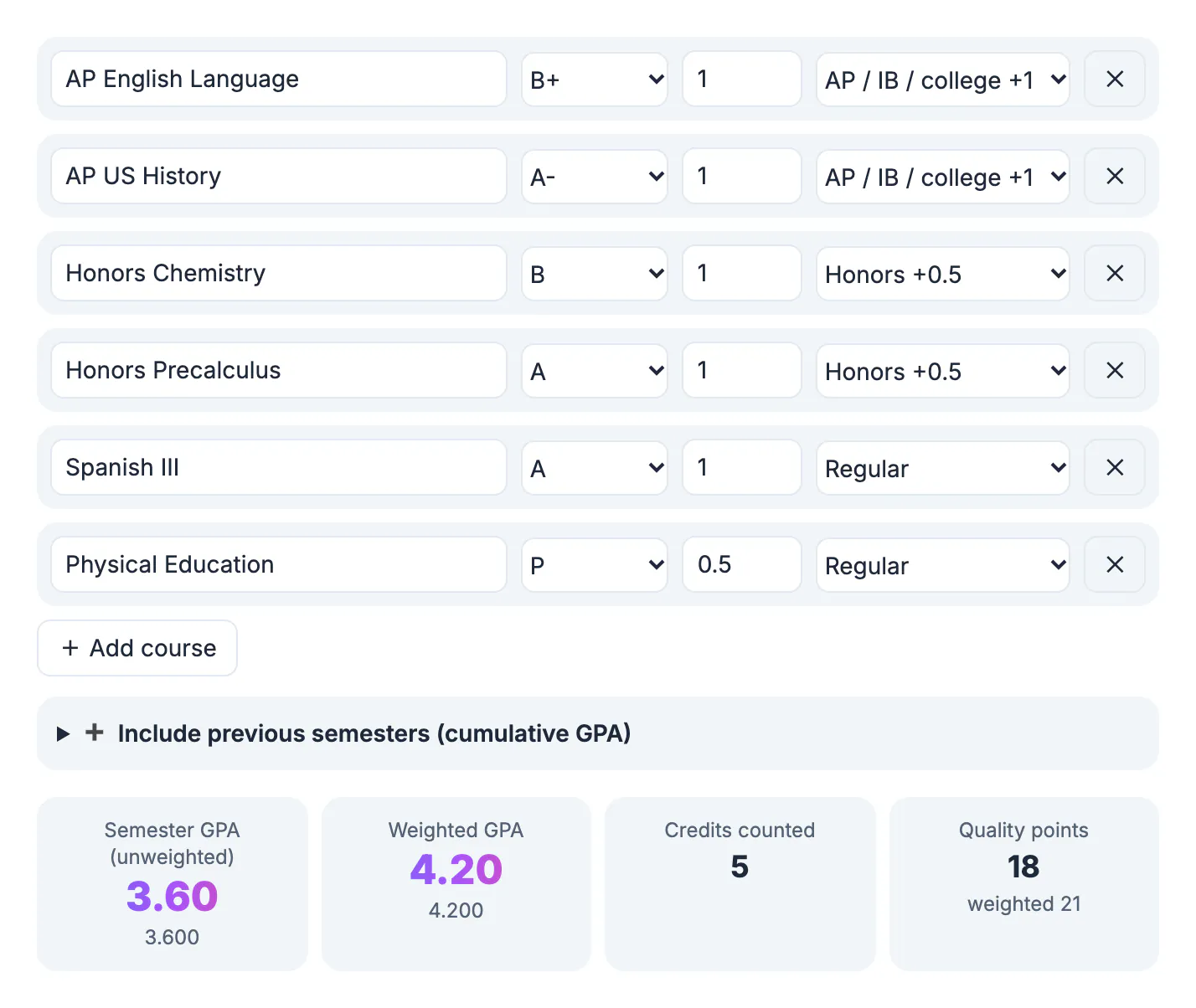
Class rank, honor rolls and some scholarships use the weighted figure, while many college applications and outside programs ask for the unweighted one or recalculate it themselves. Course selection is where this matters most: choosing between a regular class and its AP version is partly a question of whether a likely B in AP helps or hurts compared with a likely A in the regular section. Seeing both averages side by side, from your own schedule, makes that decision concrete instead of guessed. It also helps at home: parents can see why a report card full of A's in regular classes and a report card with B's in AP classes can land at similar places, and students can explain their choices with numbers rather than feelings. Counselors often ask families to bring an estimate to scheduling meetings, and a printed CSV from the tool is an easy way to do that.
How weighted GPA points are assigned
Every letter grade is first converted to grade points on the 4.0 scale the calculator uses: A = 4.0, A- = 3.7, B+ = 3.3, B = 3.0, B- = 2.7, C+ = 2.3, C = 2.0, and so on down to D- = 0.7 and F = 0. The course type then adds a bonus:
- Regular: no bonus, so an A stays 4.0.
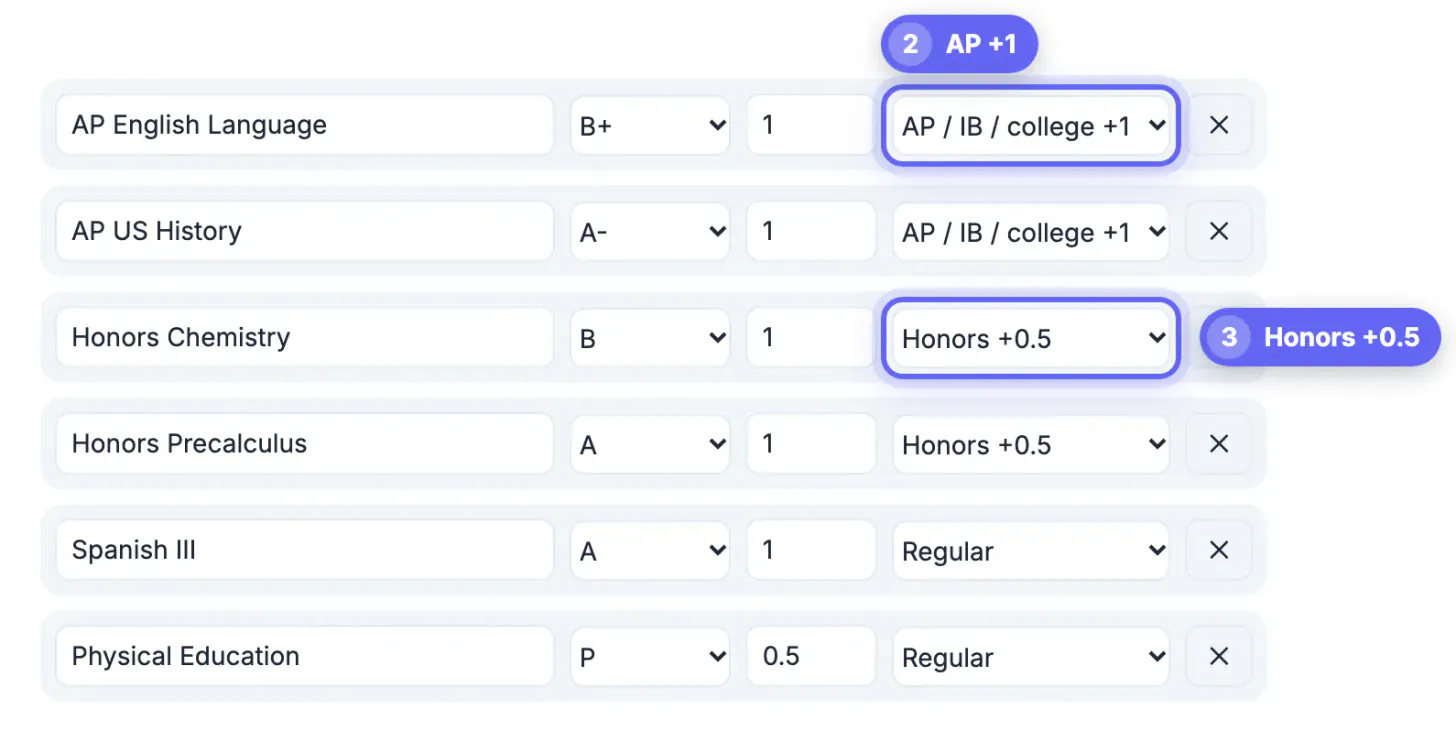
- Honors +0.5: an A becomes 4.5 and a B becomes 3.5.
- AP / IB / college +1: an A becomes 5.0 and a B+ becomes 4.3.
- No bonus is added to an F, so a failed AP class still counts as 0.
- P (pass) and W (withdrawn) are left out of both averages, along with their credits.
Each class's points are multiplied by its credits, added up and divided by the total credits counted. The weighted and unweighted results use the same credits; only the points differ.
Maya's junior-year example, class by class
Here is how the six classes in the screenshot turn into the two averages. Each full-year class is worth 1 credit and PE is 0.5.
- AP English Language, B+: 3.3 unweighted, 4.3 weighted.
- AP US History, A-: 3.7 unweighted, 4.7 weighted.
- Honors Chemistry, B: 3.0 unweighted, 3.5 weighted.
- Honors Precalculus, A: 4.0 unweighted, 4.5 weighted.
- Spanish III, A: 4.0 in both, since it is a regular class.
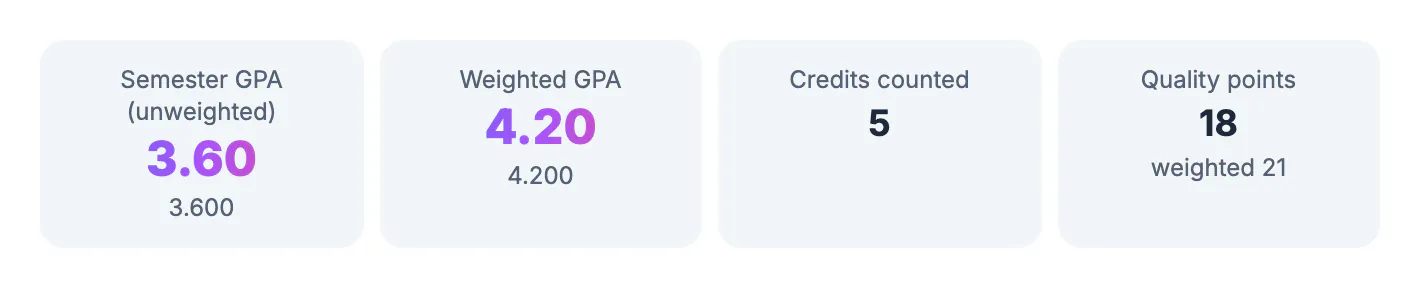
- Physical Education, P: not counted, so the calculator reports 5 credits, not 5.5.
The totals are 18 quality points unweighted and 21 weighted over 5 credits, which gives 3.60 and 4.20. The 0.60 gap is simply the 3 bonus points from two AP and two Honors classes spread over five credits.
What one grade change does to a weighted GPA
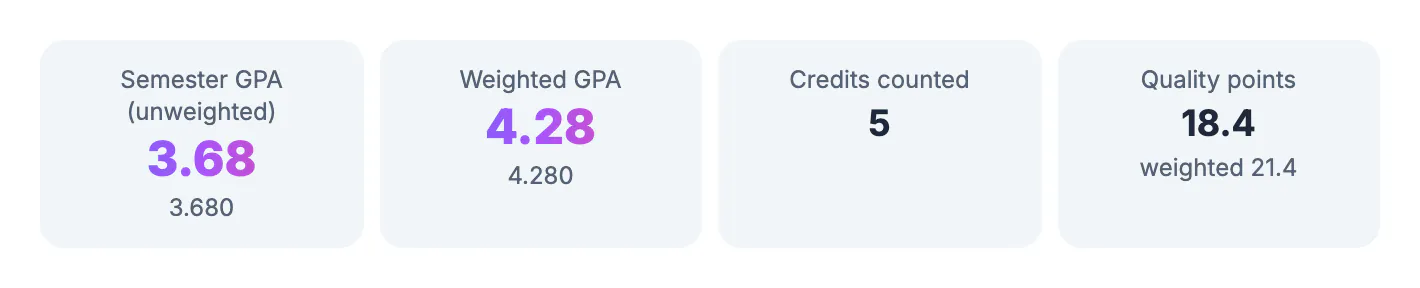
Because each class is a large share of a short schedule, a single grade moves the average a lot. In the calculator, changing AP English from B+ to A- updates both results at once:
- Unweighted rises from 3.60 to 3.68.
- Weighted rises from 4.20 to 4.28.
- Quality points go from 18 to 18.4, and weighted points from 21 to 21.4.
- Credits counted stay at 5, since the class and its credit hours did not change.
The same logic helps with course choices. Moving a class from Regular to Honors raises its weighted value by 0.5 at the same letter grade, so a B in Honors (3.5 weighted) beats a B+ in the regular section (3.3). It does not help the unweighted figure, which only sees the letter.
The Grade Calculator shows what a score needs to reach, and this percent guide covers the arithmetic.
Where school rules differ from the calculator
The +0.5 and +1.0 bonuses are common, but they are not universal. Before you rely on the number, check these points with your counselor or handbook:
- Some schools weight on a 5.0 scale only for AP and give Honors no bonus, or use different bonus values.
- Some count semester grades separately, so a full-year class appears twice with 0.5 credits each.
- Some schools give an A+ 4.33; switch the grade scale to 4.33 if yours does.
- Many colleges recalculate applicants' averages with their own rules, often using core academic classes only.
- Transcripts may round to a different number of decimals than the 2-decimal and 3-decimal figures the calculator shows.
The calculator is a planning tool that runs in your browser; your school's registrar or counselor has the official figure.
Step-by-step
Common mistakes to avoid
Pro tips
Frequently asked questions
What is the difference between weighted and unweighted averages?
Unweighted uses the plain 4.0 scale for every class. Weighted adds 0.5 for Honors and 1.0 for AP, IB or college classes, so it can go above 4.0. Colleges often see both on a school profile, and many recalculate their own version from your transcript using only core academic subjects such as English, math, science, social studies and world languages.
Can a weighted GPA be higher than 5.0?
On the 4.0 scale, no: straight A's in AP, IB or college classes give the maximum of 5.0. If you switch to the 4.33 scale, an A+ in an AP class counts as 5.33, so the average can pass 5.0.
Does a failed AP class get the bonus point?
No. The calculator gives an F zero points with no bonus, which matches the common rule.
Do pass/fail classes affect the average?
No. P and W grades, and their credits, are left out of both the weighted and unweighted averages.
Is the result my official GPA?
No. It is an estimate that runs in your browser, and nothing you type is uploaded. Your school sets its own scale, weighting and rounding, so the transcript is the official figure. If your figure and the transcript disagree, look first at credits per class, semester splits and whether your school rounds each grade before averaging.
With two AP and two Honors classes, Maya's semester averages 3.60 unweighted and 4.20 weighted: the 0.60 gap is three bonus points over five credits, and the pass/fail PE class does not count at all. Enter your own schedule, set each course type, and compare both numbers before you pick next year's classes. Always confirm your school's weighting rules, since the transcript is the final word. Keep a running record each semester so that, by application season, you already know both numbers and how they were built.
Related guides
Browse more: all calculator guides · the GPA Calculator