Pomodoro Timer for Studying: Plan Sessions That Stick
A Pomodoro timer for studying works best when each 25-minute block has one concrete job, such as ten practice problems or one chapter section turned into flashcards, followed by a 5-minute break away from your phone. Four blocks with breaks fill about two hours and deliver 100 minutes of real study, which is more than many students manage in an unstructured afternoon. This guide explains why the method suits studying and where it does not, how to plan a day or an exam week in sessions, what to do inside each 25 minutes to make material stick, and how to handle breaks, phones and study groups.
🍅 Try Pomodoro Timer now — freeOpen →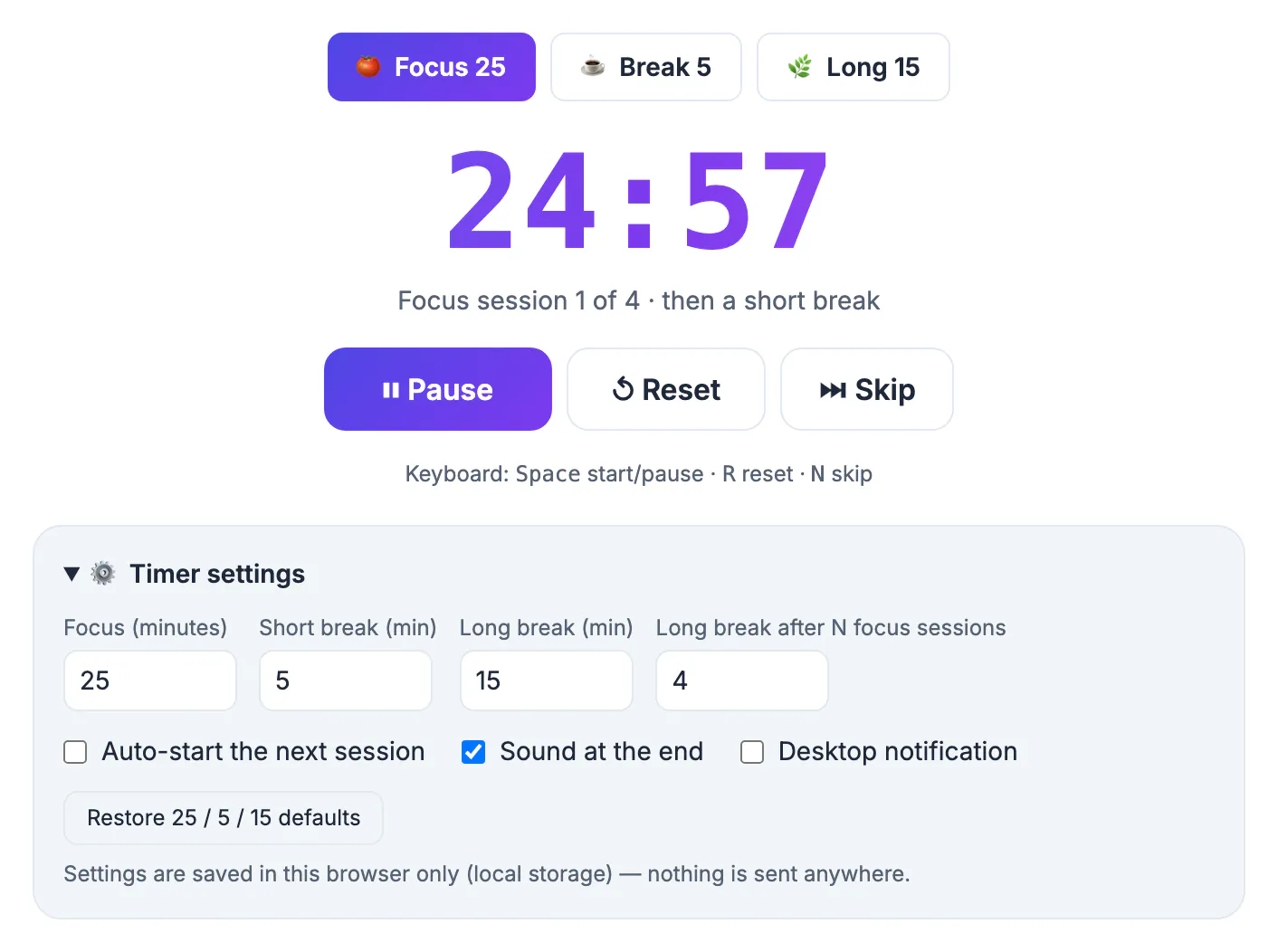
Studying has two problems that a countdown addresses directly. The first is starting: an assignment like revise for the biology final has no obvious first step and no end, so it is easy to postpone. Committing to 25 minutes on one named section feels small enough to begin. The second is drift: attention on a monotonous task tends to slip over a long unbroken stretch, and a study published in Cognition in 2011 by Ariga and Lleras found that brief, occasional switches away from a task helped people keep performance steady. A scheduled break gives that switch a fixed place, so you rest without guilt and return on time. The timer also produces a measurable unit of effort, which makes planning honest: you learn that a problem set really takes six sessions, not two.
Why a Pomodoro timer helps studying, and when to skip it
The method fits the parts of studying that are easy to put off and easy to drift from.
- Good fits: reading assigned chapters, making and reviewing flashcards, practice problems, outlining essays and memorizing vocabulary or formulas.
- Poor fits: timed mock exams, which should match the real exam length, and labs or group projects with their own schedule.
- Judgment calls: if a hard proof finally clicks at minute 24, finishing the thought is fine; take the break right after rather than skipping it.
- Signs to adjust: if you are still restless after two sessions, the task is probably too vague rather than the method failing.
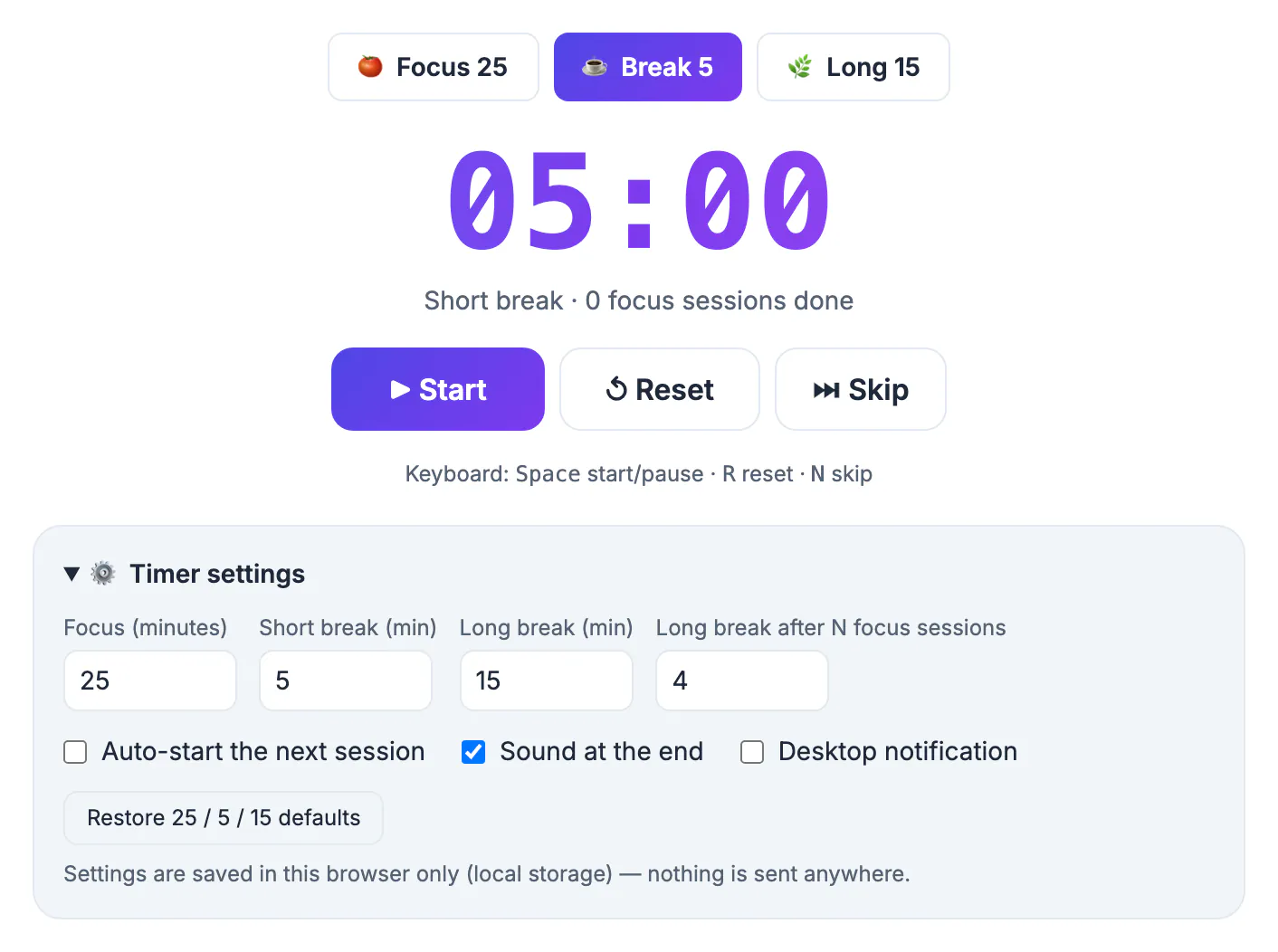
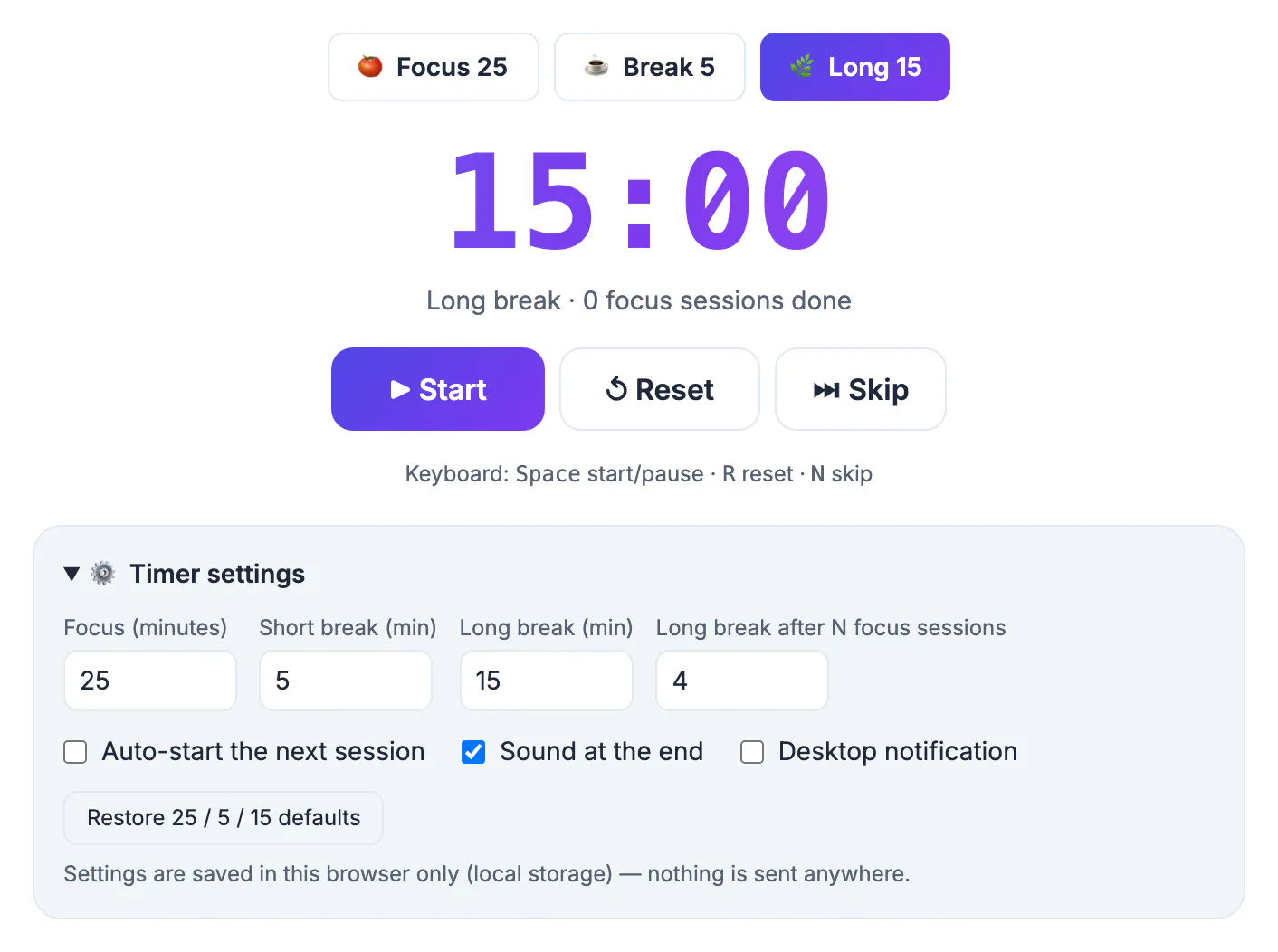
GrabCast's timer starts with the classic presets, Focus 25, Break 5 and Long 15, which suit most study sessions, and students who want longer blocks for essay writing can set Focus to 45 or 50 minutes in Timer settings. The timer lines up each break, counts focus sessions, shows the remaining time in the tab title, and plays a short tone at the end of each session.
Plan a study day or exam week in sessions
Sessions make a study plan concrete because each one is the same size. Estimate every task in sessions, then fit them into the days you have.
- Size tasks: a 20-page reading with notes might take three sessions; a 12-problem set, four; making 40 flashcards, two. Split anything larger than about six sessions into smaller tasks.
- Set a daily budget: eight sessions a day is 200 minutes of focused work, a demanding but sustainable load during finals. Four to six is realistic during a normal week with classes.
- Interleave subjects: alternate chemistry and history across sessions rather than doing four in a row on one subject, so each session starts with a fresh context.
- Space reviews: schedule a short review session for each topic one day, three days and a week after first studying it.
A sample exam-week day: two cycles of four sessions, one starting at 9:00 and one at 1:30, with the long breaks at 10:55 and 3:25. That leaves the evening for a single review session and sleep, which matters for memory more than a ninth or tenth session would.
Planning around exams? The Grade Calculator shows what score you need on the final, and the GPA Calculator shows how the semester adds up.
What to do inside each 25-minute study block
A timer protects the time, but what happens inside it decides how much you remember. Rereading highlighted notes feels productive yet produces weak recall; testing yourself is harder and works better. Roediger and Karpicke's 2006 experiments found that practicing retrieval led to better long-term retention than restudying the same material.
- Minutes 0 to 2: write the session goal in one line, such as solve problems 1 to 5 or summarize section 4.2.
- Minutes 2 to 20: work actively: answer questions before checking the key, explain concepts aloud, or close the book and write what you recall.
- Minutes 20 to 25: check answers, mark what you missed and note one question to ask the professor or tutor.
- Reading sessions: read a section, then close the text and jot three key points before moving on.
Keep a notepad open for stray thoughts. When you remember an unrelated errand mid-session, write it down and return to the work; the note is waiting at the break. Lecture recordings suit the same structure: one session to watch or read a transcript, and the next to turn it into questions.
Breaks, phones and study groups
The break is part of the method, not a reward for finishing it. Five minutes goes quickly, so choose activities that end cleanly.
- Good breaks: stand up, refill water, stretch, look out a window or walk to the end of the hallway and back.
- Risky breaks: social feeds and video apps, which rarely stop at five minutes and leave your head full of unrelated material.
- Phones: leave the phone in a bag or another room during the session; if you use it for the timer, a browser tab on your laptop is less tempting.
- Study groups: start the timer together, work silently, then use the break to compare answers or quiz one another.
In a library, the end tone may be audible, so use headphones, or turn Sound off in Timer settings and rely on a desktop notification or the countdown. After a full cycle, take the long break away from your desk; a 15-minute walk resets attention better than another 15 minutes in the same chair.
Step-by-step
Common mistakes to avoid
Pro tips
Frequently asked questions
How many Pomodoro sessions should I study per day?
Four to six on a normal class day and up to about eight during exam weeks. Eight sessions is 200 minutes of focused work, which is plenty if each one is active.
Is 25 minutes long enough for math or essays?
Usually, if the goal is specific. For long essay drafts, set Focus to 45 or 50 minutes in the GrabCast timer's settings, or run two 25-minute sessions back to back.
What should I do during a 5-minute study break?
Move, drink water or rest your eyes. Avoid social feeds and video apps, which tend to overrun the break and crowd out what you just studied.
Does the Pomodoro method help with exam cramming?
It helps structure revision, but spacing reviews over several days and testing yourself works far better than a single marathon session the night before.
Can a study group use one Pomodoro timer?
Yes. Start the timer together, work silently during the session, and use breaks to compare answers or quiz each other.
A Pomodoro timer turns studying into countable, plannable units. Give each 25-minute session one specific goal, fill it with self-testing rather than rereading, rest properly on breaks, and use your session counts to plan the next week honestly.
Related guides
Browse more: all all guides · Pomodoro Timer