VPN for Travel: Banking Abroad and What It Can't Do
A VPN for travel does two useful things: it encrypts your traffic on hotel, airport and café networks you cannot vouch for, and it can give you an internet address in your home country, which some home services expect. It does not make you anonymous, stop phishing, guarantee that your bank will accept the login, or change what is legal where you are standing. This guide covers how to prepare before you fly, how to bank abroad with fewer surprises, and the honest limits. Disclosure: this guide includes affiliate links to NordVPN. If you buy through them, GrabCast may earn a commission at no extra cost to you. Every step here also works with free tools. How we handle affiliate links.
🔐 Try 2FA Code Generator now — freeOpen →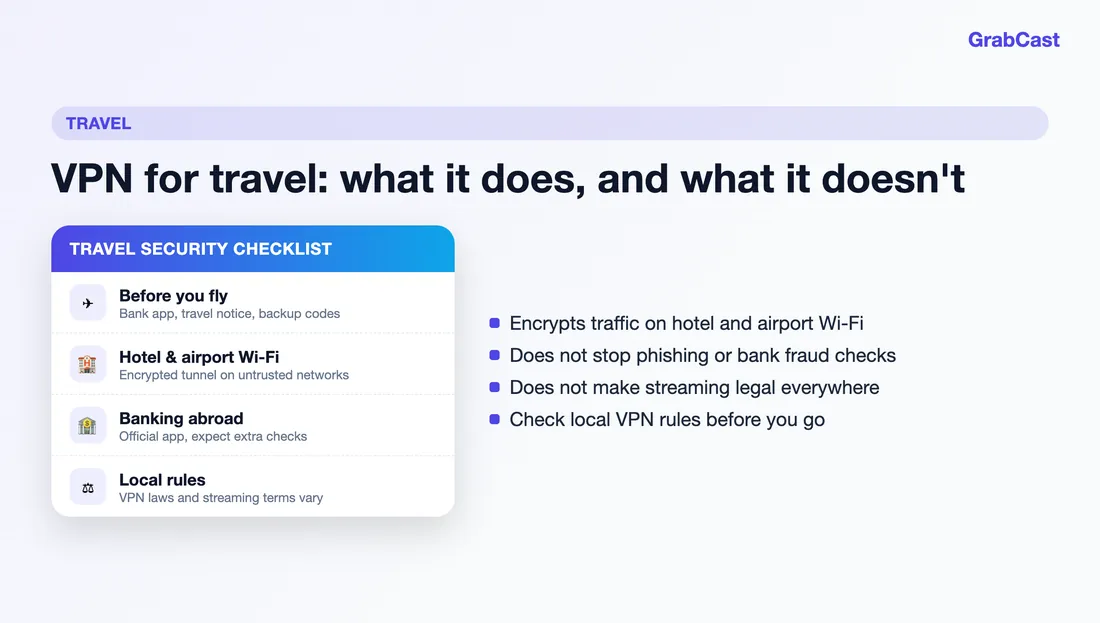
Abroad, several things change at once. You join unfamiliar networks, your phone may not receive text messages, and your logins suddenly come from a new country, which is exactly the pattern fraud systems watch for. Most lockouts on a trip are not hacks at all; they are security checks you cannot complete because the text code never arrives. Preparing your second factor and your connection before you leave matters as much as packing a charger.
Before you fly: a travel security checklist
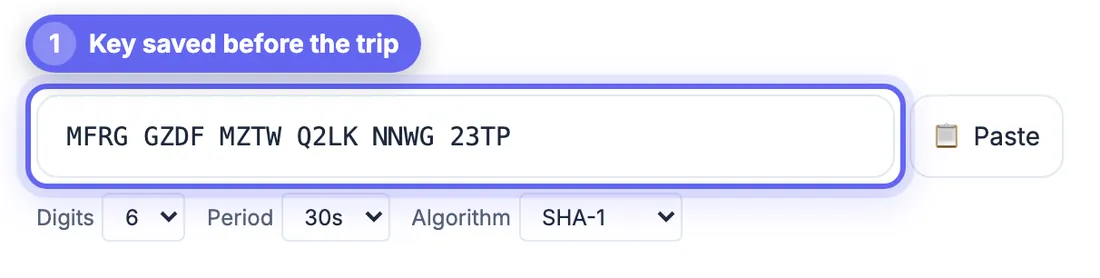
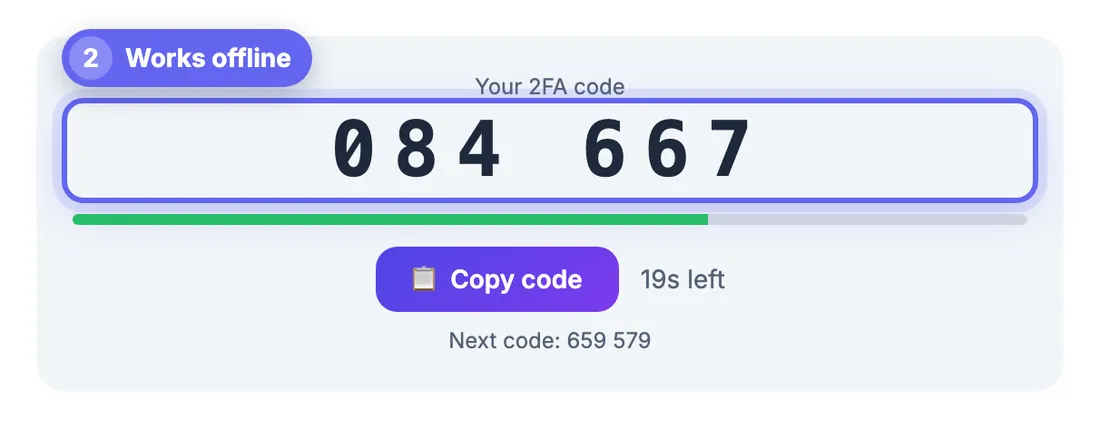
- Move off text-message codes where you can. Authenticator apps compute codes from a shared key and the clock, so they work in airplane mode on hotel Wi-Fi, while SMS codes depend on roaming. Save backup codes for email and banking too.
- Tell your bank, if it asks. Some banks still let you add a travel notice in the app; others rely on automatic detection. Check your card's foreign-transaction settings while you are at it.
- Install and test the VPN at home. Sign in, connect once and turn on any auto-connect setting. Downloading an app on a slow hotel network, or in a country where app stores limit VPN apps, is harder.
- Update everything. Phone, laptop, browser and banking apps, before you rely on unfamiliar networks.
- Check local rules. Read your government's travel advice for the destination, including any rules on VPNs and encryption.
What a VPN does well while traveling
On networks shared with strangers, a VPN is a straightforward privacy upgrade. Your traffic travels encrypted to the VPN server, so the hotel, airport or café operator sees only that you are connected to a VPN, not which sites you use. That covers old apps and background services that do not encrypt properly, not just your browser.
It can also help with home services that behave oddly abroad. Connecting to a server in your home country gives you a home-country address, which some government portals, workplace systems and news sites expect. Results vary by service, so treat it as a convenience rather than a guarantee.
NordVPN. NordVPN can auto-connect whenever you join a network you have not marked as trusted, has a Kill Switch that blocks traffic if the VPN connection drops, and a Threat Protection feature that blocks known malicious sites and trackers and checks downloads for malware. Its no-logs policy has passed several independent reviews, the recent ones by Deloitte, and one subscription covers up to 10 devices.
See NordVPN →A phone hotspot on a local eSIM is a free alternative for short sessions, and it avoids shared Wi-Fi altogether.
Banking abroad with a VPN: set expectations
Banks care about two things: that the login is really you, and that it is not coming from a risky source. A VPN affects both, in different directions.
- A home-country server can make a login look less unusual, which sometimes avoids an extra check.
- Some banks treat VPN and data-center addresses as higher risk and add verification, or block the login outright. If that happens, try another server in your home country or disconnect and use the bank's official app over mobile data.
- Either way, you may be asked for a second factor. This is where an authenticator app or backup codes you saved at home pay off.
- A VPN does nothing against fake bank texts or calls. Travelers are frequent targets; call the number on the back of your card if in doubt.
Pricing things abroad? The Currency Converter gives a quick reference rate.
The honest limits: laws, streaming and anonymity
Legality varies by country. VPNs are legal and common in the US, the UK and across the EU, but a number of countries restrict or regulate them, and some allow only government-approved services. Rules change, and using a VPN never makes an otherwise illegal activity legal. Check official travel advice before you go.
Streaming catalogs are licensed by region. Many streaming services' terms of use restrict accessing another region's catalog with a VPN or proxy, and they actively detect it. We do not promise, or recommend, using a VPN to get around those terms. If you are traveling, check whether your subscription includes watching abroad or download episodes before you leave.
A VPN is not anonymity. Sites still see your accounts, cookies and device, and the VPN provider sees your connections instead of the hotel. Choose a provider whose privacy claims have been independently audited.
Step-by-step
Common mistakes to avoid
Pro tips
Frequently asked questions
Do I need a VPN when traveling?
It is not required, but it is useful when you rely on hotel, airport and café Wi-Fi, and when home services expect a home-country address. A mobile hotspot on a local eSIM is a free alternative for short sessions.
Is it legal to use a VPN abroad?
In most countries, yes, including the US, UK and EU. Some countries restrict or regulate VPNs or only allow approved services. Check your government's official travel advice for your destination before you go, and never use a VPN to do something that is otherwise illegal.
Can I use my bank abroad with a VPN?
Often yes. Connecting to a home-country server can make the login look familiar, but some banks treat VPN addresses as high risk and add checks or block them. Have your authenticator app and backup codes ready, and fall back to the bank's app over mobile data if needed.
Will a VPN let me watch my home streaming catalog abroad?
Do not count on it. Catalogs are licensed by region, many services' terms restrict VPN use to access other regions, and services actively detect it. Check whether your plan supports travel or download shows before you leave.
Why do authenticator codes work without mobile service?
Time-based codes are calculated from a secret key and the current time, both already on your phone, so no network is needed. Text-message codes must be delivered by your carrier, which can fail when roaming.
A VPN is a good travel companion for untrusted Wi-Fi and for reaching some home services, but prepare the rest too: authenticator codes that work offline, saved backup codes and realistic expectations about banks, streaming and local law.
Related guides
Browse more: all all guides · 2FA Code Generator