How Many Calories Do I Need a Day? BMR and TDEE Math
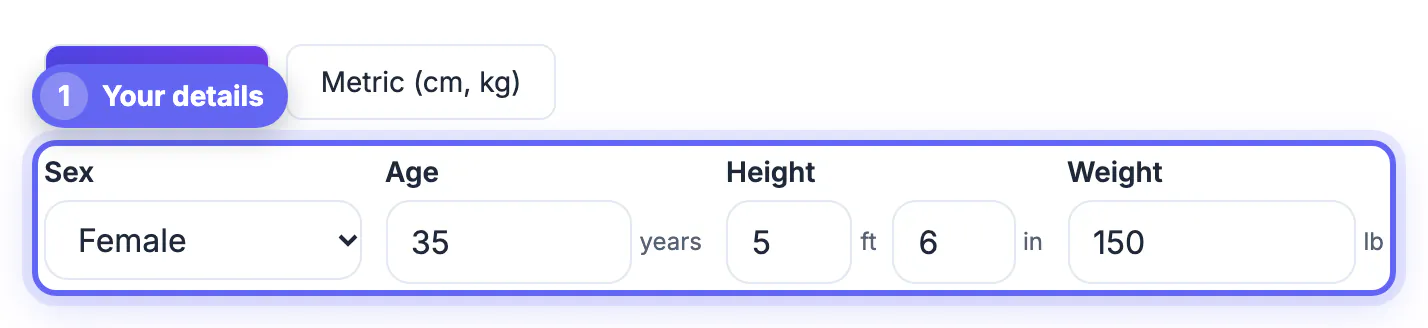
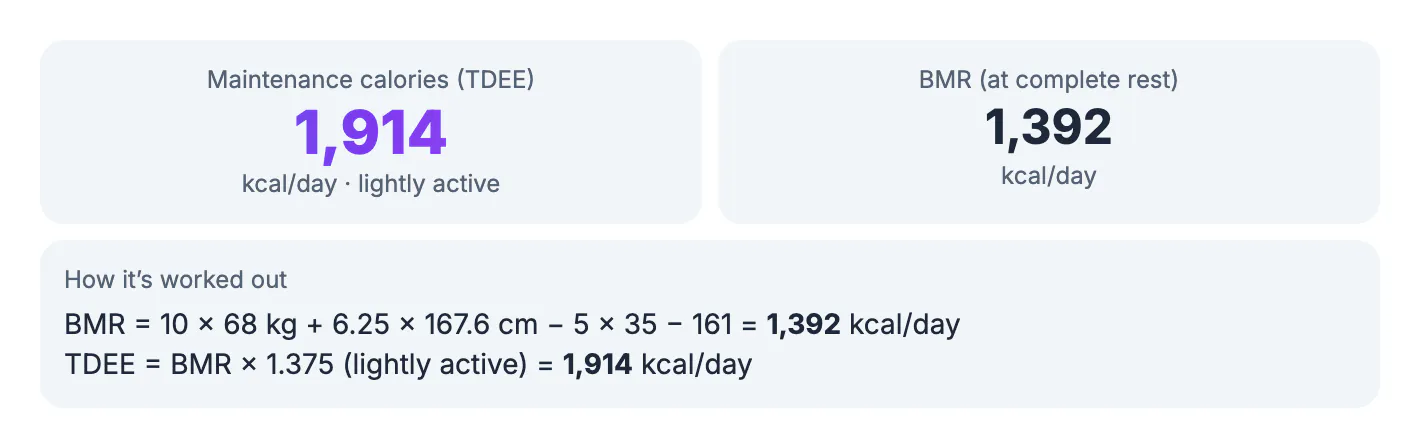
To estimate how many calories you need a day, first calculate your basal metabolic rate (BMR), the energy your body uses at complete rest, then multiply it by an activity factor between 1.2 and 1.9 to get your total daily energy expenditure (TDEE). For a 35-year-old woman who is 5 ft 6 in, weighs 150 lb and exercises lightly, that works out to a BMR of 1,392 and about 1,914 calories a day to maintain weight. This is general information, not medical advice; consult a doctor or registered dietitian before changing your diet.
🔥 Try Calorie Calculator now — freeOpen →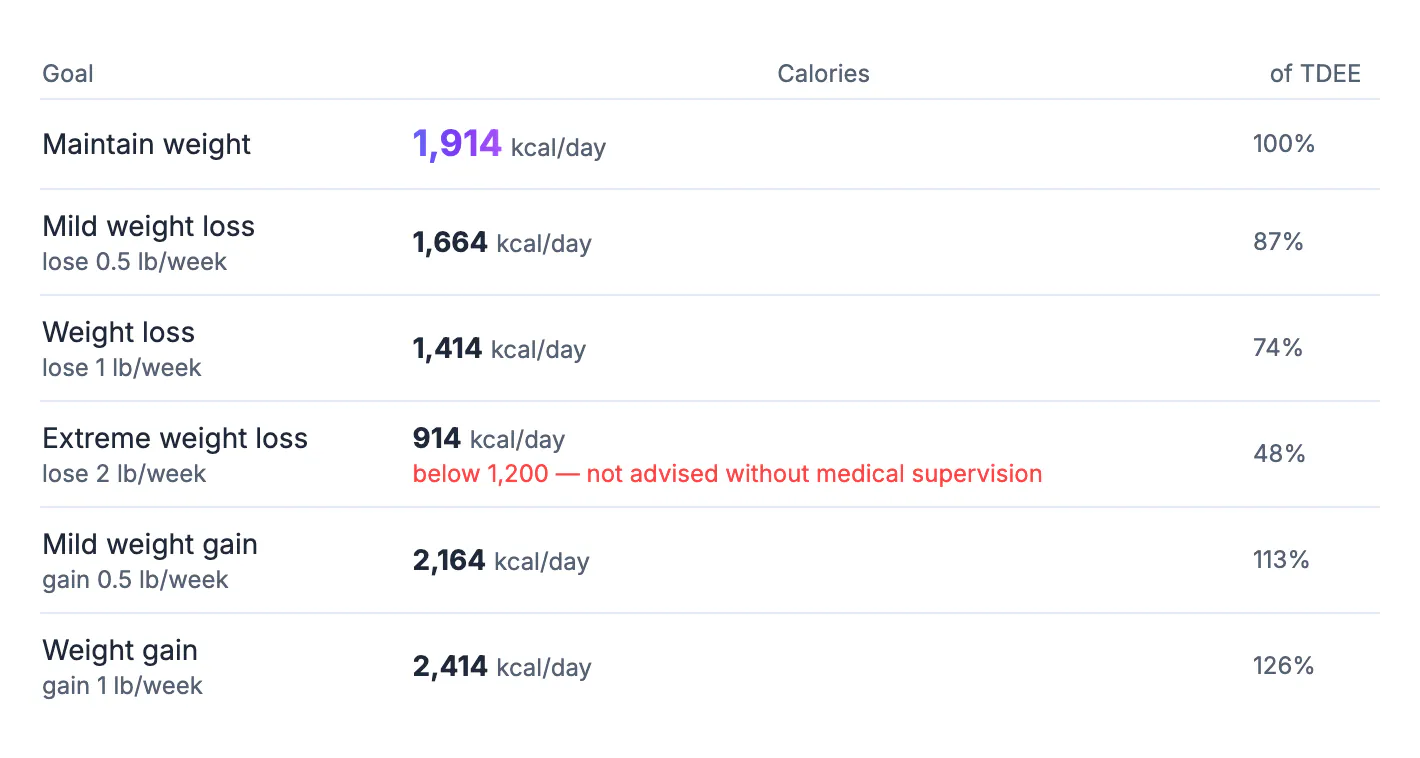
Generic figures such as 2,000 calories a day are averages printed on food labels, not targets for a specific person. Height, weight, age, sex and activity can move the real figure by more than a thousand calories. A formula gives you a sensible starting point that you then adjust against how your weight actually changes over a few weeks, since real needs vary by roughly 10 percent either way.
Step 1: calculate your BMR with Mifflin-St Jeor
The calorie calculator uses Mifflin-St Jeor by default, the equation most dietitians start with. It works in kilograms and centimeters:
- Men: BMR = 10 × weight (kg) + 6.25 × height (cm) − 5 × age + 5
- Women: BMR = 10 × weight (kg) + 6.25 × height (cm) − 5 × age − 161
For the example: 150 lb is 68.04 kg and 5 ft 6 in is 167.64 cm. So BMR = 680.4 + 1,047.8 − 175 − 161 = 1,392 calories a day. The tool converts US units for you and prints this exact working under the result, so you can check each term.
Step 2: multiply by an activity factor to get TDEE
Your total daily calories are BMR times an activity multiplier. The Activity level menu offers five:
- Sedentary, desk job with little exercise: 1.2
- Lightly active, light exercise 1 to 3 days a week: 1.375
- Moderately active, 3 to 5 days: 1.55
- Very active, hard exercise 6 to 7 days: 1.725
- Extra active, physical job plus hard daily training: 1.9
Lightly active gives 1,392 × 1.375 = 1,914 calories a day. Most people overrate their activity, so if you are unsure between two levels, start with the lower one.
Calories to lose or gain weight
The tool turns TDEE into a goal table using the rule of thumb that about 3,500 calories equal a pound of body weight (7,700 per kilogram in metric mode). For the example:
- Maintain: 1,914 calories a day
- Mild loss, about 0.5 lb a week: 1,664
- Loss, about 1 lb a week: 1,414
- Extreme loss, about 2 lb a week: 914, which the tool flags as below 1,200 and not advised without medical supervision
The floor is 1,200 calories for women and 1,500 for men. Weight change is rarely linear, so recheck your numbers every few weeks. The result also suggests balanced macros at maintenance, 30% protein, 40% carbs and 30% fat, which is 144 g protein, 191 g carbs and 64 g fat here.
Gaining works the same way in reverse: the table adds 250 calories for about half a pound a week and 500 for about a pound. A slower gain paired with strength training usually adds more muscle and less fat than a large surplus. In metric mode the steps become 275 and 550 calories, matching 0.25 kg and 0.5 kg a week, because the tool assumes roughly 7,700 calories per kilogram of body weight. Protein, fiber and regular meals make any target easier to keep.
Harris-Benedict or Katch-McArdle instead?
The Formula menu has two alternatives. The revised Harris-Benedict equation, an older formula, tends to run a little higher: 1,445 BMR and 1,986 TDEE for the same person. Katch-McArdle ignores sex and age and uses lean body mass instead: BMR = 370 + 21.6 × lean mass in kg. At 30% body fat the example has 47.6 kg of lean mass and a BMR of about 1,399.
Katch-McArdle is only as good as your body fat estimate, so use it when you have a reliable measurement. None of these formulas apply during pregnancy or breastfeeding, or to children and teens who are still growing.
Why your real calorie needs may differ
Every equation predicts an average person with your measurements. Muscle mass, genetics, sleep, some medications and health conditions shift the result, and so does how honestly activity is rated. Treat the number as a starting estimate: eat close to it for two or three weeks, track your weight trend, and adjust by 100 to 200 calories if the trend does not match your goal.
Share link and Copy result save your inputs and the goal table, so you can rerun the same numbers after your weight or routine changes. Again, this is general information and not medical advice; a doctor or registered dietitian can account for your health history.
Body composition matters too; the Body Fat Calculator and BMI Calculator give extra context.
Step-by-step

Common mistakes to avoid
Pro tips
Frequently asked questions
How many calories do I need a day?
Multiply your BMR by an activity factor from 1.2 to 1.9. A 35-year-old, 150 lb, 5 ft 6 in woman who is lightly active needs about 1,914 calories a day to maintain weight.
What is the difference between BMR and TDEE?
BMR is the energy your body uses at complete rest. TDEE adds everything you do in a day, from walking to workouts, so it is always higher than BMR.
Which calorie formula is most accurate?
Mifflin-St Jeor is the usual starting point for adults. Katch-McArdle can be better for lean, muscular people if their body fat percentage is measured reliably.
How many calories should I cut to lose weight?
A deficit of about 500 calories a day is often cited for roughly 1 pound a week. Talk to a doctor or registered dietitian before a big change, especially below 1,200 calories.
Is this calorie calculator medical advice?
No. It is general information for healthy adults. It does not apply during pregnancy, breastfeeding or growth, and a professional can tailor a plan to you.
Daily calories are BMR times an activity factor. Mifflin-St Jeor gives a solid starting estimate, which you then adjust against real weight changes over a few weeks. Keep any deficit modest, stay above the 1,200 or 1,500 calorie floor, and consult a professional before big changes.
Related guides
Browse more: all calculator guides · Calorie Calculator