Time Card Math: Total a Week With Breaks and Overtime
To total a weekly time card, work out each day as time out minus time in minus the unpaid break, add the seven days together, then split anything above 40 hours into overtime paid at 1.5 times the rate. In the example below, five weekday shifts of 8 hours 30 minutes plus a 4-hour Saturday make 46.5 hours: 40 regular hours and 6.5 overtime hours, or $1,094.50 gross at $22 an hour. This guide walks through a full time card week, including punch rounding, overnight shifts and a two-week pay period.
🕘 Try Time Card Calculator now — freeOpen →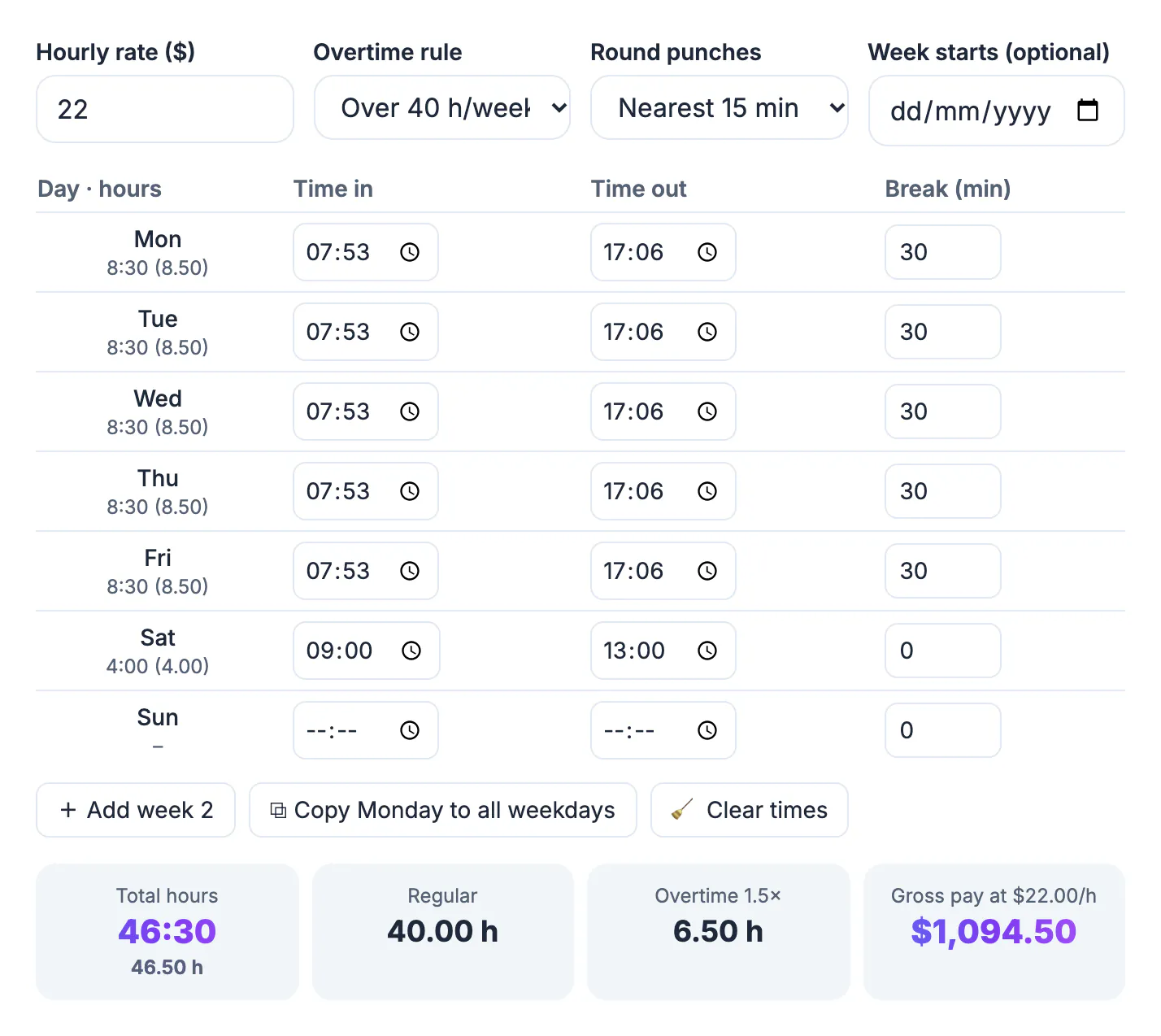
A few minutes lost per shift looks harmless, but it repeats five days a week, 52 weeks a year. Overtime makes it worse: every hour past 40 is worth 1.5 times the base rate, so a missed half hour at the end of the week costs more than one on Monday. Totaling your own card lets you catch missing punches, breaks recorded twice and rounding that always goes one way before the pay period closes.
A worked time card week, day by day
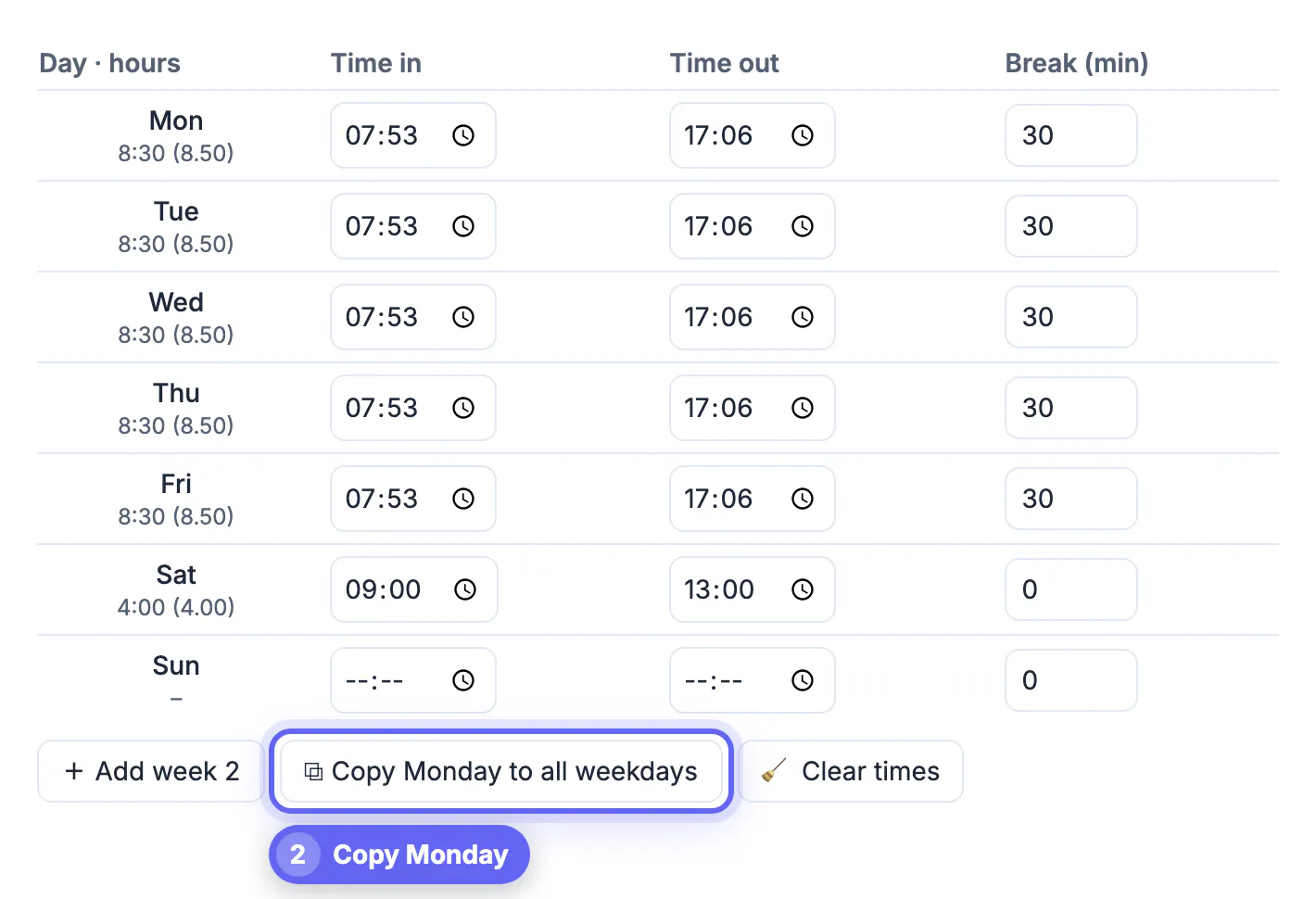
Take a warehouse associate paid $22 an hour. Monday to Friday they clock in at 7:53 AM, clock out at 5:06 PM and take a 30-minute unpaid lunch. On Saturday they work 9:00 AM to 1:00 PM with no break.
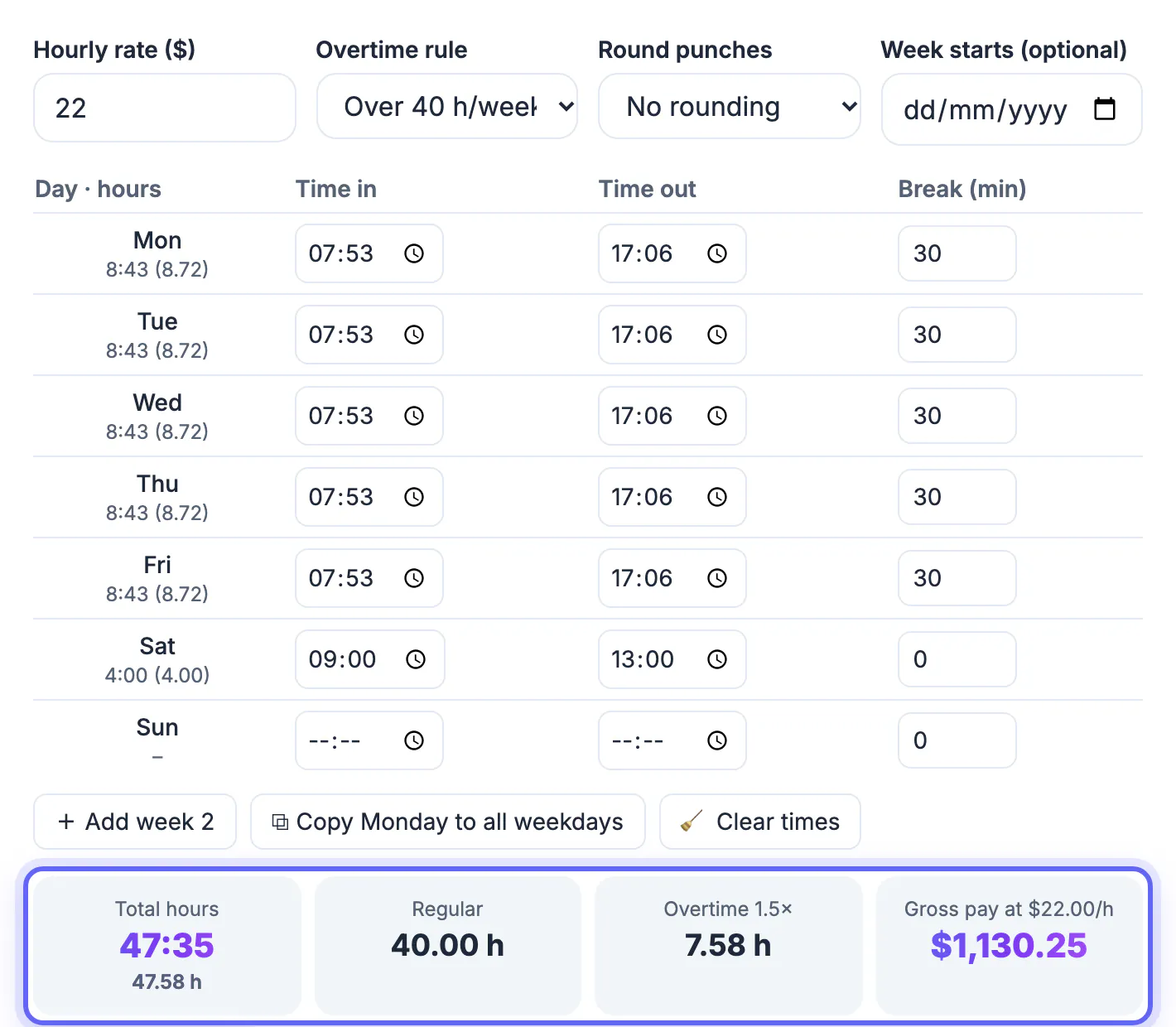
- Weekday, raw punches: 7:53 to 17:06 is 9 hours 13 minutes. Minus 30 minutes of break leaves 8:43, which is 8.72 hours.
- Weekday, rounded to 15 minutes: 7:53 becomes 8:00 and 17:06 becomes 17:00, so each day is 9 hours minus the break, or 8.5 hours.
- Saturday: 4 hours on either method.
- Week, rounded: 5 × 8.5 + 4 = 46.5 hours. Week, raw: 5 × 8:43 + 4:00 = 47:35, or 47.58 hours.
The time card calculator shows each day's hours under its name in both formats, for example 8:30 (8.50), so you can compare them with your employer's timesheet line by line.
Regular hours, overtime hours and gross pay
Under the federal rule, overtime starts once the week passes 40 hours worked. The first 40 hours are regular; the rest are paid at 1.5 times the hourly rate.
- Regular pay: 40 × $22 = $880.00.
- Overtime pay, rounded card: 6.5 × $33 = $214.50, for a total of $1,094.50.
- Overtime pay, raw punches: 7.58 × $33 = $250.25, for a total of $1,130.25.
The tool offers three rules in the Overtime rule menu: Over 40 h/week (federal), Over 8 h/day + 40 h/week (CA) and No overtime. The California option pays 1.5× after 8 hours in a day and double time after 12, so a 13-hour shift splits into 8 regular, 4 overtime and 1 double-time hour. It does not apply the seventh-consecutive-day rule, so check that case by hand. Gross pay is before taxes; the paycheck calculator estimates take-home.
How punch rounding changes your time card total
Many employers round clock punches. The Round punches menu has four settings: No rounding, Nearest 5 min, Nearest 6 min (0.1 h) and Nearest 15 min. The 15-minute version is often called the 7-minute rule, because a punch up to 7 minutes past a quarter hour rounds down and 8 or more rounds up.
In the example, rounding trims 13 minutes a day and costs the worker 1.08 hours, or $35.75, in a single week. That is not automatically wrong. US federal guidance accepts rounding only when it averages out over time, so early and late punches must both be rounded to the nearest mark rather than always in the employer's favor. If your rounded total is lower week after week, compare it with the raw punches and raise it with payroll.
Overnight shifts and two-week pay periods
- Overnight: when the time out is earlier than the time in, the calculator counts past midnight. A 10:00 PM to 6:30 AM shift with a 30-minute break totals 8 hours.
- Two weeks: press Add week 2 to get a second set of seven rows. Overtime is still counted per week, because the federal rule does not let two weeks be averaged together.
- Dated rows: set Week starts to a date and each row shows its real date, such as Mon, Nov 2, which makes the CSV easier to file.
- Records: Copy summary pastes a one-line total into a message; Download CSV saves every day with regular, overtime and double-time hours.
Your times are stored only in your browser, so the card is still there when you return on Friday.
Checking your time card against your pay stub
Once the week is totaled, line it up against the stub. Hours worked should match the Total hours card, and regular and overtime hours should appear as separate lines with separate rates. If the stub shows 46.5 hours all paid at $22, the overtime premium of $71.50 is missing. If it shows fewer hours than your raw punches, look for rounding, an auto-deducted lunch you worked through, or a missing punch.
Bring the downloaded CSV and your own notes to payroll, because a dated record with in and out times is much easier to correct than a memory of a busy week.
Overtime is usually a multiple of the base rate, and the Percentage Calculator helps check premium amounts.
Step-by-step


Common mistakes to avoid
Pro tips
Frequently asked questions
How do I calculate total hours on a time card?
For each day, subtract the time in from the time out and take away unpaid breaks. Add the days together, then convert leftover minutes to decimals by dividing by 60.
How is overtime calculated on a weekly time card?
Under the federal rule, hours worked past 40 in a workweek are overtime at 1.5 times the regular rate. Some states, such as California, also count daily overtime after 8 hours.
Is rounding time card punches legal?
Rounding to the nearest 5, 6 or 15 minutes is generally accepted in the US if it is neutral and averages out over time. Rounding that always favors the employer can underpay workers.
Does a lunch break count as hours worked?
A bona fide meal break of 30 minutes or more when you are fully relieved of duty is usually unpaid. Short rest breaks of 5 to 20 minutes are generally paid, so do not subtract them.
How do I enter an overnight shift?
Enter the real clock times, such as 22:00 in and 06:30 out. The calculator sees that the time out is earlier and counts the hours past midnight.
Total a time card one day at a time: out minus in minus unpaid breaks, then add the week and split everything past 40 hours into overtime. Compare rounded and raw totals, keep a CSV of each week, and question rounding that always shaves time off.
Related guides
Browse more: all calculator guides · Time Card Calculator