How to Add, Subtract, Multiply and Divide Fractions
To add or subtract fractions, rewrite them over a common denominator and combine the numerators: 3/4 + 5/6 becomes 9/12 + 10/12 = 19/12, or 1 7/12. To multiply, multiply straight across: 2/3 × 9/10 = 18/30 = 3/5. To divide, flip the second fraction and multiply: 2 1/2 ÷ 3/4 = 5/2 × 4/3 = 10/3, or 3 1/3. Always finish by simplifying. This guide covers each operation with worked examples, mixed numbers, and the checks that catch the usual slips.
½ Try Fraction Calculator now — freeOpen →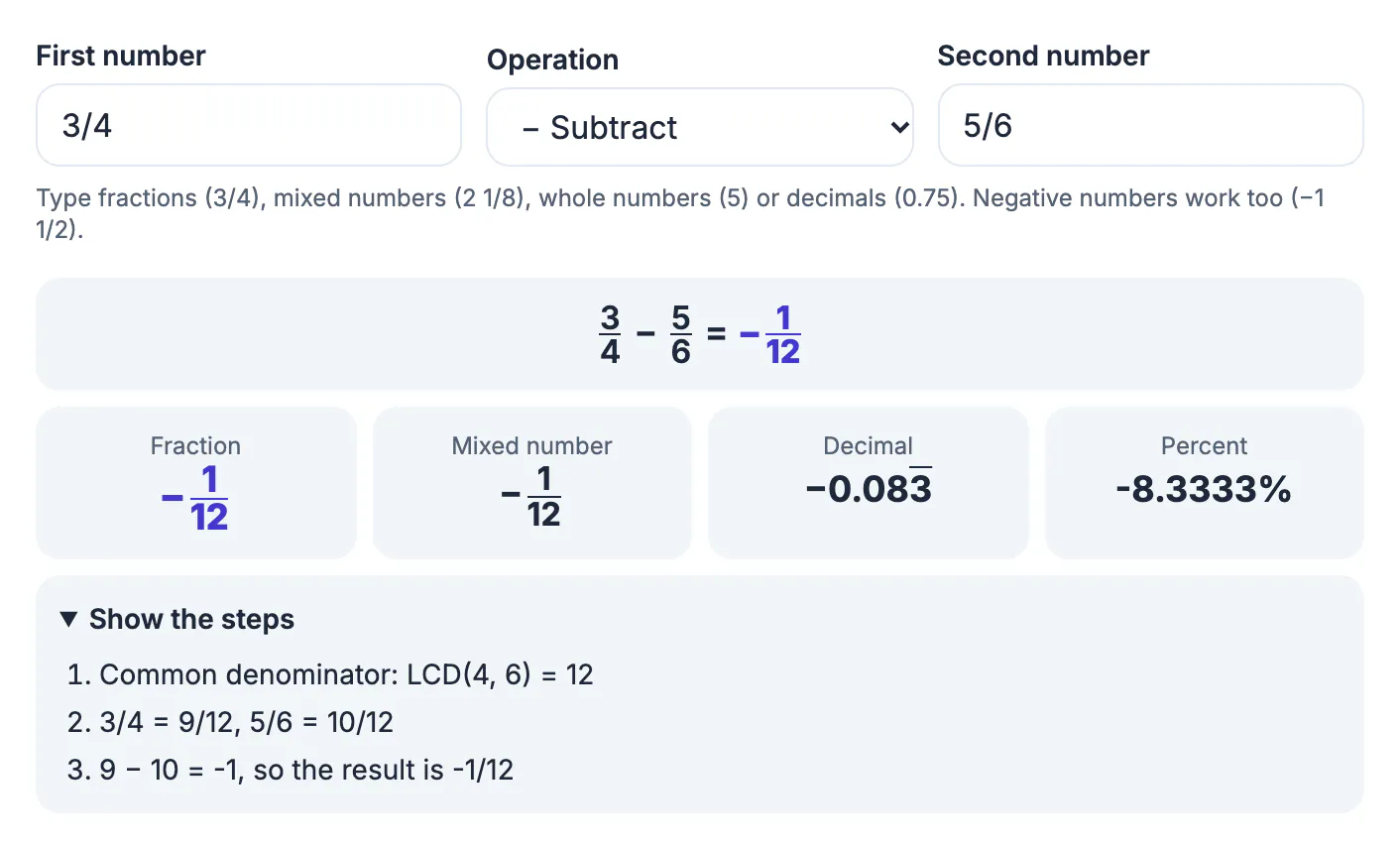
Recipes, woodworking, sewing, medication schedules and homework all use fractions. Scaling a recipe by 1 1/2, cutting 2 1/2 feet of board into 3/4-foot pieces, or combining 3/4 cup and 5/6 cup of flour are the same four operations. Doing them by hand builds number sense; checking them with a calculator that shows every step catches the small mistakes that are easy to miss, like forgetting to convert a mixed number or leaving an answer unsimplified. Once the four rules are clear, most everyday problems take under a minute, whether you are halving a recipe for two people or working out how many shelves fit on a wall.
Adding and subtracting fractions
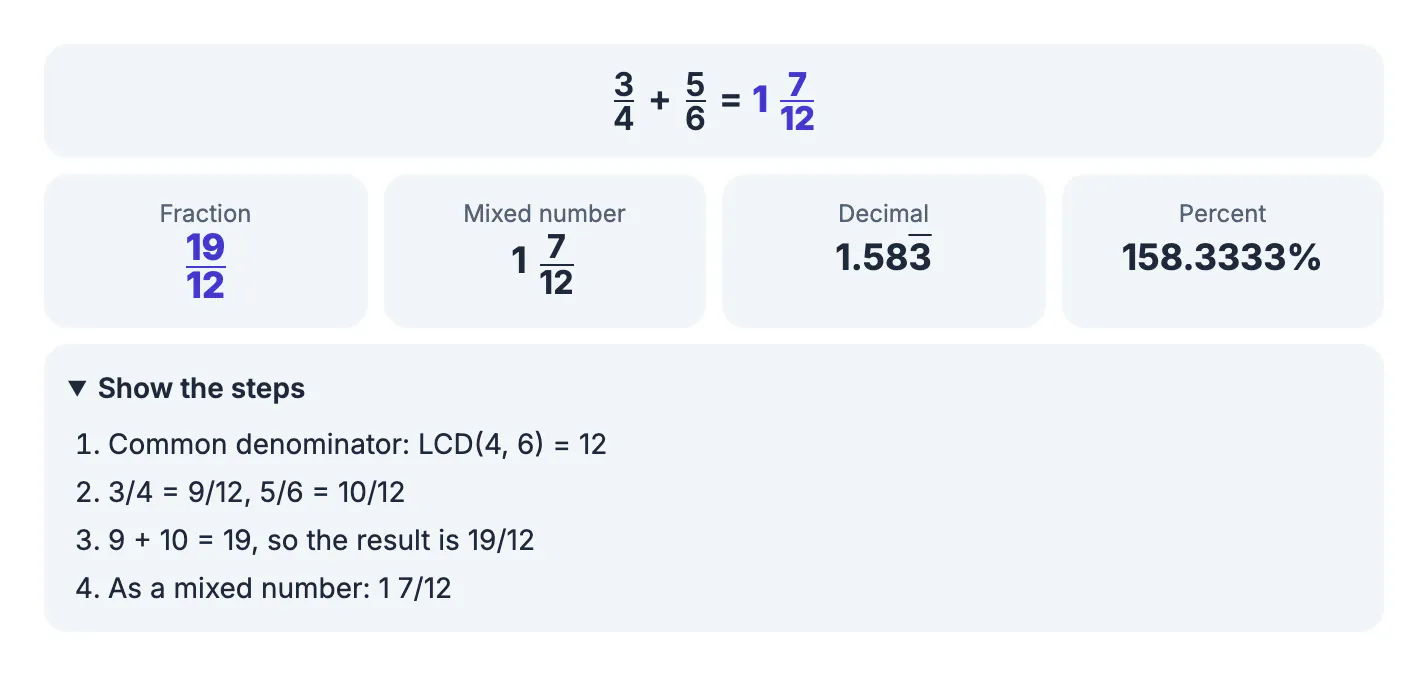
You can only add or subtract pieces of the same size, so first find a common denominator. The least common denominator (LCD) is the smallest number both denominators divide into. For 4 and 6 it is 12.
- Rewrite each one over the LCD: 3/4 = 9/12 and 5/6 = 10/12.
- Add or subtract the numerators and keep the denominator: 9 + 10 = 19, so 19/12.
- Simplify and, if the top is bigger than the bottom, write it as a mixed number: 19/12 = 1 7/12.
Subtraction works the same way: 3/4 − 5/6 = 9/12 − 10/12 = −1/12. A negative answer simply means the second amount was larger. You can also multiply the two denominators (4 × 6 = 24) as a common denominator; it works, but the numbers get bigger and you will have more simplifying to do at the end.
Multiplying fractions
Multiplication needs no common denominator. Multiply the numerators together and the denominators together, then simplify.
- 2/3 × 9/10 = (2 × 9) / (3 × 10) = 18/30.
- Divide top and bottom by their greatest common divisor, 6: 18/30 = 3/5.
- Shortcut: cancel common factors before multiplying. The 3 and 9 share a 3, and the 2 and 10 share a 2, so 2/3 × 9/10 becomes 1/1 × 3/5 = 3/5.
To multiply by a whole number, put it over 1: 4 × 3/8 = 4/1 × 3/8 = 12/8 = 1 1/2.
Dividing fractions: keep, change, flip
To divide by a fraction, multiply by its reciprocal. Keep the first number, change ÷ to ×, and turn the second one upside down.
- Convert mixed numbers first: 2 1/2 = (2 × 2 + 1)/2 = 5/2.
- Flip the divisor: 3/4 becomes 4/3.
- Multiply: 5/2 × 4/3 = 20/6, which simplifies by 2 to 10/3 = 3 1/3.
A quick sanity check helps: 3/4 fits into 2 1/2 a little more than three times, so 3 1/3 makes sense. Division by zero is undefined, and the calculator will say so rather than return a number.
Mixed numbers and simplifying
A mixed number such as 1 1/2 is a whole number plus a fraction. For multiplication and division, always rewrite it as an improper one first: multiply the whole number by the denominator and add the numerator. For addition you can add whole parts and the leftover parts separately, but converting is less error-prone.
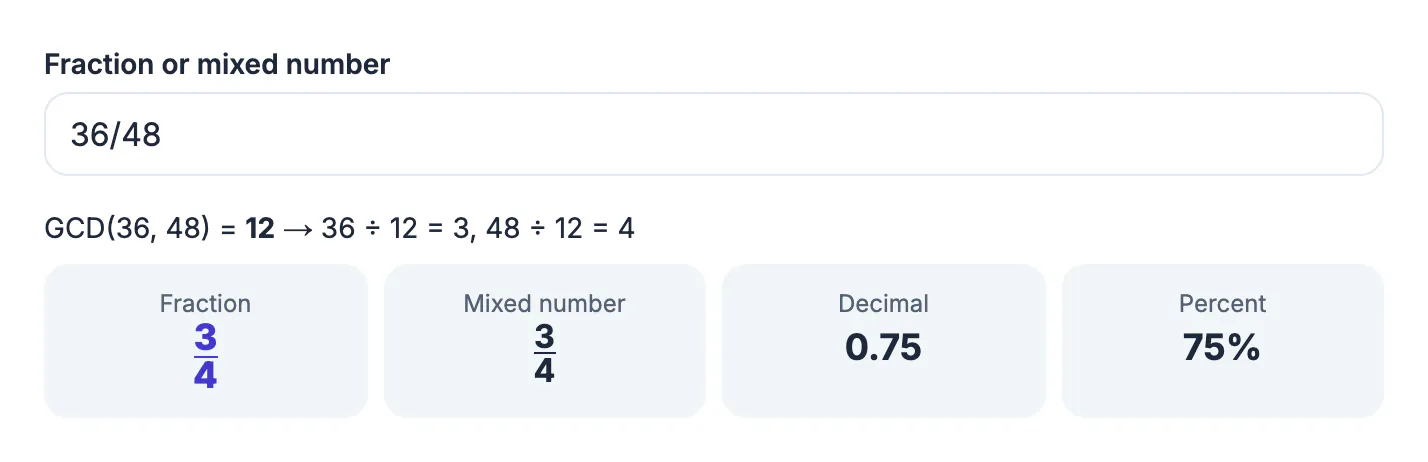
To simplify, divide the numerator and denominator by their greatest common divisor (GCD). For 36/48 the GCD is 12, so 36/48 = 3/4. The calculator's Simplify & convert tab shows the GCD and the division, then gives the same value as a mixed number, a decimal and a percent.
Worked example: division with a mixed number
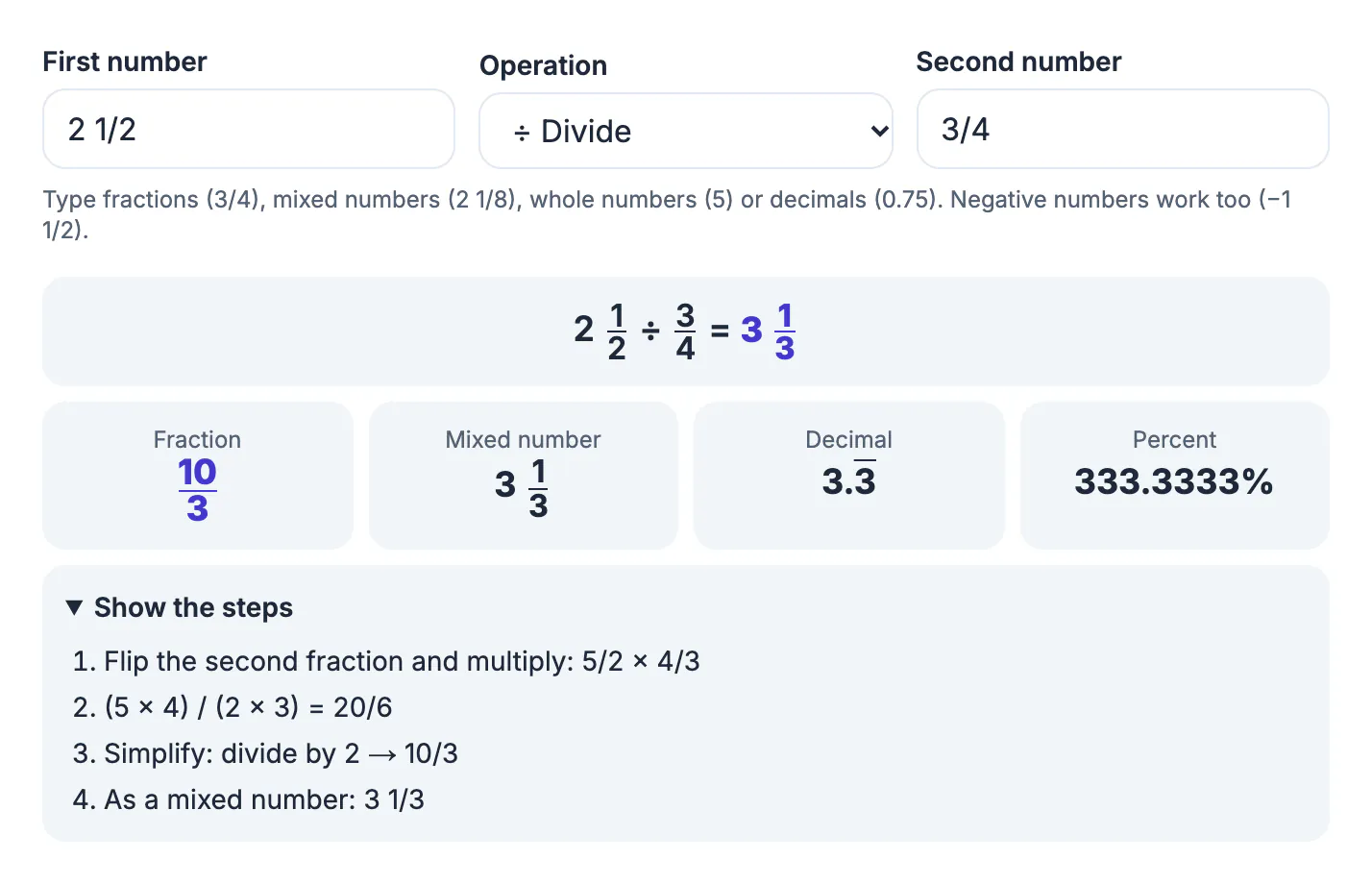
Here is the division from the intro exactly as the tool displays it. With 2 1/2 as the First number, ÷ Divide as the Operation and 3/4 as the Second number, the answer card reads 3 1/3. The steps list says: flip the second fraction and multiply, 5/2 × 4/3; then (5 × 4) / (2 × 3) = 20/6; then simplify by dividing by 2 to get 10/3; and finally, as a mixed number, 3 1/3.
In a real task this could be a 2 1/2-foot board cut into 3/4-foot pieces: you get three full pieces plus one third of a piece left over. The decimal card shows 3.3 with a repeating 3, and the percent card shows 333.3333%.
Using the Fraction Calculator
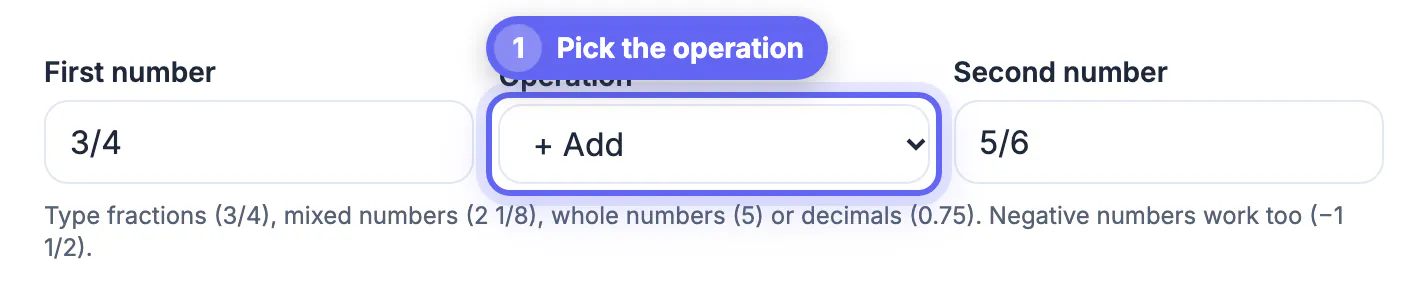
On the Calculate tab, type the First number, pick an Operation (+ Add, − Subtract, × Multiply or ÷ Divide) and type the Second number. Inputs can be simple ratios (3/4), mixed numbers with a space (2 1/2), whole numbers or decimals, and negative numbers work too. The answer appears as you type, with four cards (Fraction, Mixed number, Decimal and Percent) and a Show the steps list that names the LCD, the rewritten fractions and the simplification.
Repeating decimals are marked with a bar: 19/12 is 1.583 with the 3 repeating. The Decimal → fraction tab works in reverse, turning 0.3125 into 5/16, or rounding a measurement to the nearest 1/16 for a tape measure.
Common fraction mistakes and how to avoid them
Most errors come from applying a rule to the wrong operation. Slow down at the first step and ask what the operation requires.
- Adding denominators: 1/2 + 1/3 is not 2/5. Use a common denominator, giving 5/6.
- Skipping simplification: 6/8 should be reduced to 3/4 by dividing both by 2.
- Flipping the wrong fraction when dividing; only the second fraction is inverted.
- Forgetting to convert mixed numbers to improper fractions for multiplication and division.
- Dropping negative signs; count them before you finish.
For checking decimals and percentages, calculating a percentage shows how fractions relate to them, and calculating a grade percentage applies the same ideas to scores.
Fractions in everyday tasks
Cooking, carpentry and sewing all use fractions. Doubling a recipe that needs 3/4 cup means 1 1/2 cups, and cutting a board 5 3/8 inches means working in eighths. Practising with real measurements makes the rules stick far better than abstract exercises.
Step-by-step
Common mistakes to avoid
Pro tips
Frequently asked questions
How do you add fractions with different denominators?
Rewrite both over the least common denominator, then add the numerators. For 3/4 + 5/6 the LCD is 12, so 9/12 + 10/12 = 19/12 = 1 7/12.
How do you divide fractions?
Keep the first fraction, change division to multiplication, and flip the second fraction. 2 1/2 ÷ 3/4 = 5/2 × 4/3 = 20/6 = 10/3 = 3 1/3.
Do you need a common denominator to multiply fractions?
No. Multiply the numerators and denominators straight across, then simplify. 2/3 × 9/10 = 18/30 = 3/5.
How do I simplify a fraction?
Divide the top and bottom by their greatest common divisor. For 36/48 the GCD is 12, which gives 3/4. The Simplify & convert tab shows this division.
Can the calculator handle negative fractions and decimals?
Yes. Type −1 1/2 or 0.75 directly. Results are shown as a fraction, a mixed number, a decimal with repeating digits marked, and a percent.
Adding and subtracting need a common denominator, multiplying goes straight across, and dividing means flip the second fraction and multiply. Convert mixed numbers first, simplify at the end, and use the step list to check your own working line by line. With a little practice the rules become automatic, and the calculator becomes a quick way to confirm answers rather than a crutch.
Related guides
Browse more: all calculator guides · Fraction Calculator