Brand Voice Guidelines: Examples and a One-Page Template
Brand voice guidelines describe how your business sounds in writing: the tone, the words you always use, the words you never use and a few example posts. Big brands write forty-page books; a small business needs one page that a new hire, a freelancer or an AI writing tool can follow. This guide gives brand voice guidelines examples for three kinds of small business, a one-page template, and a way to put the guidelines to work: the Brand voice kit in GrabCast's free Scheduler measures how you actually write from your own posts, and a caption check flags stock phrases before a post goes out. The worked example is a fictional bike repair shop.
📅 Try the Social Media Scheduler now — freeOpen →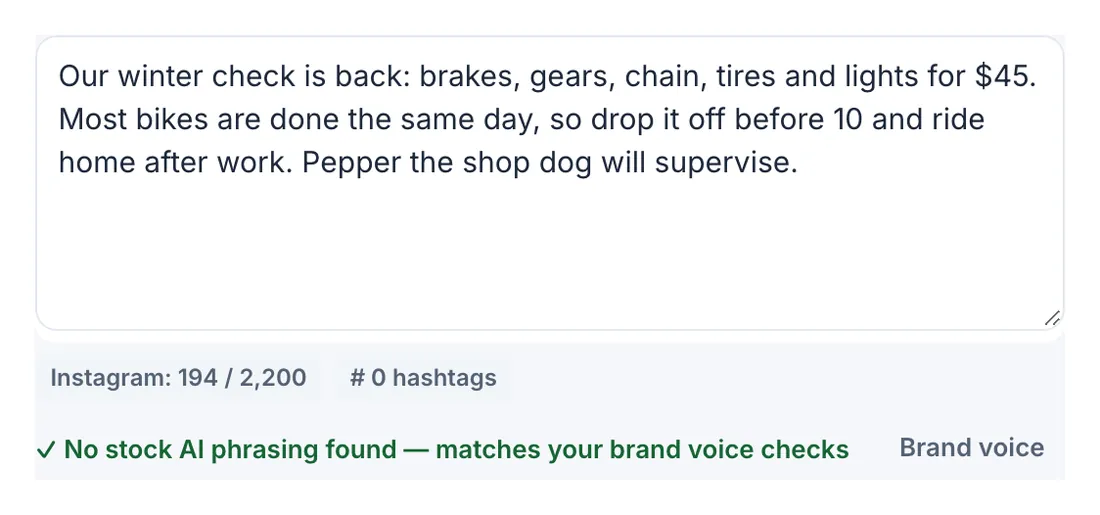
Customers recognise a business by how it talks as much as by its logo. A shop that writes short, friendly posts with prices and opening times builds a different kind of trust than one that posts hype and emoji. The voice drifts when several people post, when a busy owner writes at midnight, and especially when AI tools draft captions: without guidance they fall back on the same stock phrases everyone has seen a thousand times. Written guidelines fix the drift. They also make feedback concrete: instead of saying a draft doesn't sound like us, you can point to the rule it breaks, such as no exclamation marks in a row.
What goes into one page of brand voice guidelines
A useful one-pager has five parts:
- Who we sound like: one sentence, such as the mechanic you trust or a neighbour who bakes.
- Tone on four scales: formal to casual, serious to playful, reserved to enthusiastic, concise to detailed.
- Words we use: your recurring phrases, product names and local terms.
- Words we never use: hype words, jargon, anything off-brand or legally risky.
- Habits: emoji per post, hashtags per post and where they go, first person (we or I), punctuation rules.
Add three to five real posts that you consider on-voice. Examples teach faster than rules, for people and for AI tools alike.
Brand voice guidelines examples for small businesses
Three short style cards show how different the same template can look:
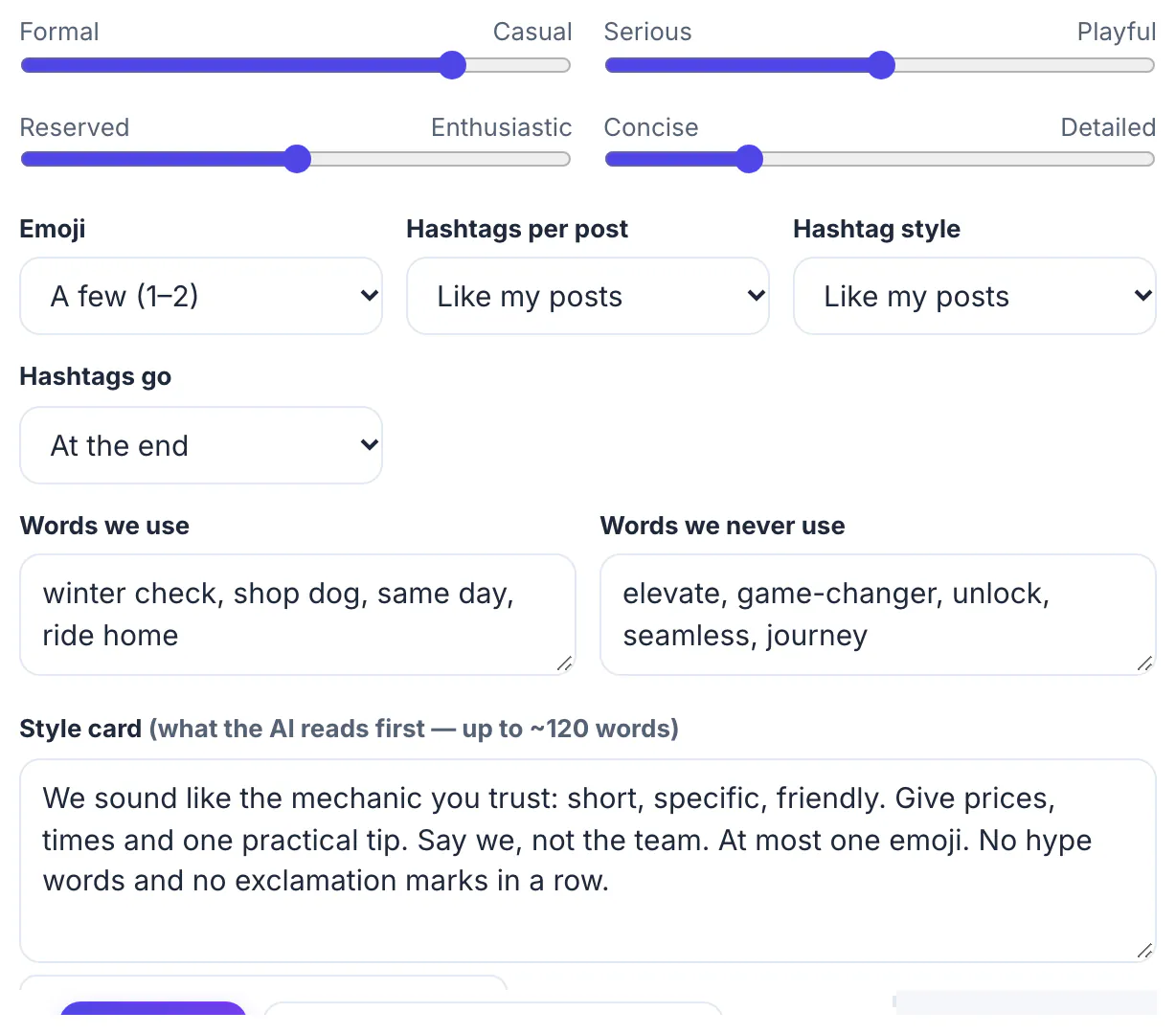
- Bike repair shop: We sound like the mechanic you trust: short, specific, friendly. Give prices, times and one practical tip. Say we. At most one emoji. No hype words and no exclamation marks in a row. Uses: winter check, same day, shop dog. Never: elevate, game-changer, unlock, seamless, journey.
- Family law practice: Calm, plain and precise. Explain one term per post. No jokes about divorce or children. Never promise an outcome. Uses: next step, free first call. Never: win, guaranteed, aggressive.
- Neighbourhood bakery: Warm and a little playful, like a note on the counter. Name the bake and the time it comes out of the oven. Two emoji at most. Uses: fresh from the oven, while they last. Never: artisanal, curated, indulge.
Notice what the cards avoid: vague adjectives such as authentic or engaging. Each rule is something you can check in a draft.
Turn your guidelines into a working brand voice kit
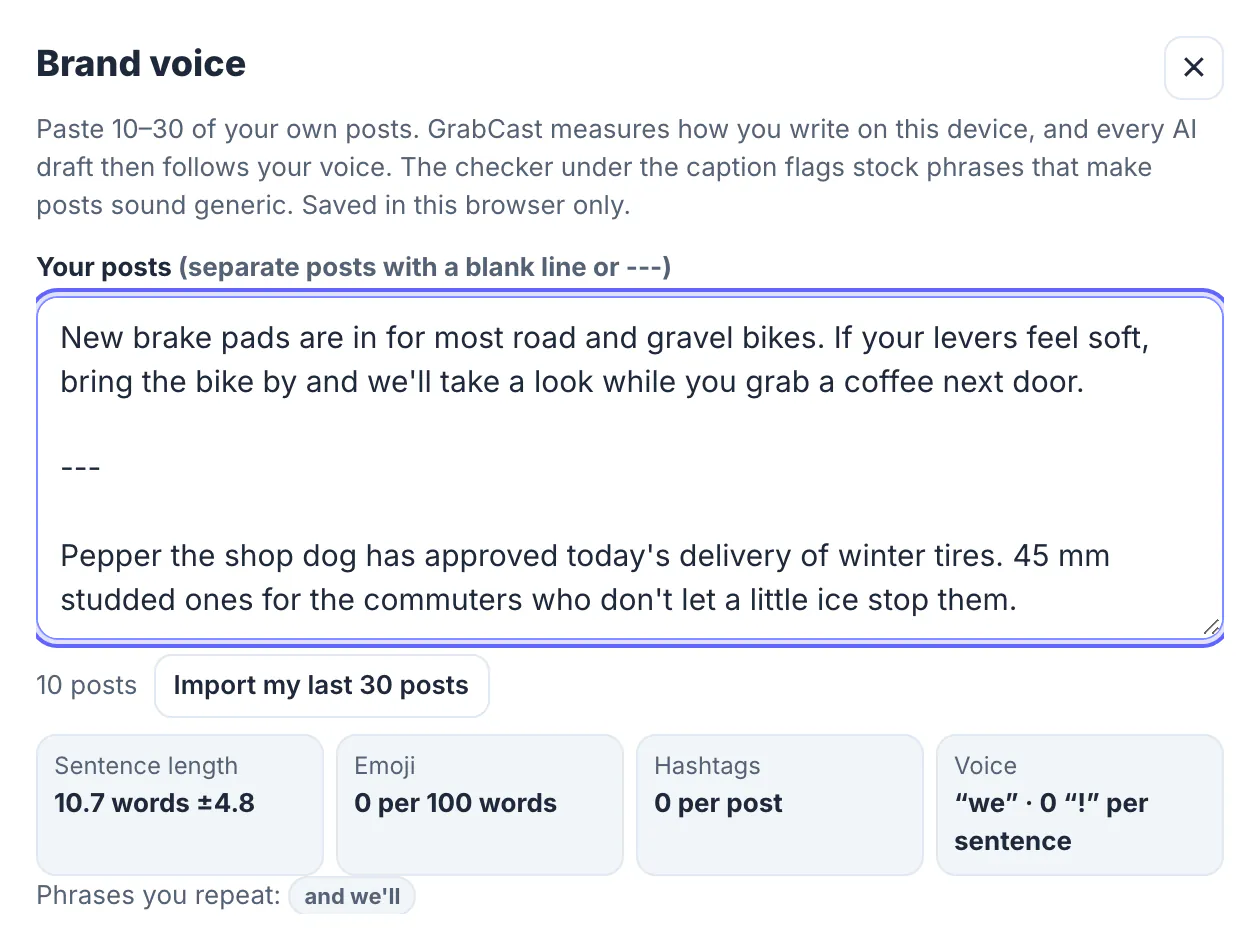
In the Scheduler's composer, open Brand voice and paste 10 to 30 of your own posts. The dialog measures how you actually write, on your device: for the bike shop's ten posts it showed 10.7 words per sentence with a spread of 4.8, no emoji, no hashtags, a we voice and no exclamation marks. That is your baseline, and it often surprises people who thought they used more emoji than they do.
- Move the four tone sliders; only sliders you move are saved, the rest mean like my posts.
- Set emoji (a few, 1 to 2), hashtags per post, hashtag style and where hashtags go.
- Fill Words we use and Words we never use.
- Write the style card, up to about 120 words, or press Write the style card from my posts for an AI draft you review before saving.
Signed in, the brand voice is saved for the whole workspace and every AI draft in it follows the card, the tone, your words and your closest sample posts. In device mode it is saved in this browser only. The AI tools that read it run on your device or with your own key first, then GrabCast's capped server AI.
Check every caption against your voice before posting
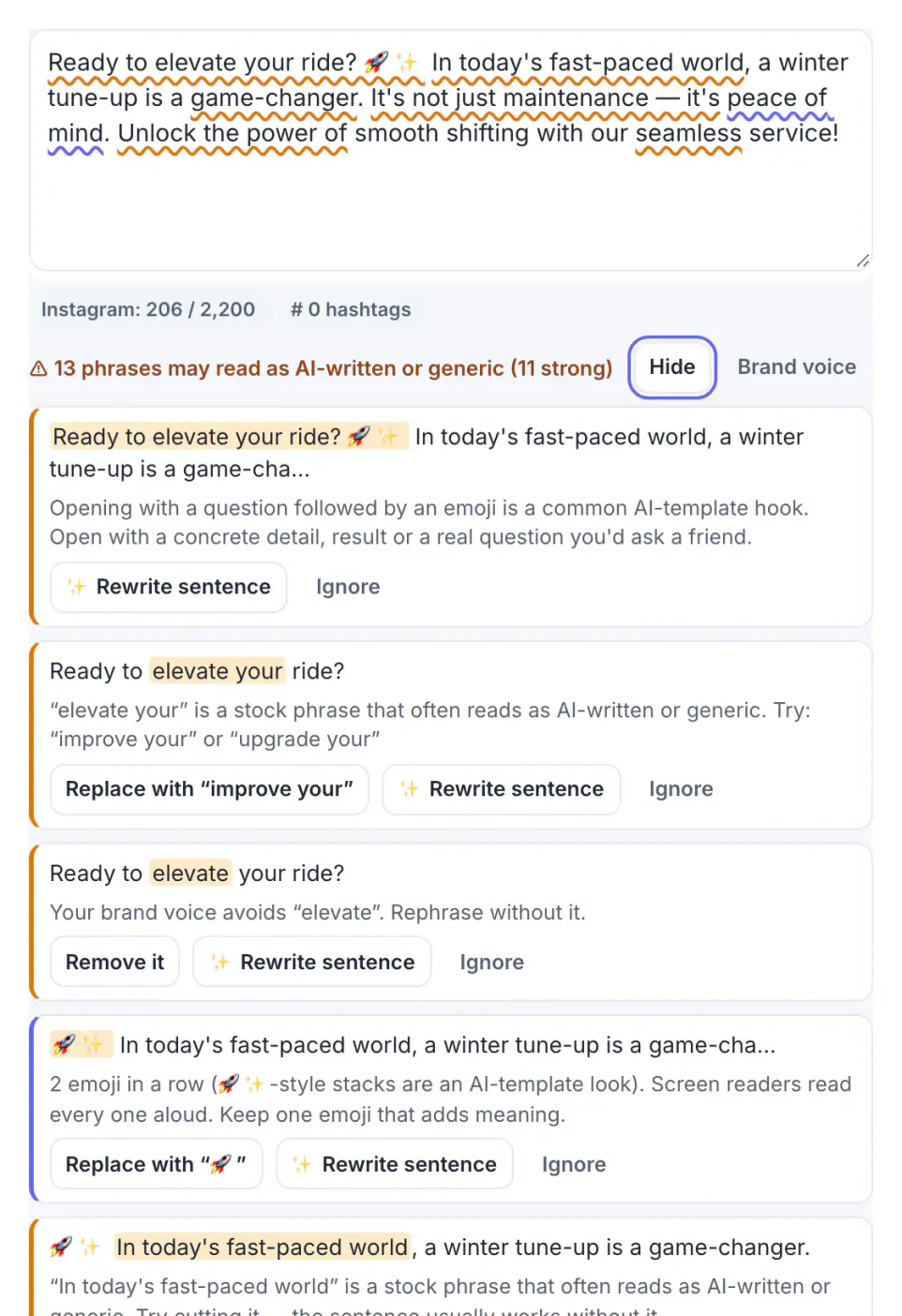
Guidelines only help if drafts are checked against them. The composer's caption check does that as you type, with no network calls: it underlines more than 170 stock phrases such as in today's fast-paced world, game-changer and unlock the power of, your own never-use words, it's not just X, it's Y constructions, stacks of hype emoji, openings like Ready to level up? 🚀, too many exclamation marks, and sentences that are all the same length.
A deliberately bad draft for the bike shop, Ready to elevate your ride? In today's fast-paced world, a winter tune-up is a game-changer…, got 13 flags, 11 of them strong. Each flag offers Replace or Remove where a plain alternative is safe, Rewrite sentence with AI in your voice, or Ignore. The rewritten caption, Our winter check is back: brakes, gears, chain, tires and lights for $45…, came back clean.
The check flags phrasing; it doesn't judge who wrote a post. For longer texts such as a newsletter or an About page, the AI Writer helps with drafts you then edit into your own voice.
When the voice is set, schedule posts with the Social Media Scheduler.
Step-by-step
Common mistakes to avoid
Pro tips
Frequently asked questions
What should brand voice guidelines include?
Who you sound like, tone on a few scales, words you use and never use, habits such as emoji and hashtags, and a few example posts that get it right.
How long should brand voice guidelines be for a small business?
One page is enough. A style card of about 120 words plus word lists and three to five example posts covers most situations.
Are my posts uploaded to build the brand voice?
The measurements are made in your browser. Signed in, the finished profile is saved for your workspace so AI drafts can follow it; in device mode it stays in this browser only.
Does the caption check detect AI-written posts?
No. It flags stock phrasing and your never-use words, whoever wrote them, so posts sound like you. It doesn't judge authorship.
Can the AI write my style card?
It can draft one from your pasted posts. The draft is labelled AI-generated and you review and edit it before saving.
Good brand voice guidelines fit on one page: who you sound like, tone, words to use and avoid, habits and a few real examples. Measure your own posts, turn the rules into a style card, and check every caption against it before it goes out. Your followers will notice the consistency long before they notice the rules.
Related guides
Browse more: all business guides · the Social Media Scheduler